How SaaS Companies Build Entire Product Teams With Remote Developers
Learn how SaaS companies build full remote product teams, from core roles and team structure by stage to NDA protection and onboarding. A complete guide for founders scaling development without a local office.

“Meet Nada Imran, a content strategist at InvoZone specializing in software development, AI...” See more
Don’t Have Time To Read Now? Download It For Later.
Table of Contents
- Why SaaS Companies Are Building Product Teams Remotely
- The Core Roles Every Remote SaaS Product Team Needs
- Team Structure by Company Stage
- Build In-House vs Staff Augmentation vs Full Dedicated Team
- Contractor vs Employer of Record: Structuring Remote Hires Compliantly
- The Tool Stack Remote Product Teams Actually Need
- How To Onboard a Remote Product Team Without Losing Weeks
- Common Mistakes SaaS Companies Make When Building Remote Teams
- How InvoZone Helps SaaS Companies Build Full Product Teams
- Conclusion
A B2B SaaS founder was 30 days away from closing a $120,000 deal. The client was ready to sign, but they had one big requirement: a built-in automated reporting dashboard.
The founder asked his lead developer, "Can we pull this off if we hire one more engineer?"
The developer shook his head. One person couldn't handle database design, UI work, frontend code, and load testing all at once. And finding four local engineers? That would take months.
Instead of losing the deal, the founder stopped looking locally and hired a dedicated remote team.
The results were immediate. The team was shipping code in under 10 days, delivered the feature 5 days ahead of schedule, closed the $120k deal, and cut pull request review times from 48 hours down to 6 hours using time-zone overlap
Why SaaS Companies Are Building Product Teams Remotely
SaaS product development runs on continuous releases, which means the team behind it needs to scale up and down without the six-month hiring cycle a local office demands.
A typical early-stage SaaS company needs the right five or six people and in the right roles, working in close enough time zones to ship fast. Remote hiring solves this because the talent pool isn't limited to one city.
The shift also isn't just about cost, though evaluating the full breakdown of remote software developer costs helps founders plan their runway far more accurately. Series A SaaS teams today run leaner than a few years ago, typically 12 to 25 engineers organized into small cross-functional squads rather than large siloed departments. That structure only works if hiring can flex with the roadmap, which is exactly what remote hiring makes possible.
For SaaS founders specifically, remote product team building solves three problems local hiring can't:
- Speed to first hire
- Access to specialized roles (like DevOps or data engineering that are hard to find locally)
- Elastic scaling (the ability to scale a team up for a launch push and back down after)

The Core Roles Every Remote SaaS Product Team Needs
A SaaS product team is a mix of people who own the product decision, the engineering execution, and the quality bar. They are working as one unit instead of separate departments handing work off to each other.
Core Team Roles and When to Hire Them
|
Role |
What They Own |
When You Need Them |
|
Product Manager |
Roadmap, feature prioritization, customer feedback loop |
From day one, even if it's a founder wearing the hat |
|
Tech Lead / Senior Engineer |
Architecture decisions, code quality, technical direction |
As soon as you have more than 2 developers |
|
Full-Stack or Backend Developers |
Core product build, APIs, business logic |
From MVP stage onward |
|
Frontend Developer |
User-facing interface and experience |
Once the product has real user-facing complexity |
|
UI/UX Designer |
User flows, interface design, usability |
Before major feature builds, not after |
|
QA Engineer |
Testing, bug tracking, release quality |
Once you're shipping weekly, not just at launch |
|
DevOps Engineer |
CI/CD pipelines, cloud infrastructure, uptime |
When manual deployments start slowing releases |
|
Data Engineer |
Analytics infrastructure, reporting pipelines |
Once product decisions depend on usage data |
Most SaaS companies evolve their hiring model as they scale. Early on, utilizing staff augmentation allows founders to plug immediate skill gaps without adding management overhead. As product roadmaps expand, many transition to a dedicated development team, where full cross-functional units take independent ownership of entire feature sets.
Team Structure by Company Stage
The right team size and structure changes as the product matures. Building a 15-person team before you have product-market fit wastes money. Staying at 3 people past $2M ARR slows you down.
SaaS Team Structure by Growth Stage
|
Stage |
Team Size |
Structure |
What Breaks If You Skip It |
|
Pre-Seed / MVP |
2–5 |
One product owner, 2–4 generalist engineers, informal process |
No clear technical ownership; every decision routes through one person |
|
Seed / Early Traction |
5–10 |
Add a design and QA function, start documenting decisions |
Bugs reach production, features ship inconsistent with the product vision |
|
Series A |
12–25 |
Cross-functional squads, each owning a product area or user journey |
Engineers step on each other's work, releases slow down |
|
Growth Stage |
25–50 |
Dedicated platform, DevOps, and data functions separate from feature squads |
Infrastructure debt piles up because no one owns it full time |
|
Scale Stage |
50+ |
Multiple product lines, each with its own PM, tech lead, and squad |
Product strategy fragments without clear ownership boundaries |
The team model, where a small cross-functional group owns a specific product area end to end, is the structure most SaaS companies converge on by Series A. It works well with remote teams specifically because each squad can operate with its own rhythm and time zone overlap, instead of forcing the whole company onto one meeting schedule.
Build In-House vs Staff Augmentation vs Full Dedicated Team
SaaS founders usually choose between three ways to build out a remote team, and each comes with a different tradeoff between control, speed, and cost. Before comparing engagement models, it's worth settling the more basic question first: the breakdown of whether to hire in house or remote developers.
Hiring Model Comparison
|
Factor |
In-House Remote Hiring |
Staff Augmentation |
Full Dedicated Team |
|
Speed to First Hire |
Slow, weeks to months per role |
Fast, days to a couple weeks |
Fast, often within days |
|
Management Overhead |
High, you own recruiting and HR |
Medium, you manage day-to-day work |
Low, the provider manages delivery |
|
Best For |
Long-term core team, IP-critical roles |
Filling specific skill gaps quickly |
Building a full team fast without local hiring infrastructure |
|
Control Over Process |
Full control |
High control, shared oversight |
Shared, defined by engagement terms |
|
Scaling Speed |
Slow, tied to your hiring pipeline |
Fast |
Fastest, provider already has vetted talent ready |
Most SaaS companies don't pick one model and stick with it forever. Early on, staff augmentation is common, adding one or two developers to an existing core team to move faster. As the roadmap grows, many shift to a dedicated development team model, where an entire cross-functional squad, product manager included, works exclusively on the product.
The right choice depends on how much internal technical leadership already exists. If there's no one in-house who can direct engineering decisions, a dedicated team with its own tech lead solves that gap. If there's already a strong internal lead, staff augmentation fills the execution gap without adding management overhead.
There's also a fourth option some SaaS companies weigh: full project outsourcing, where a vendor owns delivery end to end. This works differently from embedding remote developers into your own product team, and our remote developers vs outsourcing guide breaks down when each model actually makes sense.
Contractor vs Employer of Record: Structuring Remote Hires Compliantly
Choosing a hiring model isn't the only structural decision. SaaS companies also have to decide how a remote developer is legally engaged, and this is where a lot of founders get caught off guard later.
Independent Contractor. The simplest and fastest way to bring someone on. No local entity required, minimal paperwork upfront. The risk is misclassification. Many countries still apply payroll and tax obligations to contractor relationships that function like full employment, and treating a full-time, long-term contractor as a casual freelancer can create real financial exposure down the line.
Employer of Record (EOR). A third-party company legally employs the developer on your behalf in their country, handling payroll, benefits, and local compliance, while the developer works exclusively on your product day to day. This is generally the safer route for long-term, full-time remote hires, though it adds a monthly per-developer cost on top of salary.
Own Legal Entity. Setting up a local subsidiary or branch office gives full control over payroll, equity, and employment terms. This only makes sense once a company plans to hire a meaningful number of people in one country, since the setup and ongoing compliance costs are steep for just one or two hires.
Choosing the Right Structure
|
Situation |
Best Fit |
Why |
|
Short-term or project-based work |
Contractor |
Fastest to set up, no long-term commitment |
|
Long-term, full-time remote hire |
EOR |
Compliant, lower risk, no need to open a local entity |
|
Hiring many people in one country |
Own legal entity |
Cost-effective at volume, full control over terms |
Most SaaS founders skip this decision entirely and default to contractor agreements for everyone, which works fine short term but becomes a liability the moment a "contractor" is functionally a full-time team member for a year or more. Building this into the hiring plan early avoids a compliance cleanup later.
The Tool Stack Remote Product Teams Actually Need
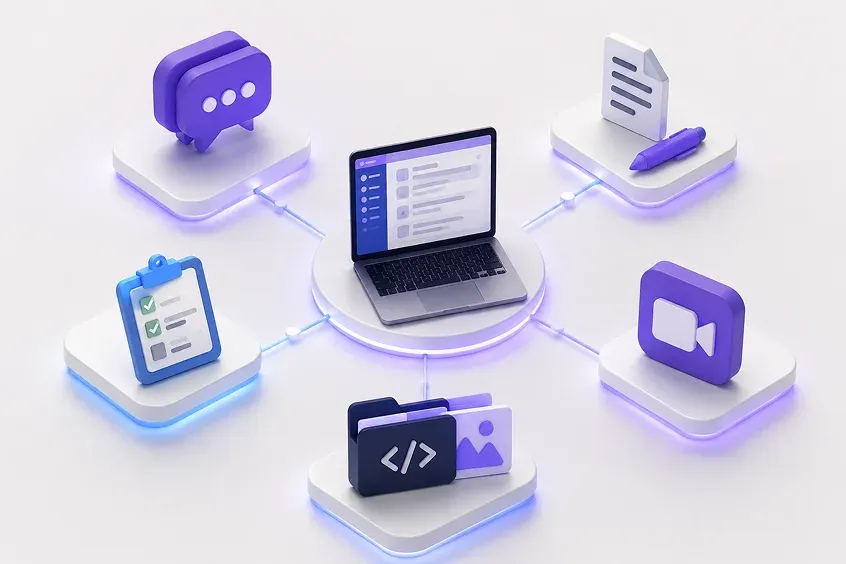
A distributed SaaS team doesn't need a dozen tools. It needs one tool per core function, chosen deliberately instead of accumulated over time.
- Communication: Slack or Microsoft Teams for day-to-day async coordination, with video kept optional for anything that doesn't need screen sharing or real-time discussion.
- Documentation: Notion or Confluence as the single source of truth for product decisions, architecture notes, and onboarding material. If a decision isn't written down here, it effectively didn't happen for anyone outside the conversation.
- Project Tracking: Linear, Jira, or ClickUp to keep sprint work, bugs, and feature requests visible across time zones without a status meeting.
- Async Video: Loom for walkthroughs, demos, and updates that don't need a live meeting slot, especially useful across large time zone gaps.
- Code and Design: GitHub for version control and code review, Figma for design collaboration between product, design, and engineering.
The mistake most SaaS teams make is picking too many tools. A well-defined stack of five tools that everyone actually uses beats ten tools where decisions get lost between them.
How To Onboard a Remote Product Team Without Losing Weeks
A slow onboarding process is where most remote SaaS teams lose their first month of productivity. Getting a developer's laptop set up isn't the bottleneck, understanding the product is.
Document before you hire
Have a written product overview, architecture summary, and coding standards ready before day one. If this only exists in your head, every new hire becomes a series of Slack questions instead of independent work.
Prioritize time zone alignment
Ensure your core team has at least 3 to 4 hours of overlapping working hours each day. Managing async friction is critical. Understanding the importance of time zone alignment for remote developers helps prevent PR bottlenecks and async lag before they drag down sprint velocity.
Assign a buddy, not just a manager
New remote hires need someone to ask small questions without feeling like they're interrupting a manager's day. This single step cuts ramp-up time significantly on distributed teams.
Set a 30-60-90 day plan
By day 30, a new engineer should understand the codebase. By day 60, they should be shipping independently. By day 90, they should be trusted with architecture-level decisions in their area. Without these markers, it's hard to tell if onboarding is actually working.
Give context, not just tickets
A developer who understands why a feature matters to the product ships better code than one who's just closing tickets. This matters more on remote teams, where there's no hallway conversation to fill in the "why."
Common Mistakes SaaS Companies Make When Building Remote Teams
- Hiring engineers before a product manager. Without someone owning the roadmap, engineers build in different directions and rework becomes constant.
- Skipping the tech lead role too long. Founders often try to be the technical decision-maker themselves past the point where it's sustainable, which slows every architecture decision down.
- Using one NDA template for every relationship. A unilateral NDA meant for a single contractor doesn't protect a multi-party integration project.
- Copying an office team structure onto a remote team. Remote squads need async-first documentation and clear ownership boundaries that in-office teams can get away with skipping.
- Scaling headcount before validating the product. A 15-person team built before product-market fit usually means expensive rework once the roadmap actually gets clear.
How InvoZone Helps SaaS Companies Build Full Product Teams
Building a remote SaaS product team from scratch means solving hiring, time zone alignment, NDA structuring, and onboarding all before a single feature ships. InvoZone removes most of that overhead for SaaS founders who need to move fast, connecting you directly with pre-vetted remote developers matched to your product's tech stack.
- 1,000+ pre-vetted developers across product, engineering, design, and QA roles, so you're not building a hiring pipeline from zero
- 24-hour matching, meaning a gap in your product team doesn't have to slow the roadmap down for weeks
- Time zone-aligned teams, built around your working hours so daily standups and code reviews actually happen in real time
- 5 global resource centers with 12+ years of experience building full product teams for SaaS companies at every stage, from MVP to scale
Whether the need is one senior engineer to fill a gap or a complete dedicated team with its own product manager and tech lead, InvoZone structures the engagement and onboarding around how your product actually works. If you're still weighing how to hire, do follow a complete guide to hiring remote developers which covers vetting, timelines, and what to check before signing anyone on.
Conclusion
Building a full SaaS product team with remote developers isn't about hiring fast and hoping the structure figures itself out. It's about knowing which roles to hire first, matching team size to company stage, and choosing the right hiring model for how much internal leadership already exists. Get those decisions right early, and scaling the team later becomes a lot less painful than fixing a structure that was never built to grow.
early, and scaling the team later becomes a lot less painful than fixing a structure that was never built to grow.
Share to:
Frequently Asked Questions
Find answers to common questions about our services
1.What's the first role a SaaS company should hire remotely?
A product manager or a strong technical lead, even before additional engineers. Without someone owning the roadmap or the architecture, a growing team builds in inconsistent directions and rework becomes constant.
2.How many remote developers does a SaaS company need at the MVP stage?
Most MVP-stage SaaS products move fastest with 2 to 4 generalist engineers plus a product owner, rather than a large specialized team. Specialized roles like DevOps and data engineering usually come later as complexity increases.
3.Should a SaaS startup use staff augmentation or a full dedicated team?
It depends on internal leadership. If there's already a strong technical lead in-house, staff augmentation fills execution gaps efficiently. If there's no internal technical direction yet, a dedicated team with its own tech lead solves that gap directly.
4.What NDA should I use when hiring a single remote developer?
A unilateral NDA is standard here, since the SaaS company is sharing confidential product information and the developer is the only party bound to protect it.
5.How long does it take to build a full remote product team?
With a pre-vetted talent pipeline, a core team of a product manager, tech lead, and two to three engineers can often be assembled within a few weeks. Building out design, QA, and DevOps roles typically happens over the following months as the product's needs grow.
6.Can InvoZone help structure the NDA for a multi-vendor SaaS project?
Yes. InvoZone works with SaaS companies to match the confidentiality agreement to the actual relationship, whether that's a single developer, an agency partnership, or a multi-party integration project.
Table of Contents
- Why SaaS Companies Are Building Product Teams Remotely
- The Core Roles Every Remote SaaS Product Team Needs
- Team Structure by Company Stage
- Build In-House vs Staff Augmentation vs Full Dedicated Team
- Contractor vs Employer of Record: Structuring Remote Hires Compliantly
- The Tool Stack Remote Product Teams Actually Need
- How To Onboard a Remote Product Team Without Losing Weeks
- Common Mistakes SaaS Companies Make When Building Remote Teams
- How InvoZone Helps SaaS Companies Build Full Product Teams
- Conclusion
A B2B SaaS founder was 30 days away from closing a $120,000 deal. The client was ready to sign, but they had one big requirement: a built-in automated reporting dashboard.
The founder asked his lead developer, "Can we pull this off if we hire one more engineer?"
The developer shook his head. One person couldn't handle database design, UI work, frontend code, and load testing all at once. And finding four local engineers? That would take months.
Instead of losing the deal, the founder stopped looking locally and hired a dedicated remote team.
The results were immediate. The team was shipping code in under 10 days, delivered the feature 5 days ahead of schedule, closed the $120k deal, and cut pull request review times from 48 hours down to 6 hours using time-zone overlap
Why SaaS Companies Are Building Product Teams Remotely
SaaS product development runs on continuous releases, which means the team behind it needs to scale up and down without the six-month hiring cycle a local office demands.
A typical early-stage SaaS company needs the right five or six people and in the right roles, working in close enough time zones to ship fast. Remote hiring solves this because the talent pool isn't limited to one city.
The shift also isn't just about cost, though evaluating the full breakdown of remote software developer costs helps founders plan their runway far more accurately. Series A SaaS teams today run leaner than a few years ago, typically 12 to 25 engineers organized into small cross-functional squads rather than large siloed departments. That structure only works if hiring can flex with the roadmap, which is exactly what remote hiring makes possible.
For SaaS founders specifically, remote product team building solves three problems local hiring can't:
- Speed to first hire
- Access to specialized roles (like DevOps or data engineering that are hard to find locally)
- Elastic scaling (the ability to scale a team up for a launch push and back down after)

The Core Roles Every Remote SaaS Product Team Needs
A SaaS product team is a mix of people who own the product decision, the engineering execution, and the quality bar. They are working as one unit instead of separate departments handing work off to each other.
Core Team Roles and When to Hire Them
|
Role |
What They Own |
When You Need Them |
|
Product Manager |
Roadmap, feature prioritization, customer feedback loop |
From day one, even if it's a founder wearing the hat |
|
Tech Lead / Senior Engineer |
Architecture decisions, code quality, technical direction |
As soon as you have more than 2 developers |
|
Full-Stack or Backend Developers |
Core product build, APIs, business logic |
From MVP stage onward |
|
Frontend Developer |
User-facing interface and experience |
Once the product has real user-facing complexity |
|
UI/UX Designer |
User flows, interface design, usability |
Before major feature builds, not after |
|
QA Engineer |
Testing, bug tracking, release quality |
Once you're shipping weekly, not just at launch |
|
DevOps Engineer |
CI/CD pipelines, cloud infrastructure, uptime |
When manual deployments start slowing releases |
|
Data Engineer |
Analytics infrastructure, reporting pipelines |
Once product decisions depend on usage data |
Most SaaS companies evolve their hiring model as they scale. Early on, utilizing staff augmentation allows founders to plug immediate skill gaps without adding management overhead. As product roadmaps expand, many transition to a dedicated development team, where full cross-functional units take independent ownership of entire feature sets.
Team Structure by Company Stage
The right team size and structure changes as the product matures. Building a 15-person team before you have product-market fit wastes money. Staying at 3 people past $2M ARR slows you down.
SaaS Team Structure by Growth Stage
|
Stage |
Team Size |
Structure |
What Breaks If You Skip It |
|
Pre-Seed / MVP |
2–5 |
One product owner, 2–4 generalist engineers, informal process |
No clear technical ownership; every decision routes through one person |
|
Seed / Early Traction |
5–10 |
Add a design and QA function, start documenting decisions |
Bugs reach production, features ship inconsistent with the product vision |
|
Series A |
12–25 |
Cross-functional squads, each owning a product area or user journey |
Engineers step on each other's work, releases slow down |
|
Growth Stage |
25–50 |
Dedicated platform, DevOps, and data functions separate from feature squads |
Infrastructure debt piles up because no one owns it full time |
|
Scale Stage |
50+ |
Multiple product lines, each with its own PM, tech lead, and squad |
Product strategy fragments without clear ownership boundaries |
The team model, where a small cross-functional group owns a specific product area end to end, is the structure most SaaS companies converge on by Series A. It works well with remote teams specifically because each squad can operate with its own rhythm and time zone overlap, instead of forcing the whole company onto one meeting schedule.
Build In-House vs Staff Augmentation vs Full Dedicated Team
SaaS founders usually choose between three ways to build out a remote team, and each comes with a different tradeoff between control, speed, and cost. Before comparing engagement models, it's worth settling the more basic question first: the breakdown of whether to hire in house or remote developers.
Hiring Model Comparison
|
Factor |
In-House Remote Hiring |
Staff Augmentation |
Full Dedicated Team |
|
Speed to First Hire |
Slow, weeks to months per role |
Fast, days to a couple weeks |
Fast, often within days |
|
Management Overhead |
High, you own recruiting and HR |
Medium, you manage day-to-day work |
Low, the provider manages delivery |
|
Best For |
Long-term core team, IP-critical roles |
Filling specific skill gaps quickly |
Building a full team fast without local hiring infrastructure |
|
Control Over Process |
Full control |
High control, shared oversight |
Shared, defined by engagement terms |
|
Scaling Speed |
Slow, tied to your hiring pipeline |
Fast |
Fastest, provider already has vetted talent ready |
Most SaaS companies don't pick one model and stick with it forever. Early on, staff augmentation is common, adding one or two developers to an existing core team to move faster. As the roadmap grows, many shift to a dedicated development team model, where an entire cross-functional squad, product manager included, works exclusively on the product.
The right choice depends on how much internal technical leadership already exists. If there's no one in-house who can direct engineering decisions, a dedicated team with its own tech lead solves that gap. If there's already a strong internal lead, staff augmentation fills the execution gap without adding management overhead.
There's also a fourth option some SaaS companies weigh: full project outsourcing, where a vendor owns delivery end to end. This works differently from embedding remote developers into your own product team, and our remote developers vs outsourcing guide breaks down when each model actually makes sense.
Contractor vs Employer of Record: Structuring Remote Hires Compliantly
Choosing a hiring model isn't the only structural decision. SaaS companies also have to decide how a remote developer is legally engaged, and this is where a lot of founders get caught off guard later.
Independent Contractor. The simplest and fastest way to bring someone on. No local entity required, minimal paperwork upfront. The risk is misclassification. Many countries still apply payroll and tax obligations to contractor relationships that function like full employment, and treating a full-time, long-term contractor as a casual freelancer can create real financial exposure down the line.
Employer of Record (EOR). A third-party company legally employs the developer on your behalf in their country, handling payroll, benefits, and local compliance, while the developer works exclusively on your product day to day. This is generally the safer route for long-term, full-time remote hires, though it adds a monthly per-developer cost on top of salary.
Own Legal Entity. Setting up a local subsidiary or branch office gives full control over payroll, equity, and employment terms. This only makes sense once a company plans to hire a meaningful number of people in one country, since the setup and ongoing compliance costs are steep for just one or two hires.
Choosing the Right Structure
|
Situation |
Best Fit |
Why |
|
Short-term or project-based work |
Contractor |
Fastest to set up, no long-term commitment |
|
Long-term, full-time remote hire |
EOR |
Compliant, lower risk, no need to open a local entity |
|
Hiring many people in one country |
Own legal entity |
Cost-effective at volume, full control over terms |
Most SaaS founders skip this decision entirely and default to contractor agreements for everyone, which works fine short term but becomes a liability the moment a "contractor" is functionally a full-time team member for a year or more. Building this into the hiring plan early avoids a compliance cleanup later.
The Tool Stack Remote Product Teams Actually Need
A distributed SaaS team doesn't need a dozen tools. It needs one tool per core function, chosen deliberately instead of accumulated over time.
- Communication: Slack or Microsoft Teams for day-to-day async coordination, with video kept optional for anything that doesn't need screen sharing or real-time discussion.
- Documentation: Notion or Confluence as the single source of truth for product decisions, architecture notes, and onboarding material. If a decision isn't written down here, it effectively didn't happen for anyone outside the conversation.
- Project Tracking: Linear, Jira, or ClickUp to keep sprint work, bugs, and feature requests visible across time zones without a status meeting.
- Async Video: Loom for walkthroughs, demos, and updates that don't need a live meeting slot, especially useful across large time zone gaps.
- Code and Design: GitHub for version control and code review, Figma for design collaboration between product, design, and engineering.
The mistake most SaaS teams make is picking too many tools. A well-defined stack of five tools that everyone actually uses beats ten tools where decisions get lost between them.

How To Onboard a Remote Product Team Without Losing Weeks
A slow onboarding process is where most remote SaaS teams lose their first month of productivity. Getting a developer's laptop set up isn't the bottleneck, understanding the product is.
Document before you hire
Have a written product overview, architecture summary, and coding standards ready before day one. If this only exists in your head, every new hire becomes a series of Slack questions instead of independent work.
Prioritize time zone alignment
Ensure your core team has at least 3 to 4 hours of overlapping working hours each day. Managing async friction is critical. Understanding the importance of time zone alignment for remote developers helps prevent PR bottlenecks and async lag before they drag down sprint velocity.
Assign a buddy, not just a manager
New remote hires need someone to ask small questions without feeling like they're interrupting a manager's day. This single step cuts ramp-up time significantly on distributed teams.
Set a 30-60-90 day plan
By day 30, a new engineer should understand the codebase. By day 60, they should be shipping independently. By day 90, they should be trusted with architecture-level decisions in their area. Without these markers, it's hard to tell if onboarding is actually working.
Give context, not just tickets
A developer who understands why a feature matters to the product ships better code than one who's just closing tickets. This matters more on remote teams, where there's no hallway conversation to fill in the "why."
Common Mistakes SaaS Companies Make When Building Remote Teams
- Hiring engineers before a product manager. Without someone owning the roadmap, engineers build in different directions and rework becomes constant.
- Skipping the tech lead role too long. Founders often try to be the technical decision-maker themselves past the point where it's sustainable, which slows every architecture decision down.
- Using one NDA template for every relationship. A unilateral NDA meant for a single contractor doesn't protect a multi-party integration project.
- Copying an office team structure onto a remote team. Remote squads need async-first documentation and clear ownership boundaries that in-office teams can get away with skipping.
- Scaling headcount before validating the product. A 15-person team built before product-market fit usually means expensive rework once the roadmap actually gets clear.
How InvoZone Helps SaaS Companies Build Full Product Teams
Building a remote SaaS product team from scratch means solving hiring, time zone alignment, NDA structuring, and onboarding all before a single feature ships. InvoZone removes most of that overhead for SaaS founders who need to move fast, connecting you directly with pre-vetted remote developers matched to your product's tech stack.
- 1,000+ pre-vetted developers across product, engineering, design, and QA roles, so you're not building a hiring pipeline from zero
- 24-hour matching, meaning a gap in your product team doesn't have to slow the roadmap down for weeks
- Time zone-aligned teams, built around your working hours so daily standups and code reviews actually happen in real time
- 5 global resource centers with 12+ years of experience building full product teams for SaaS companies at every stage, from MVP to scale
Whether the need is one senior engineer to fill a gap or a complete dedicated team with its own product manager and tech lead, InvoZone structures the engagement and onboarding around how your product actually works. If you're still weighing how to hire, do follow a complete guide to hiring remote developers which covers vetting, timelines, and what to check before signing anyone on.
Conclusion
Building a full SaaS product team with remote developers isn't about hiring fast and hoping the structure figures itself out. It's about knowing which roles to hire first, matching team size to company stage, and choosing the right hiring model for how much internal leadership already exists. Get those decisions right early, and scaling the team later becomes a lot less painful than fixing a structure that was never built to grow.
early, and scaling the team later becomes a lot less painful than fixing a structure that was never built to grow.
Share to:
Related Articles
Let’s Discuss Your Needs
Tell us about your project. we'll take it from there
