Trusted By 2000+ Clients

How Much Does It Cost to Hire a Remote Software Developer?

Learn how much it costs to hire a remote software developer in 2026. This guide breaks down developer rates by role, experience level, technology stack, country, and hiring model so you can plan your budget with more clarity. Discover what hidden costs to watch for and how to reduce hiring costs without choosing the cheapest option blindly.

Furqan Aziz
Furqan AzizCEO & Founder
Updated:02 July, 2026
Published:29 June, 2026

Furqan Aziz is CEO & Founder of InvoZone. He is a tech enthusiast by heart with 10+ years ... See more

Don’t Have Time To Read Now? Download It For Later.

There is no single “average” cost to hire a remote software developer. 

Hiring a remote software developer in 2026 can cost anywhere from $30/hour to $200+/hour.

So, what actually drives the cost of hiring a remote developer? This guide breaks down the main pricing factors, from developer type and tech stack to location, experience level, and hiring model.

The 5 Main Factors That Decide Remote Developer Cost

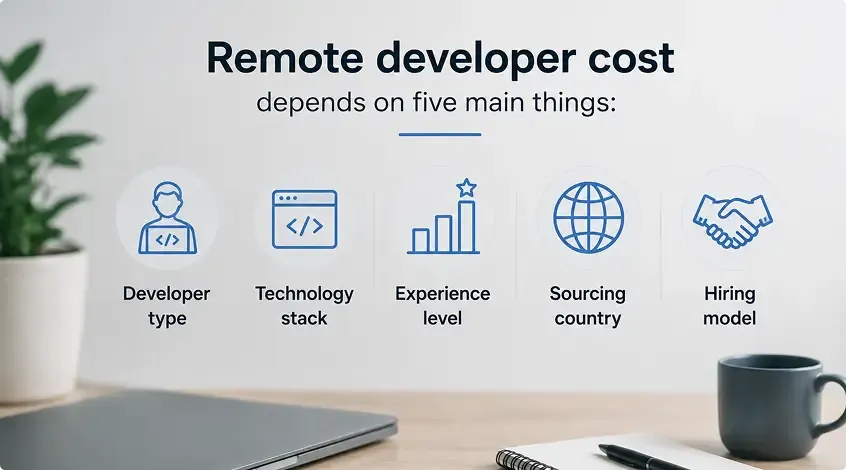
Remote developer cost depends on five main things: developer type, technology stack, experience level, sourcing country and hiring model. These factors explain why one developer may cost $15/hour while another can cost $200+/hour.

  • Developer type: Frontend, backend, mobile, DevOps, AI, and security roles have different rates.
  • Technology stack: Common stacks cost less, while AI, cloud, blockchain, and security stacks cost more.
  • Experience level: Junior developers are cheaper, while senior developers and architects cost more.
  • Sourcing country: Rates change heavily between the US, UK, Eastern Europe, Latin America, South Asia, and other regions.
  • Hiring model: Freelancers, staff augmentation, and dedicated teams all have different visible and hidden costs.
1. Cost Breakdown by Developer Role & Specialization

Each developer type has a different role, skill set, and market rate. Choosing the right type before hiring helps you avoid paying for the wrong expertise.

Depending on your product requirements, you might need a niche specialist or a cross-functional engineer. Hiring top-tier developers through software development agencies like InvoZone structure their pricing on a highly competitive $30 to $120/hour baseline. This standard rate offers a massive economic advantage, giving you access to top 3% engineering talent at a highly reasonable price point.

Cost Breakdown by Developer Role (2026 USD)

Developer Role

Hourly Rate (Global Avg)

Monthly Cost (Approx)

Best For

Frontend Developer

$30 – $110 / hr

$4,800 – $17,600

UI, web apps, SPAs

Backend Developer

$35 – $120 / hr

$5,600 – $19,200

APIs, databases, server logic

Mobile App Developer

$30 – $110 / hr

$4,800 – $17,600

iOS, Android, cross-platform apps

DevOps Engineer

$40 – $130 / hr

$6,400 – $20,800

CI/CD, cloud infra, deployments

QA Engineer

$25 – $80 / hr

$4,000 – $12,800

Testing, quality assurance

UI/UX Designer

$25 – $90 / hr

$4,000 – $14,400

User experience and interface design

Security Engineer

$40 – $150 / hr

$8,000 – $24,000

Security audits, compliance, protection

IT Support Specialist

$20 – $70 / hr

$3,200 – $11,200

Systems support, troubleshooting


2. Remote Developer Cost by Technology Stack

Talent scarcity heavily affects pricing. Standard web development stacks usually have more available developers, which keeps pricing competitive. Specialized stacks like AI infrastructure, blockchain, cloud architecture, and security command higher rates because fewer developers can handle them properly.

Cost Breakdown by Technology Stack

Primary Technology Stack

Mid-Level Rate

Senior Rate

2026 Cost Driver

AI Infrastructure & MLOps

$35–$100/hr

$100–$200+/hr

High demand for LLMs, model deployment, automation, and AI workflows

Blockchain & Web3

$30–$100/hr

$100–$180/hr

Smart contract risk, protocol complexity, and audit requirements

Cloud Infrastructure & DevOps

$30–$90/hr

$90–$170/hr

Cloud scaling, CI/CD, security, and infrastructure automation

Next.js & TypeScript

$45–$75/hr

$75–$130/hr

Popular SaaS stack with higher demand than basic JavaScript setups

Enterprise Backend Frameworks

$40–$70/hr

$70–$125/hr

Used for fintech, enterprise systems, and secure backend platforms

Mobile Native & Cross-Platform

$35–$65/hr

$65–$130/hr

iOS, Android, Flutter, and React Native app development

MERN / MEAN Stack

$30–$55/hr

$55–$100/hr

Common web app baseline with a large global talent pool

LAMP / Legacy-Adjacent Stack

$25–$45/hr

$45–$85/hr

Cost-efficient for websites, CMS, eCommerce, and business platforms


When hiring through specialized software development agencies like InvoZone, global contract rates are heavily tied to these tech choices, typically scaling across a stable $30 to $120+/hour depending on the complexity of the project. You can map out how these differences affect project planning by exploring all the technology stacks that modern agencies use to build top products.

3. Cost Breakdown By Experience Level 

Experience level is one of the most predictable pricing factors. More senior developers cost more, but they also reduce mistakes, improve architecture, and often deliver faster on complex tasks.

Junior Developers: 0–2 Years
Junior developers are the most affordable option. They work best for bug fixes, maintenance, documentation updates, simple tickets, and clearly scoped tasks. However, they need active supervision and should not be responsible for major architecture decisions.

Mid-Level Developers: 2–5 Years
Mid-level developers are usually the best value for most projects. They can handle standard features, APIs, dashboards, integrations, and product updates with less supervision. For many businesses, this is the strongest cost-to-output level.

Senior Developers: 5+ Years
Senior developers cost more, but they make better technical decisions, write cleaner code, reduce rework, and solve complex problems faster. For high-stakes products, scaling issues, AI features, fintech systems, or enterprise platforms, senior developers are usually worth the higher rate.

Tech Leads and Architects: 8+ Years
Tech leads and architects are hired when a product needs long-term technical direction. They define system architecture, review engineering decisions, guide teams, prevent technical debt, and make sure the product can scale safely.

The 2026 Shift: AI tool proficiency has fundamentally disrupted this matrix. Hiring a senior ai developer from agencies like InvoZone who actively work with tools like GitHub Copilot or Cursor delivers measurably more output per hour than one who does not. This is now a legitimate factor when evaluating whether a higher rate represents better value.

Experience Level Cost Matrix (2026 USD)

Experience Level

Experience

Hourly Rate

Monthly Cost

Best Use Case

Junior Developer

0–2 years

$20–$30/hr

$3,200–$4,400

Bug fixes, maintenance, defined tasks

Mid-Level Developer

2–5 years

$30–$80/hr

$4,800–$12,800

Core feature development

Senior Developer

5+ years

$80–$130/hr

$8,000–$20,800

Complex systems and architecture

Tech Lead / Architect

8+ years

$130–$150/hr

$20,800–$24,000

Technical leadership and system design


4. Remote Developer Costs by Sourcing Country

Geographic location remains the most significant driver of engineering rates. The table below presents exact contract rates across key global sourcing hubs for junior and senior levels, alongside full-time equivalent (FTE) monthly retainers.

Country-Wise Remote Developer Rate Matrix (2026 USD)

Sourcing Country

Junior Hourly Rate

Senior Hourly Rate

Monthly Full-Time Equivalent

United States

$30 – $80 / hr

$80 – $150+ / hr

$4,800 – $24,000+

United Kingdom

$40 – $90 / hr

$90 – $150 / hr

$6,400 – $24,000

Poland

$25 – $35 / hr

$60 – $100 / hr

$4,000 – $16,000

Ukraine

$20 – $30 / hr

$45 – $75 / hr

$3,200 – $12,000

Brazil

$20 – $30 / hr

$55 – $90 / hr

$3,200 – $14,400

India

$15 – $25 / hr

$45 – $80 / hr

$2,400 – $12,800

Pakistan

$20 – $30 / hr

$30 – $75 / hr

$3,200 – $12,000


The cheapest country is not always the best option. The right sourcing location depends on the quality of the talent pool, English communication, time zone overlap, technical specialization, and how much management support your internal team can provide.

5. Remote Developer Cost by Hiring Model

Dedicated Team
Best for long-term product development and lower management overhead. Partnering with an external vendor for a dedicated development team means you get a complete team of software developers, designers, QA engineers, and project managers working exclusively on your product while the agency handles all recruitment, HR, and infrastructure.

Staff Augmentation
Best for companies that already have internal technical leadership and need extra developers to join their team quickly. It gives more control, but your internal team must manage tasks, sprint planning, reviews, and daily direction.

Freelancer
Best for short-term fixes, one-off tasks, quick prototypes, and small isolated work. Freelancers can be cost-effective, but they carry more risk if the project requires long-term ownership, documentation, security, and continuity.

Model Comparison Matrix

Cost & Operational Component

Dedicated Team

Staff Augmentation

Freelancer

Base Rate / Cost

Medium: $35k–$85k/year equivalent

Medium to High: $40–$95/hr

Low to Medium: $25–$75/hr

Benefits & Taxes

Handled by provider

Handled by staffing agency

Usually none

Infrastructure & Tools

Usually provided by agency

Variable; you may supply tool seats

Uses own hardware/software

Hiring & Setup Fees

Low to none

Usually none

Platform fees only

Time to Onboard

1–2 weeks

3–7 days

1–3 days

Scaling Flexibility

High

Very high

Extremely high

Management Overhead

Low

Very high

High

Hidden Cost Risk

Controlled

Medium

Medium to high

How to Reduce Remote Developer Hiring Costs Without Losing Quality

Hiring a remote developer in 2026 does not have to strain your budget. The goal is not to find the cheapest developer. The goal is to lower total product cost without damaging quality.

  1. Define Clear Project Milestones Early
    Map your roadmap 3 to 6 months in advance. Prepare user stories, Figma designs, product requirements, and technical priorities before the developer starts. This prevents idle paid time.

  2. Choose the Right Region for Your Team
    For US companies, Latin America can offer strong time zone overlap. For European companies, Poland and Ukraine can provide better working-hour alignment. For cost-sensitive builds, South Asia and Southeast Asia can be strong options if vetting is handled properly.

  3. Hire AI Native Developers
    Developers who use AI tools well can move faster on boilerplate code, documentation, test generation, refactoring, and debugging. But they must still know how to review AI-generated code, test outputs, and avoid security mistakes.

  4. Commit to Longer Contracts When the Roadmap Is Clear
    If you know you need 6 to 12 months of development, a longer commitment may help you negotiate better monthly or hourly rates with a structured staff augmentation company to secure stable engineering continuity.

  5. Avoid Overhiring Senior Talent for Simple Work
    Not every task requires a senior architect. Use senior developers for architecture, scaling, security, and complex logic. Use mid-level developers for standard feature delivery and junior developers for supervised maintenance tasks.

  6. Use Paid Trial Tasks Before Long-Term Contracts
    A small paid trial helps you test communication, code quality, delivery speed, and problem-solving before making a bigger commitme

The Cost-Velocity Trap: Choosing a developer based only on the lowest hourly price usually costs more in the long run. Cheap developers often write poor code and make architectural mistakes. This creates bugs and slow development pipelines, forcing you to pay a senior team later to rewrite the application from scratch, meaning you pay twice for the same product.

Crucial Cost Checklist Before Hiring

Before hiring a remote software developer, confirm these points:

  • The project scope is clearly defined.
  • The required developer type is confirmed.
  • The tech stack is finalized.
  • The expected experience level is clear.
  • The target region or time zone is decided.
  • The hiring model is selected.
  • The budget range is approved.
  • The onboarding documents are ready.
  • The code review process is defined.
  • The communication process is clear.
  • The trial task or technical assessment is prepared.
  • IP, NDA, security, and access rules are documented.

Conclusion

Hiring a remote software developer in 2026 is not only about finding the lowest hourly rate. The final cost depends on the developer’s role, experience level, technology stack, country, hiring model, and how much support your internal team can provide. The better approach is to compare total value, not just price. A lower rate can become expensive if the developer needs constant supervision or writes poor-quality code. Before hiring, companies should define the scope clearly, choose the right model, check technical skills properly, and make sure communication, security, and onboarding are already planned. Partnering with a vetted software development agency like InvoZone provides 100% aligned time zones and 24/7 technical support where you can get access to reasonable talent within just 24 hours.

Share to:

Frequently Asked Questions

Find answers to common questions about our services

1.Which country is cheapest for hiring remote developers?

Countries like Pakistan, India, Vietnam, Nigeria, and other emerging tech hubs usually offer lower hourly rates compared to the United States, United Kingdom, and Canada. However, the cheapest option is not always the best option. Vetting quality, communication, time zone overlap, and technical fit matter just as much as price.

2.Which hiring model is most cost-effective?

Freelancers are usually most cost-effective for small tasks. Staff augmentation is better when you need developers to join your internal team. Dedicated teams are often more cost-effective for long-term product development because they reduce hiring, infrastructure, replacement, and delivery management costs.

3.Do senior developers cost more but save money long term?

Yes, in many cases. Yes. Senior developers cost more upfront, but they can save money by reducing rework, technical debt, and repeated fixes. For high-stakes products, senior talent often lowers the total cost of delivery.

4.How do AI-augmented developers impact total product cost?

AI-augmented developers can reduce time spent on repetitive tasks like boilerplate code, documentation, test generation, and debugging support. However, AI only reduces cost when the developer can properly review, test, and secure the output. Companies should not hire developers who blindly ship AI-generated code without human judgment.

5.Are there hidden infrastructure fees when hiring a dedicated team?

Usually, a dedicated team provider includes workstations, basic tools, delivery support, and local infrastructure in the monthly rate. However, your company may still pay for cloud hosting, premium software licenses, enterprise workflow tools, security tools, or internal platform access.

6.Does time zone difference increase the cost of remote development?

Not directly, but time zone overlap affects value. Hiring Nearshore developers may cost more than offshore developers because they offer real-time collaboration. Offshore developers may be cheaper, but slower feedback loops can increase project delays if communication is not managed well.

7.How do I verify a remote developer’s real skills before hiring?

Avoid relying only on resumes or portfolio claims. Use a paid trial project, live debugging task, code review exercise, or architecture discussion. This shows how the developer thinks, communicates, tests code and solves real product problems.

There is no single “average” cost to hire a remote software developer. 

Hiring a remote software developer in 2026 can cost anywhere from $30/hour to $200+/hour.

So, what actually drives the cost of hiring a remote developer? This guide breaks down the main pricing factors, from developer type and tech stack to location, experience level, and hiring model.

The 5 Main Factors That Decide Remote Developer Cost

Remote developer cost depends on five main things: developer type, technology stack, experience level, sourcing country and hiring model. These factors explain why one developer may cost $15/hour while another can cost $200+/hour.

  • Developer type: Frontend, backend, mobile, DevOps, AI, and security roles have different rates.
  • Technology stack: Common stacks cost less, while AI, cloud, blockchain, and security stacks cost more.
  • Experience level: Junior developers are cheaper, while senior developers and architects cost more.
  • Sourcing country: Rates change heavily between the US, UK, Eastern Europe, Latin America, South Asia, and other regions.
  • Hiring model: Freelancers, staff augmentation, and dedicated teams all have different visible and hidden costs.

1. Cost Breakdown by Developer Role & Specialization

Each developer type has a different role, skill set, and market rate. Choosing the right type before hiring helps you avoid paying for the wrong expertise.

Depending on your product requirements, you might need a niche specialist or a cross-functional engineer. Hiring top-tier developers through software development agencies like InvoZone structure their pricing on a highly competitive $30 to $120/hour baseline. This standard rate offers a massive economic advantage, giving you access to top 3% engineering talent at a highly reasonable price point.

Cost Breakdown by Developer Role (2026 USD)

Developer Role

Hourly Rate (Global Avg)

Monthly Cost (Approx)

Best For

Frontend Developer

$30 – $110 / hr

$4,800 – $17,600

UI, web apps, SPAs

Backend Developer

$35 – $120 / hr

$5,600 – $19,200

APIs, databases, server logic

Mobile App Developer

$30 – $110 / hr

$4,800 – $17,600

iOS, Android, cross-platform apps

DevOps Engineer

$40 – $130 / hr

$6,400 – $20,800

CI/CD, cloud infra, deployments

QA Engineer

$25 – $80 / hr

$4,000 – $12,800

Testing, quality assurance

UI/UX Designer

$25 – $90 / hr

$4,000 – $14,400

User experience and interface design

Security Engineer

$40 – $150 / hr

$8,000 – $24,000

Security audits, compliance, protection

IT Support Specialist

$20 – $70 / hr

$3,200 – $11,200

Systems support, troubleshooting


2. Remote Developer Cost by Technology Stack

Talent scarcity heavily affects pricing. Standard web development stacks usually have more available developers, which keeps pricing competitive. Specialized stacks like AI infrastructure, blockchain, cloud architecture, and security command higher rates because fewer developers can handle them properly.

Cost Breakdown by Technology Stack

Primary Technology Stack

Mid-Level Rate

Senior Rate

2026 Cost Driver

AI Infrastructure & MLOps

$35–$100/hr

$100–$200+/hr

High demand for LLMs, model deployment, automation, and AI workflows

Blockchain & Web3

$30–$100/hr

$100–$180/hr

Smart contract risk, protocol complexity, and audit requirements

Cloud Infrastructure & DevOps

$30–$90/hr

$90–$170/hr

Cloud scaling, CI/CD, security, and infrastructure automation

Next.js & TypeScript

$45–$75/hr

$75–$130/hr

Popular SaaS stack with higher demand than basic JavaScript setups

Enterprise Backend Frameworks

$40–$70/hr

$70–$125/hr

Used for fintech, enterprise systems, and secure backend platforms

Mobile Native & Cross-Platform

$35–$65/hr

$65–$130/hr

iOS, Android, Flutter, and React Native app development

MERN / MEAN Stack

$30–$55/hr

$55–$100/hr

Common web app baseline with a large global talent pool

LAMP / Legacy-Adjacent Stack

$25–$45/hr

$45–$85/hr

Cost-efficient for websites, CMS, eCommerce, and business platforms


When hiring through specialized software development agencies like InvoZone, global contract rates are heavily tied to these tech choices, typically scaling across a stable $30 to $120+/hour depending on the complexity of the project. You can map out how these differences affect project planning by exploring all the technology stacks that modern agencies use to build top products.

3. Cost Breakdown By Experience Level 

Experience level is one of the most predictable pricing factors. More senior developers cost more, but they also reduce mistakes, improve architecture, and often deliver faster on complex tasks.

Junior Developers: 0–2 Years
Junior developers are the most affordable option. They work best for bug fixes, maintenance, documentation updates, simple tickets, and clearly scoped tasks. However, they need active supervision and should not be responsible for major architecture decisions.

Mid-Level Developers: 2–5 Years
Mid-level developers are usually the best value for most projects. They can handle standard features, APIs, dashboards, integrations, and product updates with less supervision. For many businesses, this is the strongest cost-to-output level.

Senior Developers: 5+ Years
Senior developers cost more, but they make better technical decisions, write cleaner code, reduce rework, and solve complex problems faster. For high-stakes products, scaling issues, AI features, fintech systems, or enterprise platforms, senior developers are usually worth the higher rate.

Tech Leads and Architects: 8+ Years
Tech leads and architects are hired when a product needs long-term technical direction. They define system architecture, review engineering decisions, guide teams, prevent technical debt, and make sure the product can scale safely.

The 2026 Shift: AI tool proficiency has fundamentally disrupted this matrix. Hiring a senior ai developer from agencies like InvoZone who actively work with tools like GitHub Copilot or Cursor delivers measurably more output per hour than one who does not. This is now a legitimate factor when evaluating whether a higher rate represents better value.

Experience Level Cost Matrix (2026 USD)

Experience Level

Experience

Hourly Rate

Monthly Cost

Best Use Case

Junior Developer

0–2 years

$20–$30/hr

$3,200–$4,400

Bug fixes, maintenance, defined tasks

Mid-Level Developer

2–5 years

$30–$80/hr

$4,800–$12,800

Core feature development

Senior Developer

5+ years

$80–$130/hr

$8,000–$20,800

Complex systems and architecture

Tech Lead / Architect

8+ years

$130–$150/hr

$20,800–$24,000

Technical leadership and system design


4. Remote Developer Costs by Sourcing Country

Geographic location remains the most significant driver of engineering rates. The table below presents exact contract rates across key global sourcing hubs for junior and senior levels, alongside full-time equivalent (FTE) monthly retainers.

Country-Wise Remote Developer Rate Matrix (2026 USD)

Sourcing Country

Junior Hourly Rate

Senior Hourly Rate

Monthly Full-Time Equivalent

United States

$30 – $80 / hr

$80 – $150+ / hr

$4,800 – $24,000+

United Kingdom

$40 – $90 / hr

$90 – $150 / hr

$6,400 – $24,000

Poland

$25 – $35 / hr

$60 – $100 / hr

$4,000 – $16,000

Ukraine

$20 – $30 / hr

$45 – $75 / hr

$3,200 – $12,000

Brazil

$20 – $30 / hr

$55 – $90 / hr

$3,200 – $14,400

India

$15 – $25 / hr

$45 – $80 / hr

$2,400 – $12,800

Pakistan

$20 – $30 / hr

$30 – $75 / hr

$3,200 – $12,000


The cheapest country is not always the best option. The right sourcing location depends on the quality of the talent pool, English communication, time zone overlap, technical specialization, and how much management support your internal team can provide.

5. Remote Developer Cost by Hiring Model

Dedicated Team
Best for long-term product development and lower management overhead. Partnering with an external vendor for a dedicated development team means you get a complete team of software developers, designers, QA engineers, and project managers working exclusively on your product while the agency handles all recruitment, HR, and infrastructure.

Staff Augmentation
Best for companies that already have internal technical leadership and need extra developers to join their team quickly. It gives more control, but your internal team must manage tasks, sprint planning, reviews, and daily direction.

Freelancer
Best for short-term fixes, one-off tasks, quick prototypes, and small isolated work. Freelancers can be cost-effective, but they carry more risk if the project requires long-term ownership, documentation, security, and continuity.

Model Comparison Matrix

Cost & Operational Component

Dedicated Team

Staff Augmentation

Freelancer

Base Rate / Cost

Medium: $35k–$85k/year equivalent

Medium to High: $40–$95/hr

Low to Medium: $25–$75/hr

Benefits & Taxes

Handled by provider

Handled by staffing agency

Usually none

Infrastructure & Tools

Usually provided by agency

Variable; you may supply tool seats

Uses own hardware/software

Hiring & Setup Fees

Low to none

Usually none

Platform fees only

Time to Onboard

1–2 weeks

3–7 days

1–3 days

Scaling Flexibility

High

Very high

Extremely high

Management Overhead

Low

Very high

High

Hidden Cost Risk

Controlled

Medium

Medium to high

How to Reduce Remote Developer Hiring Costs Without Losing Quality

Hiring a remote developer in 2026 does not have to strain your budget. The goal is not to find the cheapest developer. The goal is to lower total product cost without damaging quality.

  1. Define Clear Project Milestones Early
    Map your roadmap 3 to 6 months in advance. Prepare user stories, Figma designs, product requirements, and technical priorities before the developer starts. This prevents idle paid time.

  2. Choose the Right Region for Your Team
    For US companies, Latin America can offer strong time zone overlap. For European companies, Poland and Ukraine can provide better working-hour alignment. For cost-sensitive builds, South Asia and Southeast Asia can be strong options if vetting is handled properly.

  3. Hire AI Native Developers
    Developers who use AI tools well can move faster on boilerplate code, documentation, test generation, refactoring, and debugging. But they must still know how to review AI-generated code, test outputs, and avoid security mistakes.

  4. Commit to Longer Contracts When the Roadmap Is Clear
    If you know you need 6 to 12 months of development, a longer commitment may help you negotiate better monthly or hourly rates with a structured staff augmentation company to secure stable engineering continuity.

  5. Avoid Overhiring Senior Talent for Simple Work
    Not every task requires a senior architect. Use senior developers for architecture, scaling, security, and complex logic. Use mid-level developers for standard feature delivery and junior developers for supervised maintenance tasks.

  6. Use Paid Trial Tasks Before Long-Term Contracts
    A small paid trial helps you test communication, code quality, delivery speed, and problem-solving before making a bigger commitme

The Cost-Velocity Trap: Choosing a developer based only on the lowest hourly price usually costs more in the long run. Cheap developers often write poor code and make architectural mistakes. This creates bugs and slow development pipelines, forcing you to pay a senior team later to rewrite the application from scratch, meaning you pay twice for the same product.

Crucial Cost Checklist Before Hiring

Before hiring a remote software developer, confirm these points:

  • The project scope is clearly defined.
  • The required developer type is confirmed.
  • The tech stack is finalized.
  • The expected experience level is clear.
  • The target region or time zone is decided.
  • The hiring model is selected.
  • The budget range is approved.
  • The onboarding documents are ready.
  • The code review process is defined.
  • The communication process is clear.
  • The trial task or technical assessment is prepared.
  • IP, NDA, security, and access rules are documented.

Conclusion

Hiring a remote software developer in 2026 is not only about finding the lowest hourly rate. The final cost depends on the developer’s role, experience level, technology stack, country, hiring model, and how much support your internal team can provide. The better approach is to compare total value, not just price. A lower rate can become expensive if the developer needs constant supervision or writes poor-quality code. Before hiring, companies should define the scope clearly, choose the right model, check technical skills properly, and make sure communication, security, and onboarding are already planned. Partnering with a vetted software development agency like InvoZone provides 100% aligned time zones and 24/7 technical support where you can get access to reasonable talent within just 24 hours.

Let’s Discuss Your Needs

Share your details with us. We’ll take it from there.

Get in Touch Now

Share to:

Related Articles

Let’s Discuss Your Needs

Tell us about your project. we'll take it from there

Phone
Choose Your Tech Stack
Top Web Development Companies in Mississauga
Software Development Company - Design Rush
Top Software Development Companies in Toronto, ON
Best Software Development Companies In 2021
Fatest growing app development companies
Top 100+ Software Development Companies in 2021
Finest Mobile App Developers in Canada - March 2021
Top eCommerce Development Companies in the USA
Top Web Development Companies
Top Web Development Companies in Mississauga
Software Development Company - Design Rush
Top Software Development Companies in Toronto, ON
Best Software Development Companies In 2021
Fatest growing app development companies
Top 100+ Software Development Companies in 2021
Finest Mobile App Developers in Canada - March 2021
Top eCommerce Development Companies in the USA
Top Web Development Companies
Top Web Development Companies in Mississauga
Software Development Company - Design Rush
Top Software Development Companies in Toronto, ON
Best Software Development Companies In 2021
Fatest growing app development companies
Top 100+ Software Development Companies in 2021
Finest Mobile App Developers in Canada - March 2021
Top eCommerce Development Companies in the USA
Top Web Development Companies