Remote Developers vs Outsourcing: Key Differences Explained
This guide explains the practical differences between hiring remote developers and outsourcing projects. By the end of this article, you will understand the key differences between each model and how to select the right approach according to your business requirements.

“Furqan Aziz is CEO & Founder of InvoZone. He is a tech enthusiast by heart with 10+ years ...” See more
Don’t Have Time To Read Now? Download It For Later.
Table of Contents
Your last outsourced project shipped late and the cost exceeded more than quoted. Sounds familiar
Here is what nobody tells you upfront: remote developers and outsourcing are not the same model.
They have different cost structures, different ownership rules, and different expectations for who manages the work.
Let’s break it down so you make your hiring decision wisely.
Defining the Core Models
To choose the right setup, you first need to understand what each model actually gives your business.

What Is Remote Developer Hiring?
Remote hiring is the direct employment of individual software engineers who work outside a traditional office setting, often from different cities or countries. These developers are integrated into your company culture, follow your internal workflows and report directly to your engineering managers just like local employees.
What Is Software Development Outsourcing?
Software development outsourcing means hiring an external company to handle part or all of your software work. The outsourcing partner usually manages the team, delivery process, and technical execution. This is based on the software outsourcing model, type and project scope your business chooses.
Outsourcing works best when the scope is clear or when your internal team needs a specific technical skill for a limited period.
Main Types of Software Outsourcing
- Onshore Outsourcing: Partnering with an external team within your own country.
- Nearshore Outsourcing: Working with teams in neighboring countries with similar time zones.
- Offshore Outsourcing: Contracting with software firms in distant countries to access specialized talent pools and optimize development budgets.
Comparison Across 8 Key Factors
Read how these three setup models change your day-to-day operations:
|
Workflow Factor |
Remote Developers |
Software Outsourcing |
|
Control |
You keep direct control because the developers work inside your team and follow your process. |
Control is shared because the vendor manages delivery based on the agreed scope. |
|
Management |
Your team manages tasks, priorities, reviews, and daily progress. |
The vendor usually manages the team through a project manager or delivery lead. |
|
Cost Structure |
Costs are usually based on hourly, monthly, or role-based rates. |
Costs are usually tied to project scope, milestones, or monthly team contracts. |
|
Scalability |
Scaling depends on how fast you can find and onboard the right developers. |
Scaling is usually faster when the vendor already has available engineers. |
|
Onboarding Effort |
You need to explain your product, tools, codebase, and internal process. |
The vendor handles team onboarding, but your business still needs to explain the product and requirements clearly. |
|
Product Context |
Developers build stronger product context when they work with your team long term. |
The vendor builds context for the project, but knowledge transfer must be planned before the contract ends. |
|
Communication |
Communication is direct through your tools, meetings, and sprint process. |
Communication usually follows a structured process through the vendor’s project manager, with technical calls when needed. |
|
Main Risk |
This model needs strong internal management and clear task ownership. |
This model depends on vendor quality, clear scope, and proper review checkpoints. |
Key Differences in Business Terms
It is crucial to know these fundamental differences before making your final decision. Read below to make sure you don't put your projects at risk.
Cost & Financial Predictability
Remote developer hiring usually gives you a predictable monthly cost. You pay based on the developer’s role, seniority, and location. This works well when you need ongoing development and want the same person to stay close to your product.
Software outsourcing has a different cost structure. You may pay by project, milestone, or monthly team contract. This can work well for defined work. The cost becomes harder to control when the scope keeps changing or requirements are unclear.
Cost Structure Deep Dive
- Remote hiring is a predictable cost i.e. salary or monthly rate. You know exactly what you are paying every month.
- Outsourcing is variable. You pay per project, per milestone, or on a time-and-materials basis. While it can be cheaper for short, well-defined work, budgets can balloon fast if the development scope is unclear or requirements change mid-project.
Control and Daily Management
When you hire a dedicated remote developer, they become a core part of your company. They participate in your daily standups, adapt to your communication style, and align closely with your business values. This deep integration leads to high employee satisfaction and long-term product context. This gives you more control over daily work, but your team still needs to manage tasks and review progress.
Software outsourcing gives more delivery responsibility to the vendor. The external team usually works from a defined scope and reports progress through a project manager or delivery lead. The external team works independently based on your Product Requirements Document (PRD). While this removes the need for daily micro-management, it also means your review process needs to be clear from the start.
If you do not set clear KPIs and strict review checkpoints, you risk receiving a final product that does not match your internal quality standards.
"If you deprive yourself of outsourcing and your competitors do not, you're putting yourself out of business."
— Lee Kuan Yew, Former Prime Minister of Singapore
Long-Term Knowledge Retention
A remote developer builds product context over time. They learn your codebase, business rules, user needs and technical decisions. That context becomes useful when the roadmap changes or new features depend on past work.
An outsourced team builds context for the project they are hired to complete. Once the contract ends, that knowledge leaves with the vendor. If you do not plan a structured knowledge transfer before the engagement closes, you lose everything they learned.
Team Loyalty and Accountability
A remote developer's career depends on your satisfaction. They usually work more closely with your internal team. Following a clear view of remote developer pricing, vetting and hiring options helps you choose someone who fits your team’s working style. You’ll find them attending regular meetings, receiving direct feedback and becoming part of your delivery routine. This makes accountability easier to track.
With outsourcing, accountability depends on the vendor’s delivery process. Collaborating with specialized software outsourcing professionals ensures you have access to structured milestones, review checkpoints, and a defined approval process. A strong outsourcing partner will make progress visible without requiring you to manage individual engineers.
If weekly updates feel vague, take it as an immediate warning sign.
Security and Data Access
Remote developers can work under your internal access rules. You can limit repository permissions, control tool access,and apply your company’s security policies.
With outsourcing, sensitive data goes to a third-party organization. NDAs and security audits reduce the risk. For fintech, healthtech, government, or other regulated industries, this should be discussed before development starts.
How to Choose the Right Model
Selecting your development approach depends on your project timeline, security constraints, and internal management capacity.
When to Choose Remote Developer Hiring
- You are building a long-term product and need a developer embedded in your team for months or years.
- You want an engineer who will dedicate 100% of their focus to your codebase.
- Intellectual property ownership is non-negotiable from day one.
- You want someone in your standups, adapting to your culture, and building institutional knowledge.
- You need specialized skills unavailable or too expensive locally. Research shows that 72% of companies cite this talent shortage as their primary reason for remote hiring.
- You want direct management without a vendor layer between you and the work.
- You want to expand your operations into new regions while maintaining direct management authority over your software engineering culture..
When to Choose Software Outsourcing
- You need to ship an MVP or prototype in one to three months and do not have time to hire.
- The project is well-defined with a fixed scope, with no ambiguity and no ongoing iteration.
- You need to offload non-core work like QA pipelines, legacy maintenance, or a specific integration.
- You are testing a new feature or technical direction without committing to permanent headcount.
- You need a full team immediately because outsourcing vendors can deploy faster than any internal hiring process.
After selecting your delivery model, establish clear operational guidelines to protect your investment.
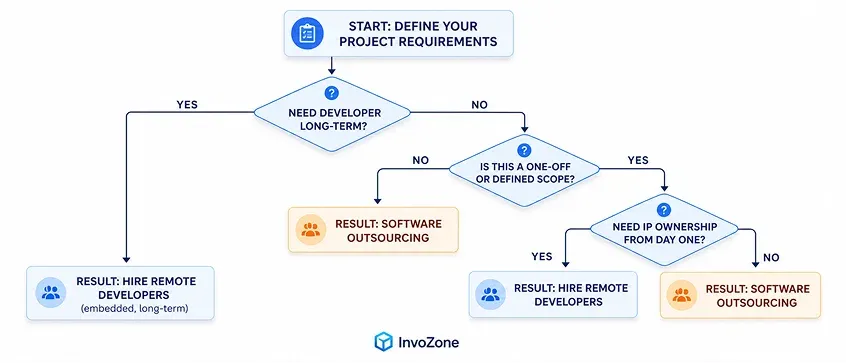
Simple Decision Tree: Choose Your Development Model
Use this quick decision tree if you are unsure whether to hire remote developers or choose software outsourcing.
How InvoZone Supports Both Models
Finding the right balance between control, speed and cost can take weeks of internal evaluation. InvoZone eliminates this complexity by providing flexible models according to your business structure.
With over 12+ years of experience and more than 100 successful projects, InvoZone connects you with the top 3% of tech talent. We match your requirements with pre-vetted engineers within an average of 24 hours.
Depending on your structural needs, we offer multiple engagement models:
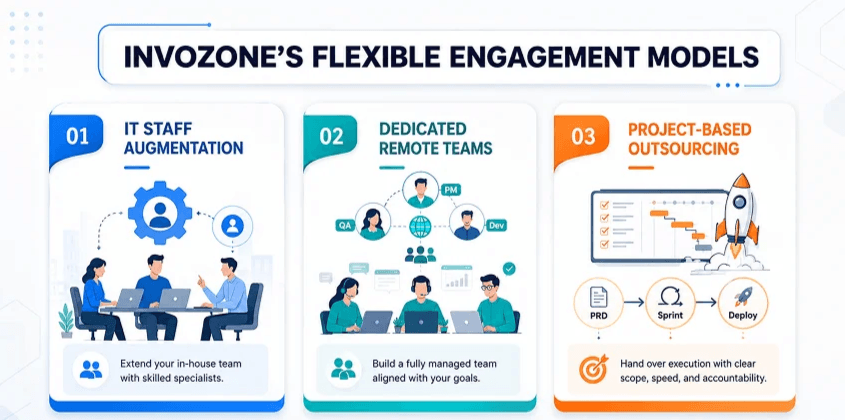
Add a skilled developer directly into your existing team. They work with your team, follow your process, and support your delivery without changing your internal structure.
Dedicated teams give you a full development team focused on your product. This works well when your internal team already has leadership in place but needs more hands-on delivery. Hire remote developers who work directly with your team and stay aligned with your workflow.
Fixed price works when your project scope is already clear. You agree on the cost, timeline, and deliverables before development begins, so the budget stays controlled. Hand over a defined project to an elite team to get better business results through a clear delivery plan.
Contact us today for a free consultation and get a 30-day roadmap for your business before you spend a single penny.
Final Takeaway
Remote developers and outsourcing work best in different situations. Choose remote developers when you need long-term product focus, direct control and someone working inside your team. Go for outsourcing when the scope is clear and you want an external team to manage delivery. So before you choose, get honest about what your project actually needs so you end up making the right hiring decisions!
Share to:
Frequently Asked Questions
Find answers to common questions about our services
1.Is remote hiring cheaper than project outsourcing?
Not necessarily. Remote developers involve ongoing salary costs. Outsourcing uses variable pricing i.e. per project, per milestone, or time-and-materials. For short, well-defined work, outsourcing can be cheaper. For long-term development, a dedicated remote developer almost always delivers better value per dollar.
2.How do you protect intellectual property when outsourcing software development?
To protect your proprietary systems, ensure your outsourcing partner signs a comprehensive Non-Disclosure Agreement (NDA) before sharing any technical briefs. Choose vendors that use secure development environments, restricted access controls, and legally guarantee full source code ownership to your company upon milestone completion.
3.Can you combine in-house teams with outsourced talent?
Yes. This is called a hybrid engineering model. In this setup, your internal leaders retain ownership of the core system architecture, product strategy, and intellectual property. You then use outsourced engineers or staff augmentation to scale execution capacity, build secondary features, or handle specialized tasks like automated QA testing.
4.Can you use both remote developers and outsourcing at the same time?
Yes. Most mature engineering teams do. Core product work and IP-sensitive development stays with your remote team. Non-core builds or specialized, time-boxed projects go to outsourcing partners. The hybrid model balances control and speed.
5.What is the main risk of outsourcing software development?
Loss of product knowledge when the contract ends. If you do not plan a structured knowledge transfer before the engagement closes, the context built during the project walks out with the vendor. Scope creep and unclear IP ownership are the other two most common failure points.
6.Is outsourcing good for startups?
Yes, for early-stage work with clear scope i.e. MVPs, prototypes, and specific technical builds. Once the product finds traction and the roadmap becomes long-term, shifting to dedicated remote developers gives you more control over quality, culture, and IP.
7.What should I look for in an outsourcing contract to protect my IP?
Require a signed NDA before sharing any technical documentation. Confirm full source code ownership transfers to your company at each milestone. Specify restricted data access controls and audit rights. For regulated industries, add data processing agreements and compliance clauses relevant to your sector.
Table of Contents
Your last outsourced project shipped late and the cost exceeded more than quoted. Sounds familiar
Here is what nobody tells you upfront: remote developers and outsourcing are not the same model.
They have different cost structures, different ownership rules, and different expectations for who manages the work.
Let’s break it down so you make your hiring decision wisely.
Defining the Core Models
To choose the right setup, you first need to understand what each model actually gives your business.

What Is Remote Developer Hiring?
Remote hiring is the direct employment of individual software engineers who work outside a traditional office setting, often from different cities or countries. These developers are integrated into your company culture, follow your internal workflows and report directly to your engineering managers just like local employees.
What Is Software Development Outsourcing?
Software development outsourcing means hiring an external company to handle part or all of your software work. The outsourcing partner usually manages the team, delivery process, and technical execution. This is based on the software outsourcing model, type and project scope your business chooses.
Outsourcing works best when the scope is clear or when your internal team needs a specific technical skill for a limited period.
Main Types of Software Outsourcing
- Onshore Outsourcing: Partnering with an external team within your own country.
- Nearshore Outsourcing: Working with teams in neighboring countries with similar time zones.
- Offshore Outsourcing: Contracting with software firms in distant countries to access specialized talent pools and optimize development budgets.
Comparison Across 8 Key Factors
Read how these three setup models change your day-to-day operations:
|
Workflow Factor |
Remote Developers |
Software Outsourcing |
|
Control |
You keep direct control because the developers work inside your team and follow your process. |
Control is shared because the vendor manages delivery based on the agreed scope. |
|
Management |
Your team manages tasks, priorities, reviews, and daily progress. |
The vendor usually manages the team through a project manager or delivery lead. |
|
Cost Structure |
Costs are usually based on hourly, monthly, or role-based rates. |
Costs are usually tied to project scope, milestones, or monthly team contracts. |
|
Scalability |
Scaling depends on how fast you can find and onboard the right developers. |
Scaling is usually faster when the vendor already has available engineers. |
|
Onboarding Effort |
You need to explain your product, tools, codebase, and internal process. |
The vendor handles team onboarding, but your business still needs to explain the product and requirements clearly. |
|
Product Context |
Developers build stronger product context when they work with your team long term. |
The vendor builds context for the project, but knowledge transfer must be planned before the contract ends. |
|
Communication |
Communication is direct through your tools, meetings, and sprint process. |
Communication usually follows a structured process through the vendor’s project manager, with technical calls when needed. |
|
Main Risk |
This model needs strong internal management and clear task ownership. |
This model depends on vendor quality, clear scope, and proper review checkpoints. |
Key Differences in Business Terms
It is crucial to know these fundamental differences before making your final decision. Read below to make sure you don't put your projects at risk.
Cost & Financial Predictability
Remote developer hiring usually gives you a predictable monthly cost. You pay based on the developer’s role, seniority, and location. This works well when you need ongoing development and want the same person to stay close to your product.
Software outsourcing has a different cost structure. You may pay by project, milestone, or monthly team contract. This can work well for defined work. The cost becomes harder to control when the scope keeps changing or requirements are unclear.
Cost Structure Deep Dive
- Remote hiring is a predictable cost i.e. salary or monthly rate. You know exactly what you are paying every month.
- Outsourcing is variable. You pay per project, per milestone, or on a time-and-materials basis. While it can be cheaper for short, well-defined work, budgets can balloon fast if the development scope is unclear or requirements change mid-project.
Control and Daily Management
When you hire a dedicated remote developer, they become a core part of your company. They participate in your daily standups, adapt to your communication style, and align closely with your business values. This deep integration leads to high employee satisfaction and long-term product context. This gives you more control over daily work, but your team still needs to manage tasks and review progress.
Software outsourcing gives more delivery responsibility to the vendor. The external team usually works from a defined scope and reports progress through a project manager or delivery lead. The external team works independently based on your Product Requirements Document (PRD). While this removes the need for daily micro-management, it also means your review process needs to be clear from the start.
If you do not set clear KPIs and strict review checkpoints, you risk receiving a final product that does not match your internal quality standards.
"If you deprive yourself of outsourcing and your competitors do not, you're putting yourself out of business."
— Lee Kuan Yew, Former Prime Minister of Singapore
Long-Term Knowledge Retention
A remote developer builds product context over time. They learn your codebase, business rules, user needs and technical decisions. That context becomes useful when the roadmap changes or new features depend on past work.
An outsourced team builds context for the project they are hired to complete. Once the contract ends, that knowledge leaves with the vendor. If you do not plan a structured knowledge transfer before the engagement closes, you lose everything they learned.
Team Loyalty and Accountability
A remote developer's career depends on your satisfaction. They usually work more closely with your internal team. Following a clear view of remote developer pricing, vetting and hiring options helps you choose someone who fits your team’s working style. You’ll find them attending regular meetings, receiving direct feedback and becoming part of your delivery routine. This makes accountability easier to track.
With outsourcing, accountability depends on the vendor’s delivery process. Collaborating with specialized software outsourcing professionals ensures you have access to structured milestones, review checkpoints, and a defined approval process. A strong outsourcing partner will make progress visible without requiring you to manage individual engineers.
If weekly updates feel vague, take it as an immediate warning sign.
Security and Data Access
Remote developers can work under your internal access rules. You can limit repository permissions, control tool access,and apply your company’s security policies.
With outsourcing, sensitive data goes to a third-party organization. NDAs and security audits reduce the risk. For fintech, healthtech, government, or other regulated industries, this should be discussed before development starts.
How to Choose the Right Model
Selecting your development approach depends on your project timeline, security constraints, and internal management capacity.
When to Choose Remote Developer Hiring
- You are building a long-term product and need a developer embedded in your team for months or years.
- You want an engineer who will dedicate 100% of their focus to your codebase.
- Intellectual property ownership is non-negotiable from day one.
- You want someone in your standups, adapting to your culture, and building institutional knowledge.
- You need specialized skills unavailable or too expensive locally. Research shows that 72% of companies cite this talent shortage as their primary reason for remote hiring.
- You want direct management without a vendor layer between you and the work.
- You want to expand your operations into new regions while maintaining direct management authority over your software engineering culture..
When to Choose Software Outsourcing
- You need to ship an MVP or prototype in one to three months and do not have time to hire.
- The project is well-defined with a fixed scope, with no ambiguity and no ongoing iteration.
- You need to offload non-core work like QA pipelines, legacy maintenance, or a specific integration.
- You are testing a new feature or technical direction without committing to permanent headcount.
- You need a full team immediately because outsourcing vendors can deploy faster than any internal hiring process.
After selecting your delivery model, establish clear operational guidelines to protect your investment.
Simple Decision Tree: Choose Your Development Model
Use this quick decision tree if you are unsure whether to hire remote developers or choose software outsourcing.

How InvoZone Supports Both Models
Finding the right balance between control, speed and cost can take weeks of internal evaluation. InvoZone eliminates this complexity by providing flexible models according to your business structure.
With over 12+ years of experience and more than 100 successful projects, InvoZone connects you with the top 3% of tech talent. We match your requirements with pre-vetted engineers within an average of 24 hours.
Depending on your structural needs, we offer multiple engagement models:

Add a skilled developer directly into your existing team. They work with your team, follow your process, and support your delivery without changing your internal structure.
Dedicated teams give you a full development team focused on your product. This works well when your internal team already has leadership in place but needs more hands-on delivery. Hire remote developers who work directly with your team and stay aligned with your workflow.
Fixed price works when your project scope is already clear. You agree on the cost, timeline, and deliverables before development begins, so the budget stays controlled. Hand over a defined project to an elite team to get better business results through a clear delivery plan.
Contact us today for a free consultation and get a 30-day roadmap for your business before you spend a single penny.
Final Takeaway
Remote developers and outsourcing work best in different situations. Choose remote developers when you need long-term product focus, direct control and someone working inside your team. Go for outsourcing when the scope is clear and you want an external team to manage delivery. So before you choose, get honest about what your project actually needs so you end up making the right hiring decisions!
Share to:
Related Articles
Let’s Discuss Your Needs
Tell us about your project. we'll take it from there
