Trusted By 2000+ Clients

Why the Cheapest Remote Developer Almost Always Costs More

Hiring low-rate developers often results in higher total project costs due to hidden expenses like extensive reworking, senior supervision, and high turnover, making senior talent more economical in the long run. This blog explores all you need to know about the hidden costs of cheap engineering talent and serves as a guide on what to look for when making your next hiring decision.

Furqan Aziz
Furqan AzizCEO & Founder
Updated:23 July, 2026
Published:23 July, 2026

Furqan Aziz is CEO & Founder of InvoZone. He is a tech enthusiast by heart with 10+ years ... See more

Don’t Have Time To Read Now? Download It For Later.

You know that moment. 

The one where you're staring at a spreadsheet while your CFO asks for a plan to optimize engineering overhead. You stumble across a developer profile that looks perfect.

The rate is twenty-five dollars an hour. The reviews are glowing, the portfolio is clean, and they can start tomorrow morning. 

And you think: "This is it."

I have been that person. I was the CTO who convinced himself the cheap hire would be different. I assumed close management and clear specifications would make the arrangement work.

The one who thought, "Everyone says cheap devs cost more, but I'll manage them better. I'll be more hands-on. It'll work this time."

It never works. I'm going to show you why.

By the end of this, you'll understand exactly where the hidden costs live, how to calculate what a software developer actually costs you and why the smartest engineering leaders refuse to hire the cheapest option.

The First Problem: You're Looking At The Wrong Number

When hiring remote developers, hourly rates seem simple as they fit nicely into projection models.

However, they are also deceptive.

The Base Calculation

Your upfront payment of $25 per hour is only a fraction of the actual transaction. The moment a junior remote developer joins your repository, you incur several immediate operational expenses:

  • Management load: Project management and payroll processing require manual execution.

By the time you tally these baseline operational expenses, that $25 developer costs your business closer to $45 per hour.

Each of these factors chips away at the apparent "savings" from choosing a lower hourly rate.

The Jerry and Alex Problem: Why Hourly Rate Is a Trap

Here's something that sounds obvious but almost nobody applies when hiring developers.

Imagine you have two developers for a task: Alex and Jerry.

Alex charges $25/hour and takes eight hours to complete the task. Total cost: $200. Jerry charges $60/hour but takes three hours. Total cost: $180.

Jerry finishes faster and costs less overall because he has executed this exact workflow dozens of times. He knows the frameworks, the edge cases, and the common pitfalls. He writes clean code that requires minimal revision.

Alex is still figuring it out. His code mostly works under ideal conditions, but it requires substantial review. Six months later, when you need to add a new feature, Alex’s code is brittle and hard to extend.

Let me show you the real math.


Alex (Junior, $25/hr)

Jerry (Senior, $60/hr)

Development time

8 hours ($200)

3 hours ($180)

Senior engineer review

3 hours ($450)

30 minutes ($75)

Rework and revisions

4 hours ($100)

0 hours ($0)

Technical debt cleanup later

$1,200 estimate

$200 estimate

True cost

~$1,950

~$455


Alex wasn't cheaper. Alex was a trap.

This is what most companies miss. 

They compare hourly rates like they're buying bananas. 

They don't calculate the total cost of ownership and don't factor in the oversight, the rework, the maintenance and the time their own people spend managing the situation.

Here's the real question you should be asking: Not "what's your hourly rate?" but "how much will this actually cost me when everything is said and done?"

The honest answer? 

A higher-rate developer who works faster and produces better quality is almost always cheaper than a lower-rate developer who takes longer, needs more oversight, and leaves a trail of technical debt.

The Five Costs Nobody Factors In (But They Absolutely Should)

1. The Rework Loop: Building the Same Thing Three Times

You write a spec and your developer builds it. You test the feature, realize it misses critical edge cases, and send it back. They rebuild it but it still fails under load.

Here's the difference I've seen play out a dozen times. Let's make it clear with the same example.

Jerry (Senior Developer)

Gets a loose ticket and immediately asks clarifying questions. "What do you actually need here? Are we optimizing for speed or maintainability? Does this need to handle edge cases X and Y?"

Alex (Junior Developer)

Gets the same ticket and starts coding. They don't ask the questions and build exactly what you said, not what you meant. Then you send it back, they fix it and you send it back again.

The financial cost of this cycle is severe:

  • Unmanaged rework consumes roughly 18% of total project timelines.
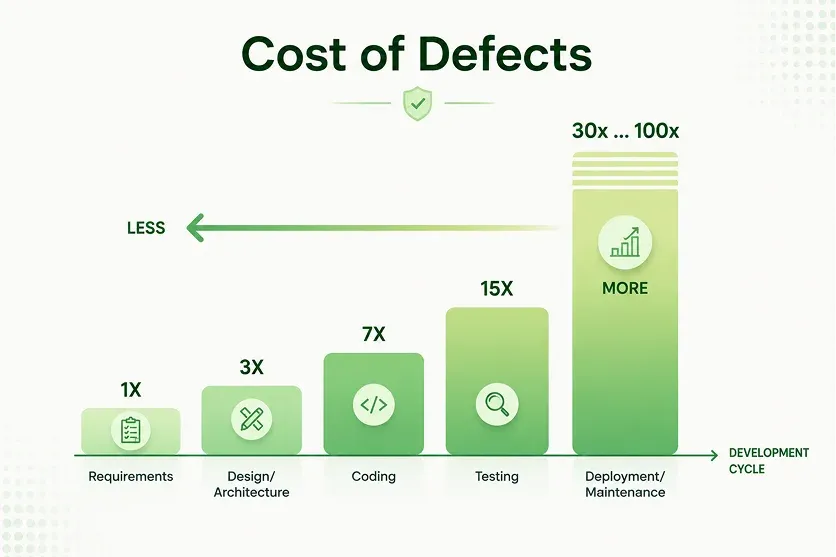
  • Catching a bug in production costs thirty times more than identifying it during the initial design phase
  • Poorly executed codebases add 30% to 50% in additional project expenses due to debugging delays.

What you need to do:

Stop handing vague tickets to junior developers. Hourly rates don't reveal the true cost of a project. You have to look at the bigger picture including the rework, the oversight, the delays to find your real return on investment.

"A developer who questions your requirements isn't being difficult. The ones who just nod and start typing are the ones who will cost you the most.”

The financial cost of this cycle is severe. Research illustrates how the effort and cost required to fix a defect scale exponentially the later it is discovered in the development cycle:
2. The Supervision Tax

This expense never appears on an agency invoice.

When you hire engineers who require constant guidance, you redirect your senior staff. Your $150-per-hour architects spend their days hosting troubleshooting calls and correcting simple logic errors.

Let's look at the daily reality:

Metric

Junior Developer ($25/hr)

Mid-Level Developer ($60/hr)

Direct Daily Cost

$200 (8 hours)

$480 (8 hours)

Senior Review Time

3 hours ($450)

0.5 hours ($75)

Actual Daily Total

$650

$555


When you hire a cheap developer, you make your most expensive people significantly less productive. The cheap hire lowers your upfront rate while making your experienced leadership miserable and unproductive.

3. The Turnover Tax: Perpetual Onboarding

Here's a number that surprised me when I first saw it.

The average annual turnover rate in the tech industry is 13.2%. Highly competitive offshore markets see annual developer turnover rates between 25% and 40%.

Think about what that means. Every 18 to 24 months, your entire outsourced team essentially 

resets. When a developer leaves, they take product context, structural and domain knowledge, and all those undocumented fixes with them. Your team spends months training a replacement, paying for the same learning curve repeatedly instead of building new product features.

The real cost:

  • The average outsourced developer takes 3–6 months to ramp up
  • High-churn teams see 25–40% of a project timeline wasted due to onboarding inefficiencies
  • Each departure costs $75,000 in lost institutional knowledge

Nearshore teams or stable dedicated teams see turnover closer to 12% to 18% annually. The stability alone justifies the higher rate.

I've watched companies spend six figures on cheap developers and get absolutely nothing to show for it because the team kept turning over. Every new hire meant new context, new mistakes, and new delays.

4. The Time Zone Tax: Your "Quick" Feature Takes Forever

Twelve hours of timezone separation turns minor clarifications into multi-day delays.

You submit feedback at 9:00 AM and the developer is asleep. They push a correction at midnight. You wake up, discover a secondary bug, and submit a new ticket.

A simple adjustment that takes two hours on a synchronous team now requires three business days. While your competitors ship updates daily, your features sit stalled in communication queues.

The real cost:

  • Time zone coordination extends project timelines by 15% to 20%.
  • Communication overhead causes a 23% productivity loss.
  • A 3-week feature easily becomes a 4.5-week project.

This is why establishing seamless time zone alignment is an absolute game-changer when hiring remote developers. Sourcing talent with a shared schedule protects your team from delivery delays.

5. Technical Debt: The Bill That Comes Due Later

Poorly structured code compounds like high-interest debt. According to global code quality analyses, technical debt costs businesses billions of dollars annually in lost productivity.

  • Engineers spend an average of 17.3 hours per week managing legacy technical debt.
  • Nearly 45% of production code bases are fragile and prone to unexpected failures under load.
  • Maintaining legacy infrastructure and correcting failed migrations consumes a significant portion of modern enterprise budgets.

Cheap code is the primary source of technical debt. Every architectural shortcut taken to meet a deadline today becomes an engineering emergency tomorrow.

So Where Does That Leave You?

The data shows that most companies end up in the $30–49/hour bracket for a reason. It is the sweet spot where you secure genuine autonomy and production quality without paying Silicon Valley premiums.

For US-based teams, choosing offshore software outsourcing with a premier partner offers a structural advantage:

  • Managed overlap: Dedicated offshore teams structure overlapping shifts to guarantee 3 to 5 hours of synchronous daily collaboration.
  • High retention: Premium offshore agencies maintain a stable 12% to 18% annual turnover, protecting your institutional product knowledge.
  • Strategic talent: You access massive global engineering pools for specialized backend, frontend, and AI-native development at highly cost-effective rates.

By partnering with an established network like InvoZone, you secure these nearshore benefits without the vetting overhead. InvoZone provides dedicated pre-vetted remote developers who integrate into your stack within 24 hours. They align with your working hours and bring the senior-level autonomy needed to prevent constant rework. You get the cost efficiency of global sourcing, backed by the execution quality of an onshore team.

Partner Evaluation: 5 Criteria for True ROI

If you are looking at outsourcing partners, focus on total return on investment. Evaluate prospective networks using these five criteria:

  • Results: Do they show clear, documented project outcomes where they owned the execution?
  • References: Would their previous clients pay to hire them again?
  • Communication: Do they respond quickly and with clear context?
  • Expertise: Do they offer active engineering opinions, or do they just take orders?
  • Relevance: Do they have direct experience with your stack, or a proven track record of solving new problems quickly?

Three Questions Before You Hire

Run your next candidate through these three questions first:

  • Do you trust them to work alone? If you have to micromanage their day, you bought a project management burden, not an engineer.
  • Did you calculate the actual cost? Add the price of slow code reviews, extra QA rounds, timezone delays, and onboarding to that $25 rate.
  • What happens if they quit in six months? If your entire pipeline freezes because one person left, your business model has a single point of failure.

Moral: Speed of delivery determines your actual development cost, not the hourly rate on your invoice.

A Final Thought

The developers who perform best in remote roles are not always the ones who interview best. They are the ones who communicate proactively, document their thinking, handle ambiguity without freezing and make their work visible without being asked.

A good vetting process screens for all of those things. The companies that have figured this out are spending it differently. It focused on the signals that actually predict success instead of the ones that are easiest to measure. 

If you want to skip the vetting overhead entirely, InvoZone pre-screens every engineer across technical ability, communication quality, and remote work readiness before you see a single profile. Most clients meet their first matched developer within 24 hours.

Share to:

Frequently Asked Questions

Find answers to common questions about our services

1.What is the actual fully loaded cost of a $25/hour developer?

At least $45/hour. The invoice rate ignores recruiting, onboarding overhead, software licenses, and management time. Once you factor in the "supervision tax" (senior devs fixing their errors), endless rework, and high turnover, a cheap developer almost always ends up costing more than a senior engineer charging $60/hour.

2.Why do cheap remote developers quit so fast?

Because they have zero incentive to stay. Cheap agencies often charge clients $80/hour but pay their developers only $20/hour, pocketing a massive margin. The developers feel undervalued and will instantly jump ship the second another agency offers them a tiny $2/hour raise. When they leave, they take all your undocumented product context with them.

3.How much does technical debt actually cost?

A staggering amount. Globally, technical debt costs US businesses $2.41 trillion annually. On a team level, the average engineer wastes 17.3 hours per week just maintaining legacy mess and fixing bad code instead of shipping new features.

4.How do time zones impact project speed?

Timezone gaps turn simple, two-minute questions into 24-hour delays. If your developer is asleep during your workday, a minor bug fix that should take an hour drags out over three days of back-and-forth messages. This coordination lag routinely extends project timelines by 15% to 20%.

5.How common is rework in cheap software projects?

It consumes about 18% of the average project timeline. Worse, catching a bug in production after a junior dev deploys it costs thirty times more to fix than catching it during the initial design phase. Badly written codebases ultimately add 30% to 50% in extra debugging expenses.

6.Is nearshore actually better for US companies?

Yes, especially if you value real-time collaboration. You get a solid 10 to 12 hours of workday overlap so your team can pair-program and run synchronous standups. For a 6-person team, nearshore sourcing saves roughly $120,000 to $180,000 per year compared to hiring onshore US developers, without losing the ability to work together in real-time.

7.How do I test for autonomy during hiring?

Give the candidate a loosely defined problem with some intentional blank spots. Do not give them a step-by-step checklist. Watch what they do. An autonomous engineer will stop, ask clarifying questions about edge cases, and challenge your assumptions. A passive engineer will just nod, start typing, and build exactly what you said even if it makes no sense for your product.

8.What is the number one interview question companies skip?

"How do you handle unclear requirements when you can't get an immediate answer from me?"

This question is the ultimate test of remote readiness. If they say they wait passively for you to log back online, they will stall your team. If they explain how they document their assumptions, choose the safest path forward, and flag the decision for review, they will thrive.
 

9.Should I hire freelancers or use a dedicated provider?

Freelancers are fine for quick, transactional gigs, but they have no long-term commitment to your company. Dedicated providers are built for scale. They pre-vet talent, handle payroll, sign strict NDAs, and ensure continuity if a developer leaves. Providers like InvoZone sit in this sweet spot, matching you with pre-screened nearshore developers within 24 hours so you can scale without the recruiting headache.

You know that moment. 

The one where you're staring at a spreadsheet while your CFO asks for a plan to optimize engineering overhead. You stumble across a developer profile that looks perfect.

The rate is twenty-five dollars an hour. The reviews are glowing, the portfolio is clean, and they can start tomorrow morning. 

And you think: "This is it."

I have been that person. I was the CTO who convinced himself the cheap hire would be different. I assumed close management and clear specifications would make the arrangement work.

The one who thought, "Everyone says cheap devs cost more, but I'll manage them better. I'll be more hands-on. It'll work this time."

It never works. I'm going to show you why.

By the end of this, you'll understand exactly where the hidden costs live, how to calculate what a software developer actually costs you and why the smartest engineering leaders refuse to hire the cheapest option.

The First Problem: You're Looking At The Wrong Number

When hiring remote developers, hourly rates seem simple as they fit nicely into projection models.

However, they are also deceptive.

The Base Calculation

Your upfront payment of $25 per hour is only a fraction of the actual transaction. The moment a junior remote developer joins your repository, you incur several immediate operational expenses:

  • Management load: Project management and payroll processing require manual execution.

By the time you tally these baseline operational expenses, that $25 developer costs your business closer to $45 per hour.

Each of these factors chips away at the apparent "savings" from choosing a lower hourly rate.

The Jerry and Alex Problem: Why Hourly Rate Is a Trap

Here's something that sounds obvious but almost nobody applies when hiring developers.

Imagine you have two developers for a task: Alex and Jerry.

Alex charges $25/hour and takes eight hours to complete the task. Total cost: $200. Jerry charges $60/hour but takes three hours. Total cost: $180.

Jerry finishes faster and costs less overall because he has executed this exact workflow dozens of times. He knows the frameworks, the edge cases, and the common pitfalls. He writes clean code that requires minimal revision.

Alex is still figuring it out. His code mostly works under ideal conditions, but it requires substantial review. Six months later, when you need to add a new feature, Alex’s code is brittle and hard to extend.

Let me show you the real math.


Alex (Junior, $25/hr)

Jerry (Senior, $60/hr)

Development time

8 hours ($200)

3 hours ($180)

Senior engineer review

3 hours ($450)

30 minutes ($75)

Rework and revisions

4 hours ($100)

0 hours ($0)

Technical debt cleanup later

$1,200 estimate

$200 estimate

True cost

~$1,950

~$455


Alex wasn't cheaper. Alex was a trap.

This is what most companies miss. 

They compare hourly rates like they're buying bananas. 

They don't calculate the total cost of ownership and don't factor in the oversight, the rework, the maintenance and the time their own people spend managing the situation.

Here's the real question you should be asking: Not "what's your hourly rate?" but "how much will this actually cost me when everything is said and done?"

The honest answer? 

A higher-rate developer who works faster and produces better quality is almost always cheaper than a lower-rate developer who takes longer, needs more oversight, and leaves a trail of technical debt.

The Five Costs Nobody Factors In (But They Absolutely Should)

1. The Rework Loop: Building the Same Thing Three Times

You write a spec and your developer builds it. You test the feature, realize it misses critical edge cases, and send it back. They rebuild it but it still fails under load.

Here's the difference I've seen play out a dozen times. Let's make it clear with the same example.

Jerry (Senior Developer)

Gets a loose ticket and immediately asks clarifying questions. "What do you actually need here? Are we optimizing for speed or maintainability? Does this need to handle edge cases X and Y?"

Alex (Junior Developer)

Gets the same ticket and starts coding. They don't ask the questions and build exactly what you said, not what you meant. Then you send it back, they fix it and you send it back again.

The financial cost of this cycle is severe:

  • Unmanaged rework consumes roughly 18% of total project timelines.
  • Catching a bug in production costs thirty times more than identifying it during the initial design phase
  • Poorly executed codebases add 30% to 50% in additional project expenses due to debugging delays.

What you need to do:

Stop handing vague tickets to junior developers. Hourly rates don't reveal the true cost of a project. You have to look at the bigger picture including the rework, the oversight, the delays to find your real return on investment.

"A developer who questions your requirements isn't being difficult. The ones who just nod and start typing are the ones who will cost you the most.”

The financial cost of this cycle is severe. Research illustrates how the effort and cost required to fix a defect scale exponentially the later it is discovered in the development cycle:

2. The Supervision Tax

This expense never appears on an agency invoice.

When you hire engineers who require constant guidance, you redirect your senior staff. Your $150-per-hour architects spend their days hosting troubleshooting calls and correcting simple logic errors.

Let's look at the daily reality:

Metric

Junior Developer ($25/hr)

Mid-Level Developer ($60/hr)

Direct Daily Cost

$200 (8 hours)

$480 (8 hours)

Senior Review Time

3 hours ($450)

0.5 hours ($75)

Actual Daily Total

$650

$555


When you hire a cheap developer, you make your most expensive people significantly less productive. The cheap hire lowers your upfront rate while making your experienced leadership miserable and unproductive.

3. The Turnover Tax: Perpetual Onboarding

Here's a number that surprised me when I first saw it.

The average annual turnover rate in the tech industry is 13.2%. Highly competitive offshore markets see annual developer turnover rates between 25% and 40%.

Think about what that means. Every 18 to 24 months, your entire outsourced team essentially 

resets. When a developer leaves, they take product context, structural and domain knowledge, and all those undocumented fixes with them. Your team spends months training a replacement, paying for the same learning curve repeatedly instead of building new product features.

The real cost:

  • The average outsourced developer takes 3–6 months to ramp up
  • High-churn teams see 25–40% of a project timeline wasted due to onboarding inefficiencies
  • Each departure costs $75,000 in lost institutional knowledge

Nearshore teams or stable dedicated teams see turnover closer to 12% to 18% annually. The stability alone justifies the higher rate.

I've watched companies spend six figures on cheap developers and get absolutely nothing to show for it because the team kept turning over. Every new hire meant new context, new mistakes, and new delays.

4. The Time Zone Tax: Your "Quick" Feature Takes Forever

Twelve hours of timezone separation turns minor clarifications into multi-day delays.

You submit feedback at 9:00 AM and the developer is asleep. They push a correction at midnight. You wake up, discover a secondary bug, and submit a new ticket.

A simple adjustment that takes two hours on a synchronous team now requires three business days. While your competitors ship updates daily, your features sit stalled in communication queues.

The real cost:

  • Time zone coordination extends project timelines by 15% to 20%.
  • Communication overhead causes a 23% productivity loss.
  • A 3-week feature easily becomes a 4.5-week project.

This is why establishing seamless time zone alignment is an absolute game-changer when hiring remote developers. Sourcing talent with a shared schedule protects your team from delivery delays.

5. Technical Debt: The Bill That Comes Due Later

Poorly structured code compounds like high-interest debt. According to global code quality analyses, technical debt costs businesses billions of dollars annually in lost productivity.

  • Engineers spend an average of 17.3 hours per week managing legacy technical debt.
  • Nearly 45% of production code bases are fragile and prone to unexpected failures under load.
  • Maintaining legacy infrastructure and correcting failed migrations consumes a significant portion of modern enterprise budgets.

Cheap code is the primary source of technical debt. Every architectural shortcut taken to meet a deadline today becomes an engineering emergency tomorrow.

So Where Does That Leave You?

The data shows that most companies end up in the $30–49/hour bracket for a reason. It is the sweet spot where you secure genuine autonomy and production quality without paying Silicon Valley premiums.

For US-based teams, choosing offshore software outsourcing with a premier partner offers a structural advantage:

  • Managed overlap: Dedicated offshore teams structure overlapping shifts to guarantee 3 to 5 hours of synchronous daily collaboration.
  • High retention: Premium offshore agencies maintain a stable 12% to 18% annual turnover, protecting your institutional product knowledge.
  • Strategic talent: You access massive global engineering pools for specialized backend, frontend, and AI-native development at highly cost-effective rates.

By partnering with an established network like InvoZone, you secure these nearshore benefits without the vetting overhead. InvoZone provides dedicated pre-vetted remote developers who integrate into your stack within 24 hours. They align with your working hours and bring the senior-level autonomy needed to prevent constant rework. You get the cost efficiency of global sourcing, backed by the execution quality of an onshore team.

Partner Evaluation: 5 Criteria for True ROI

If you are looking at outsourcing partners, focus on total return on investment. Evaluate prospective networks using these five criteria:

  • Results: Do they show clear, documented project outcomes where they owned the execution?
  • References: Would their previous clients pay to hire them again?
  • Communication: Do they respond quickly and with clear context?
  • Expertise: Do they offer active engineering opinions, or do they just take orders?
  • Relevance: Do they have direct experience with your stack, or a proven track record of solving new problems quickly?

Three Questions Before You Hire

Run your next candidate through these three questions first:

  • Do you trust them to work alone? If you have to micromanage their day, you bought a project management burden, not an engineer.
  • Did you calculate the actual cost? Add the price of slow code reviews, extra QA rounds, timezone delays, and onboarding to that $25 rate.
  • What happens if they quit in six months? If your entire pipeline freezes because one person left, your business model has a single point of failure.

Moral: Speed of delivery determines your actual development cost, not the hourly rate on your invoice.

A Final Thought

The developers who perform best in remote roles are not always the ones who interview best. They are the ones who communicate proactively, document their thinking, handle ambiguity without freezing and make their work visible without being asked.

A good vetting process screens for all of those things. The companies that have figured this out are spending it differently. It focused on the signals that actually predict success instead of the ones that are easiest to measure. 

If you want to skip the vetting overhead entirely, InvoZone pre-screens every engineer across technical ability, communication quality, and remote work readiness before you see a single profile. Most clients meet their first matched developer within 24 hours.

Let’s Discuss Your Needs

Share your details with us. We’ll take it from there.

Get in Touch Now

Share to:

Related Articles

Let’s Discuss Your Needs

Tell us about your project. we'll take it from there

Phone
Choose Your Tech Stack
Top Web Development Companies in Mississauga
Software Development Company - Design Rush
Top Software Development Companies in Toronto, ON
Best Software Development Companies In 2021
Fatest growing app development companies
Top 100+ Software Development Companies in 2021
Finest Mobile App Developers in Canada - March 2021
Top eCommerce Development Companies in the USA
Top Web Development Companies
Top Web Development Companies in Mississauga
Software Development Company - Design Rush
Top Software Development Companies in Toronto, ON
Best Software Development Companies In 2021
Fatest growing app development companies
Top 100+ Software Development Companies in 2021
Finest Mobile App Developers in Canada - March 2021
Top eCommerce Development Companies in the USA
Top Web Development Companies
Top Web Development Companies in Mississauga
Software Development Company - Design Rush
Top Software Development Companies in Toronto, ON
Best Software Development Companies In 2021
Fatest growing app development companies
Top 100+ Software Development Companies in 2021
Finest Mobile App Developers in Canada - March 2021
Top eCommerce Development Companies in the USA
Top Web Development Companies