When to Use Staff Augmentation vs Build a Dedicated Team
Staff augmentation is best for filling quick skill gaps under your direct supervision. Dedicated teams provide a complete and self-managed team for long-term projects. Choosing the right model depends entirely on your project duration, your budget limits and how much time you have to manage external developers.

“Furqan Aziz is CEO & Founder of InvoZone. He is a tech enthusiast by heart with 10+ years ...” See more
Don’t Have Time To Read Now? Download It For Later.
Table of Contents
That Slack message from your CTO hits at 4:37 PM on a Thursday. "We need to ship this feature. The team is maxed out. What is the plan?"
You have been here before. It is a stressful spot to be in.
Two options land on your desk. Staff augmentation and dedicated teams. Both save money and sound reasonable to you as well.
The decision comes down to your calendar. How much time do you actually have to manage people?
Here is how to cut through the industry buzzwords and decide which model fits your current management capacity, your timeline and your budget.
What These Models Actually Mean
Let’s strip away the corporate jargon and break down what these two models actually mean.
Staff Augmentation
With staff augmentation, you hire external developers to join your existing in-house team. They function exactly like internal employees: they attend your morning standups, use your tooling, and report directly to your engineering managers. The provider handles administrative tasks like payroll and benefits, while you maintain full day-to-day operational control.
Think of it as hiring contractors through a staffing agency, but with highly pre-vetted remote developers who have been pre-vetted by the outsourcing partner.
Key characteristics:
- Focus: Immediate skill gaps or temporary capacity increases
- Management: Under your direct, daily supervision
- Onboarding: Fast (typically 1 to 2 weeks)
- Engagement Term: Highly flexible (weeks to months)
Staff augmentation works best when:
- You already have an engineering team and management structure
- You need to fill specific skill gaps quickly ((e.g., bringing on a senior backend Node.js specialist or a DevOps engineer)
- You want direct day-to-day control over the engineers
- Your workload varies and you need to scale up or down monthly
Dedicated Team: A Self-Managed Unit That Owns the Product
A dedicated team is a complete, self-managed software engineering unit. It includes its own technical lead, developers, and often dedicated quality assurance (QA) professionals. While you provide the overarching product vision and priorities, the team manages its own internal day-to-day processes, sprint planning, and delivery execution.
Think of it as having a development agency working exclusively on your product, but with a higher degree of transparency and client involvement than traditional project outsourcing.
Key characteristics:
- Full-time commitment to a single client's project
- Long-term engagement (typically 6+ months, often multi-year)
- Vendor handles team management, retention, and operational logistics
- Team builds deep institutional knowledge
- Predictable monthly costs
- Ramp-up takes 4-8 weeks
Dedicated teams work best when:
- You do not have an internal engineering team (or are building a net-new capability)
- You want to spin up a product pod quickly without internal management overhead
- The scope is large enough to sustain a full team (typically four or more engineers)
- You are comfortable delegating technical leadership to the team's internal structure
The Core Difference: Who Manages the Work?
This is the question that decides everything.
With staff augmentation, you do. Your engineering manager owns the relationship. The external engineer is an extension of your team in every practical sense. With a dedicated team, the provider's team lead manages day-to-day operations. You own the product vision and priorities, but you are not running their standups or reviewing their daily work.
Comparison:
|
Comparison Metric |
Staff Augmentation |
Dedicated Team |
|
Who manages daily work? |
You do |
Vendor does |
|
Who sets priorities? |
You do |
You do |
|
Team structure |
Individual contractors join your existing team |
Self-contained unit with its own internal structure |
|
Engagement length |
Weeks to months |
6+ months, often multi-year |
|
Ramp-up time |
1-2 weeks |
4-8 weeks |
|
Knowledge retention |
Lives in individuals who may rotate off |
Stays with the team |
|
Flexibility |
Scale up/down monthly |
More rigid, restructuring takes longer |
|
Management burden |
High—you manage everything |
Operational Insight
According to recent industry surveys, nearly 87% of technical organizations now incorporate some form of external talent directly into their workforce mix. The difference between success and failure is not whether you use external talent, but whether you have the internal management bandwidth to support them.
The Hidden Costs Nobody Talks About
There exist certain costs that one should always be aware of. You need to know about all the different costs before deciding on a hiring model, as it is crucial to protecting your bottom line and developer sanity.

Management Overhead
Here is the reality check nobody gives you.
This one compounds over time. With staff augmentation, knowledge lives in individual contractors who may rotate off the project. When they leave, they take product context, domain knowledge, and undocumented fixes with them.
If you have strong internal engineering leadership with bandwidth to spare, staff augmentation works beautifully. If your engineering managers are already stretched thin, adding augmented staff to supervise might create a management bottleneck.
A dedicated team comes with its own management structure. The vendor handles day-to-day coordination, sprint planning, and quality assurance. You set priorities and review deliverables. You do not run their standups.
The gap: Staff augmentation saves 15% to 25% on raw, direct talent costs but demands significantly more internal management capacity, which can easily lead to classic remote hiring mistakes if handled carelessly.
Knowledge Retention
This one compounds over time.
With staff augmentation, knowledge lives in individual contractors who may rotate off the project. When they leave, they take product context, domain knowledge, and undocumented fixes with them.
A dedicated team builds collective knowledge within the team and maintains documentation as part of their process. The context stays with the team rather than walking out the door when an individual engagement ends.
The math: When comparing total cost of ownership at the end of 24 months, dedicated teams provide at least 40-55% lower TCO than staff augmentation. The compounding efficiencies result in minimum savings of $150,000 to $300,000 for every four-developer squad compared to rotating augmented resources.
Ramp-Up vs. Long-Term Productivity
Staff augmentation gets you productive fast (1 to 2 weeks) because individual developers join an existing team with established context and processes.
A dedicated team needs 4 to 8 weeks to establish processes, understand the domain, and build team dynamics. But once they are running, they move faster because they have deep context, shared processes, and collective ownership. For long-term engagements of 6+ months, dedicated teams typically offer 15-25% cost savings compared to equivalent staff augmentation arrangements.
The Cost Reality
Let us talk numbers.
Staff augmentation typically costs $35 to $80 per hour per developer. For a full-time engineer, that is roughly $7,200 to $10,000 per month. You manage them directly and provide project management and QA yourself.
Dedicated teams typically cost $15,000 to $40,000 per month all-in. This rate includes the developers, project manager, QA, and management overhead. For a team of four developers plus a PM and QA, the per-developer cost often works out lower than staff augmentation when you factor in everything you are getting
Cost Comparison: Staff Augmentation vs. Dedicated Team
Lets build your 12-month comparison table to look at Staff Augmentation vs. Dedicated Teams specifically through the lens of Offshore Operations.
The Real Cost: 12-Month Offshore Comparison
(Based on a 4 Mid-Level Developer team size, assuming a South Asia baseline)
|
Cost Category |
Staff Augmentation (Offshore) |
Dedicated Team (Offshore) |
|
Direct Talent Costs |
$307,200 (4 devs × $40/hr × 160 hrs/mo × 12 mos) |
$264,000 (Flat monthly rate: 4 devs + PM + QA) |
|
Internal Management Tax |
$48,000 (Consumes 40% of your internal lead's salary writing hyper-detailed specs, doing late-night/early-morning handoffs, and managing blockers) |
$18,000 (Consumes ~15% of your time; the offshore team's internal PM handles the daily timezone coordination) |
|
Onboarding & Ramp-up Friction |
$60,000 (Takes 4-6 weeks per dev to understand legacy architecture asynchronously) |
$8,000 (The squad is already cohesive and has their own established internal delivery framework) |
|
Tooling, Setup & Security |
$6,000 (Secure VPNs, compliance, IP tracking, and remote desktop setup) |
Included |
|
Total Cost of Ownership |
$421,200 |
$290,000 |
The data proves that Staff Augmentation is a short-term sprint tool. If you try to run it as a long-term engine, the invisible tax of managing, onboarding, and securing individual resources will quietly inflate your budget by over 31%.
For sustained roadmaps, a structured and self-managed offshore dedicated team delivers far superior capital efficiency and organizational peace of mind.
Three Questions Before You Choose
Run your situation through these three questions before deciding.
Do you have internal management capacity?
If your engineering managers are already stretched thin, staff augmentation will break them. You will add a management burden at exactly the wrong time. Choose a dedicated team that handles its own coordination.
How long is this engagement?
If you need someone for three months to handle a specific project, staff augmentation makes sense. If you are building a product that will evolve over multiple years, a dedicated team delivers better ROI.
What happens to the knowledge when people leave?
With staff augmentation, knowledge walks out the door when contracts end. With a dedicated team, knowledge stays with the team. If your product requires deep context and continuity, that difference matters.
Choose Wisely as the Industry Shifts
The global IT outsourcing market is projected to reach $525 billion by 2030.
Within this expansion, the dedicated development team market alone was valued at $98 billion in 2023 and is expected to grow at a compound annual growth rate (CAGR) of 5.1% through 2030. This industry shift highlights a simple truth: successful scaling is about matching the duration of your project to the right model.
As the industry pivots toward more structured, self-managed offshore teams, your choice between these two models should be highly tactical:
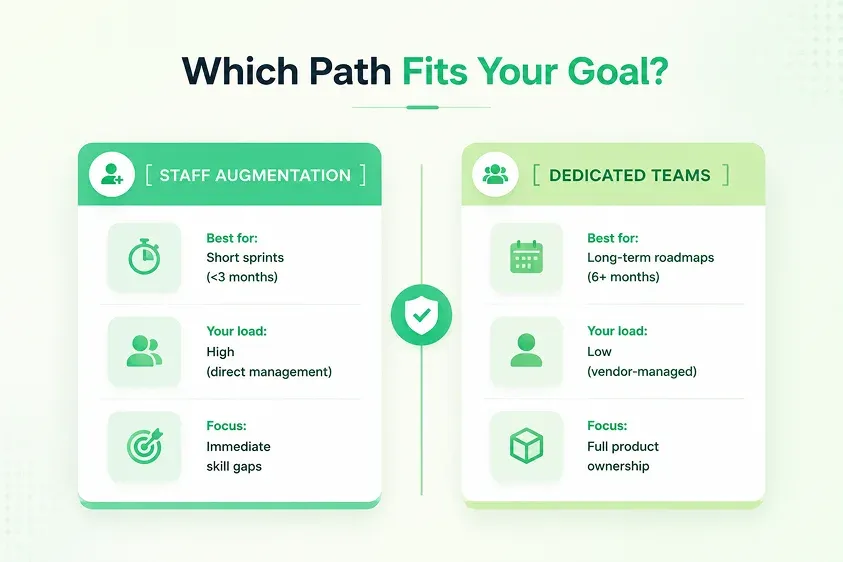
Three Ways to Scale with InvoZone
Scaling your team successfully requires matching the right talent to the right operational model. InvoZone provides pre-screened, nearshore engineers through three flexible structures, letting you choose the exact level of management and budget control you need.
Staff Augmentation
You rent individual developers to plug into your existing team. You manage their daily tasks, code reviews, and standups.
Dedicated Teams
You hire a complete, self-managed squad (developers, QA, and a tech lead). They own the product build and the vendor manages their daily work.
Fixed Price & Scope
You pay a flat, fixed price for a specific finished product (like an MVP or a migration). The vendor takes complete ownership of the build and delivers it to you on a set timeline.
A Final Thought
Choosing between staff augmentation and a dedicated team is not a question of which model is universally superior. If you have the management bandwidth to guide individual developers daily, go with staff augmentation. It is fast, flexible and gets the job done. If your managers are already working overtime just to keep up, do yourself a favor and bring in a dedicated team that can run itself.
Take a quick look at your team's weekly calendar. If it is already flooded with meetings and fire-fighting, that is your answer. Choose the model that matches your situation. Once you know how your organization currently holds strength, you can choose wisely as per where you genuinely need operational support.
Share to:
Frequently Asked Questions
Find answers to common questions about our services
1.Which model is cheaper in the long run?
A dedicated team is significantly cheaper over time. While staff augmentation looks cheaper on paper for month one, it loses financial efficiency due to heavy senior management overhead, talent turnover, and coordination bottlenecks. Over a 24-month horizon, a dedicated team delivers 40% to 55% lower total cost of ownership. One should know the cost and process to hire a dedicated remote developer to calculate your potential savings when making your final decision.
2.When is staff augmentation actually the superior choice?
Staff augmentation wins when you have an established, high-performing internal team that simply lacks specific capacity or niche skills. If you need a senior React engineer for three months to hit a critical launch date, or a DevOps specialist to complete a cloud migration, staff augmentation gets you that exact talent without unnecessary team overhead.
3.When should a business build a dedicated team instead?
You should build a dedicated team when you are building a product from scratch, launching a net-new capability, or scaling a complex product with a long-term roadmap. It is also the ideal choice if your internal engineering managers are already at capacity and cannot take on the burden of supervising more individual contractors.
4.Why do dedicated teams have better knowledge retention?
With staff augmentation, product context lives inside the head of an individual contractor. If they get a better offer and leave, that knowledge walks out the door. Dedicated teams operate as a collective unit; they document codebases together, build shared testing pipelines, and cross-train on your domain. If one developer leaves, the internal team leads seamlessly onboards their replacement without freezing your pipeline.
5.How do the ramp-up times compare?
Staff augmentation is much faster, getting developers active in 1 to 2 weeks because they are simply slotting into your pre-existing environment. A dedicated team takes 4 to 8 weeks to spin up because the squad must establish internal processes, build developer environments, and align structurally with your product vision before writing code.
6.Can we combine both models?
Absolutely. Many scaling companies use a dedicated team to own and continuously build out their core product lines, while leveraging staff augmentation to handle temporary seasonal spikes, legacy system maintenance, or short-term feature sprints.
7.Which model is better for early-stage startups?
If the startup has a highly technical founder who wants to micromanage the codebase and act as the lead architect, staff augmentation works well. However, if the founders are business-focused and lack deep technical management capacity, a dedicated team is far better because it delivers a fully functional, self-managed engineering department from day one.
8.How does quality assurance differ between the two?
In staff augmentation, you must supply your own QA processes and engineers; if the contractor writes buggy code, your team has to catch and fix it. In a dedicated team model, quality assurance is baked into the monthly team rate. The vendor provides QA professionals who work directly with the developers to test and validate features before they are delivered to you.
Table of Contents
That Slack message from your CTO hits at 4:37 PM on a Thursday. "We need to ship this feature. The team is maxed out. What is the plan?"
You have been here before. It is a stressful spot to be in.
Two options land on your desk. Staff augmentation and dedicated teams. Both save money and sound reasonable to you as well.
The decision comes down to your calendar. How much time do you actually have to manage people?
Here is how to cut through the industry buzzwords and decide which model fits your current management capacity, your timeline and your budget.
What These Models Actually Mean
Let’s strip away the corporate jargon and break down what these two models actually mean.
Staff Augmentation
With staff augmentation, you hire external developers to join your existing in-house team. They function exactly like internal employees: they attend your morning standups, use your tooling, and report directly to your engineering managers. The provider handles administrative tasks like payroll and benefits, while you maintain full day-to-day operational control.
Think of it as hiring contractors through a staffing agency, but with highly pre-vetted remote developers who have been pre-vetted by the outsourcing partner.
Key characteristics:
- Focus: Immediate skill gaps or temporary capacity increases
- Management: Under your direct, daily supervision
- Onboarding: Fast (typically 1 to 2 weeks)
- Engagement Term: Highly flexible (weeks to months)
Staff augmentation works best when:
- You already have an engineering team and management structure
- You need to fill specific skill gaps quickly ((e.g., bringing on a senior backend Node.js specialist or a DevOps engineer)
- You want direct day-to-day control over the engineers
- Your workload varies and you need to scale up or down monthly
Dedicated Team: A Self-Managed Unit That Owns the Product
A dedicated team is a complete, self-managed software engineering unit. It includes its own technical lead, developers, and often dedicated quality assurance (QA) professionals. While you provide the overarching product vision and priorities, the team manages its own internal day-to-day processes, sprint planning, and delivery execution.
Think of it as having a development agency working exclusively on your product, but with a higher degree of transparency and client involvement than traditional project outsourcing.
Key characteristics:
- Full-time commitment to a single client's project
- Long-term engagement (typically 6+ months, often multi-year)
- Vendor handles team management, retention, and operational logistics
- Team builds deep institutional knowledge
- Predictable monthly costs
- Ramp-up takes 4-8 weeks
Dedicated teams work best when:
- You do not have an internal engineering team (or are building a net-new capability)
- You want to spin up a product pod quickly without internal management overhead
- The scope is large enough to sustain a full team (typically four or more engineers)
- You are comfortable delegating technical leadership to the team's internal structure
The Core Difference: Who Manages the Work?
This is the question that decides everything.
With staff augmentation, you do. Your engineering manager owns the relationship. The external engineer is an extension of your team in every practical sense. With a dedicated team, the provider's team lead manages day-to-day operations. You own the product vision and priorities, but you are not running their standups or reviewing their daily work.
Comparison:
|
Comparison Metric |
Staff Augmentation |
Dedicated Team |
|
Who manages daily work? |
You do |
Vendor does |
|
Who sets priorities? |
You do |
You do |
|
Team structure |
Individual contractors join your existing team |
Self-contained unit with its own internal structure |
|
Engagement length |
Weeks to months |
6+ months, often multi-year |
|
Ramp-up time |
1-2 weeks |
4-8 weeks |
|
Knowledge retention |
Lives in individuals who may rotate off |
Stays with the team |
|
Flexibility |
Scale up/down monthly |
More rigid, restructuring takes longer |
|
Management burden |
High—you manage everything |
Operational Insight
According to recent industry surveys, nearly 87% of technical organizations now incorporate some form of external talent directly into their workforce mix. The difference between success and failure is not whether you use external talent, but whether you have the internal management bandwidth to support them.
The Hidden Costs Nobody Talks About
There exist certain costs that one should always be aware of. You need to know about all the different costs before deciding on a hiring model, as it is crucial to protecting your bottom line and developer sanity.

Management Overhead
Here is the reality check nobody gives you.
This one compounds over time. With staff augmentation, knowledge lives in individual contractors who may rotate off the project. When they leave, they take product context, domain knowledge, and undocumented fixes with them.
If you have strong internal engineering leadership with bandwidth to spare, staff augmentation works beautifully. If your engineering managers are already stretched thin, adding augmented staff to supervise might create a management bottleneck.
A dedicated team comes with its own management structure. The vendor handles day-to-day coordination, sprint planning, and quality assurance. You set priorities and review deliverables. You do not run their standups.
The gap: Staff augmentation saves 15% to 25% on raw, direct talent costs but demands significantly more internal management capacity, which can easily lead to classic remote hiring mistakes if handled carelessly.
Knowledge Retention
This one compounds over time.
With staff augmentation, knowledge lives in individual contractors who may rotate off the project. When they leave, they take product context, domain knowledge, and undocumented fixes with them.
A dedicated team builds collective knowledge within the team and maintains documentation as part of their process. The context stays with the team rather than walking out the door when an individual engagement ends.
The math: When comparing total cost of ownership at the end of 24 months, dedicated teams provide at least 40-55% lower TCO than staff augmentation. The compounding efficiencies result in minimum savings of $150,000 to $300,000 for every four-developer squad compared to rotating augmented resources.
Ramp-Up vs. Long-Term Productivity
Staff augmentation gets you productive fast (1 to 2 weeks) because individual developers join an existing team with established context and processes.
A dedicated team needs 4 to 8 weeks to establish processes, understand the domain, and build team dynamics. But once they are running, they move faster because they have deep context, shared processes, and collective ownership. For long-term engagements of 6+ months, dedicated teams typically offer 15-25% cost savings compared to equivalent staff augmentation arrangements.
The Cost Reality
Let us talk numbers.
Staff augmentation typically costs $35 to $80 per hour per developer. For a full-time engineer, that is roughly $7,200 to $10,000 per month. You manage them directly and provide project management and QA yourself.
Dedicated teams typically cost $15,000 to $40,000 per month all-in. This rate includes the developers, project manager, QA, and management overhead. For a team of four developers plus a PM and QA, the per-developer cost often works out lower than staff augmentation when you factor in everything you are getting
Cost Comparison: Staff Augmentation vs. Dedicated Team
Lets build your 12-month comparison table to look at Staff Augmentation vs. Dedicated Teams specifically through the lens of Offshore Operations.
The Real Cost: 12-Month Offshore Comparison
(Based on a 4 Mid-Level Developer team size, assuming a South Asia baseline)
|
Cost Category |
Staff Augmentation (Offshore) |
Dedicated Team (Offshore) |
|
Direct Talent Costs |
$307,200 (4 devs × $40/hr × 160 hrs/mo × 12 mos) |
$264,000 (Flat monthly rate: 4 devs + PM + QA) |
|
Internal Management Tax |
$48,000 (Consumes 40% of your internal lead's salary writing hyper-detailed specs, doing late-night/early-morning handoffs, and managing blockers) |
$18,000 (Consumes ~15% of your time; the offshore team's internal PM handles the daily timezone coordination) |
|
Onboarding & Ramp-up Friction |
$60,000 (Takes 4-6 weeks per dev to understand legacy architecture asynchronously) |
$8,000 (The squad is already cohesive and has their own established internal delivery framework) |
|
Tooling, Setup & Security |
$6,000 (Secure VPNs, compliance, IP tracking, and remote desktop setup) |
Included |
|
Total Cost of Ownership |
$421,200 |
$290,000 |
The data proves that Staff Augmentation is a short-term sprint tool. If you try to run it as a long-term engine, the invisible tax of managing, onboarding, and securing individual resources will quietly inflate your budget by over 31%.
For sustained roadmaps, a structured and self-managed offshore dedicated team delivers far superior capital efficiency and organizational peace of mind.
Three Questions Before You Choose
Run your situation through these three questions before deciding.
Do you have internal management capacity?
If your engineering managers are already stretched thin, staff augmentation will break them. You will add a management burden at exactly the wrong time. Choose a dedicated team that handles its own coordination.
How long is this engagement?
If you need someone for three months to handle a specific project, staff augmentation makes sense. If you are building a product that will evolve over multiple years, a dedicated team delivers better ROI.
What happens to the knowledge when people leave?
With staff augmentation, knowledge walks out the door when contracts end. With a dedicated team, knowledge stays with the team. If your product requires deep context and continuity, that difference matters.
Choose Wisely as the Industry Shifts
The global IT outsourcing market is projected to reach $525 billion by 2030.
Within this expansion, the dedicated development team market alone was valued at $98 billion in 2023 and is expected to grow at a compound annual growth rate (CAGR) of 5.1% through 2030. This industry shift highlights a simple truth: successful scaling is about matching the duration of your project to the right model.
As the industry pivots toward more structured, self-managed offshore teams, your choice between these two models should be highly tactical:

Three Ways to Scale with InvoZone
Scaling your team successfully requires matching the right talent to the right operational model. InvoZone provides pre-screened, nearshore engineers through three flexible structures, letting you choose the exact level of management and budget control you need.
Staff Augmentation
You rent individual developers to plug into your existing team. You manage their daily tasks, code reviews, and standups.
Dedicated Teams
You hire a complete, self-managed squad (developers, QA, and a tech lead). They own the product build and the vendor manages their daily work.
Fixed Price & Scope
You pay a flat, fixed price for a specific finished product (like an MVP or a migration). The vendor takes complete ownership of the build and delivers it to you on a set timeline.
A Final Thought
Choosing between staff augmentation and a dedicated team is not a question of which model is universally superior. If you have the management bandwidth to guide individual developers daily, go with staff augmentation. It is fast, flexible and gets the job done. If your managers are already working overtime just to keep up, do yourself a favor and bring in a dedicated team that can run itself.
Take a quick look at your team's weekly calendar. If it is already flooded with meetings and fire-fighting, that is your answer. Choose the model that matches your situation. Once you know how your organization currently holds strength, you can choose wisely as per where you genuinely need operational support.
Share to:
Related Articles
Let’s Discuss Your Needs
Tell us about your project. we'll take it from there
