Trusted By 2000+ Clients

How to Choose an AI Development Partner for Enterprise Projects

The right AI development partner can decide whether your enterprise AI project delivers real value or stalls at the pilot stage. This guide covers 12 key evaluation criteria, the main engagement models, and the red flags to avoid when choosing a vendor.

Edward Kring
Edward KringVP of Engineering
Updated:12 November, 2026
Published:12 November, 2026

“Unlock the power of technology with Edward Kring, VP of Engineering at InvoZone. Discover ...” See more

Don’t Have Time To Read Now? Download It For Later.

Choosing the right AI development partner can determine whether an enterprise AI project delivers measurable business value or remains stuck in the pilot stage. Beyond technical expertise, companies need a partner that understands their data, existing systems, security requirements, and long-term business objectives.

However, evaluating AI development companies is not always straightforward. Many providers offer similar services, from custom AI applications and LLM development to AI agents, RAG, and MLOps. The real differences often lie in production experience, implementation capabilities, compliance readiness, and the ability to deliver measurable results.

This guide explains how to choose an AI development partner for enterprise projects, covering 12 evaluation criteria, technical and security requirements, engagement models, common red flags, and practical questions to ask before making a decision.

What Is an AI Development Partner for Enterprise Projects?

An AI development partner is a specialized engineering firm that designs, builds, and runs production-grade AI systems for enterprise clients. It is not a staffing agency, a tool reseller, or a prompt-engineering consultancy.

The scope usually covers custom AI applications, LLM fine-tuning, retrieval-augmented generation (RAG), autonomous AI agents, computer vision, natural language processing (NLP), and MLOps. MLOps refers to the practices and tools that deploy, monitor, and retrain models after they go live.

Two traits set these firms apart from other options:

  • Compared with a traditional dev shop: An AI partner owns the full lifecycle, from data readiness and model selection through evaluation, deployment, and monitoring.
  • Compared with an internal team: An external partner brings experience across industries, senior AI engineers who are hard to hire, and ready-made infrastructure such as evaluation frameworks that most internal teams lack on day one.

Demand for enterprise AI services keeps climbing. Gartner forecasts the AI services segment at $585.5 billion in 2026, up from $436.4 billion in 2025. A bigger market gives buyers more choice, but it also produces more vendors that look the same on paper.

How Does Azumo Fit the Enterprise AI Partner Criteria?

Azumo is one of several enterprise AI firms whose public disclosures are useful to review against the framework above. The figures below come from the company's own materials, so treat them as a starting point and verify them through references, audit reports, and a scoped PoC, just as you would with any enterprise AI partner.

  • Track record: Azumo launched in 2016 in San Francisco and reports 100+ customers, 300+ production deployments, and an average client engagement of more than 3.2 years.
  • Technical depth (criterion 1): The company lists 100+ production AI systems that span AI agents built with LangGraph, CrewAI, and Microsoft AutoGen, along with RAG, NLP, computer vision, LLM evaluation, MLOps, and fine-tuning methods such as SFT, RLHF, DPO, LoRA, and QLoRA.
  • Proof of concept (criterion 5): For an AI talent intelligence company, Azumo built an LLM proof of concept that classifies psychometric answers into 50 behavioral dimensions, using LoRA and QLoRA for fine-tuning.
  • Security and compliance (criterion 8): Azumo states that it holds SOC 2 certification with annual audits, supports GDPR and CCPA, offers HIPAA readiness with BAAs, and uses AES-256 encryption. Its security page provides more detail.
  • Vendor neutrality: The firm deploys across OpenAI, Anthropic Claude, Google Gemini, LLaMA, Mistral, Qwen, DeepSeek, Cohere, Grok, Amazon Nova, and Azure OpenAI.
  • Measurable case studies (criterion 10): For Angle Health, an LLM-powered RFP-to-quote system cut cycle time from 45 minutes to 5 minutes, a 90% reduction. For Centegix, Azumo used YOLO-based computer vision and OCR to extract driver's license data in real time, and for Meta it built a Named Entity Recognition system for supplier data. Its case study library also covers Stovell AI and Omnicom.
  • Social proof: Azumo reports a 4.9 verified rating across Clutch and DesignRush, 150% net retention, and a "Hot Vendor for AI" designation from Aragon Research.
  • Engagement models (criterion 12): The company offers dedicated teams, staff augmentation, and end-to-end delivery.
Why Does the Choice of AI Development Partner Matter in 2026?

The data on enterprise AI outcomes is sobering. Several research groups reached the same conclusion in 2025 and 2026: most AI projects fail to deliver what the business expected.

  • Gartner: A survey of 782 infrastructure and operations leaders, which Gartner ran in November and December 2025, found that only 28% of AI infrastructure projects fully succeed, while 20% fail outright.
  • MIT: Research from August 2025 found that 95% of generative AI pilots failed to deliver meaningful results.
  • RAND: In 2026, RAND reported that 33.8% of AI projects never reached production, and only 37.8% met their objectives.
  • McKinsey: According to McKinsey's State of AI 2026, 88% of organizations use AI, but only 37% can attribute any EBIT impact to it.

The root causes point straight at partner selection. In the Gartner survey, 38% of leaders cite skill gaps and another 38% cite poor data quality. The same analysis shows that 73% of failed projects had no agreed definition of success before kickoff.

Bottom line: Your choice of AI development partner is the biggest lever you control against these odds.

What Are the Key Criteria for Choosing an AI Development Partner?

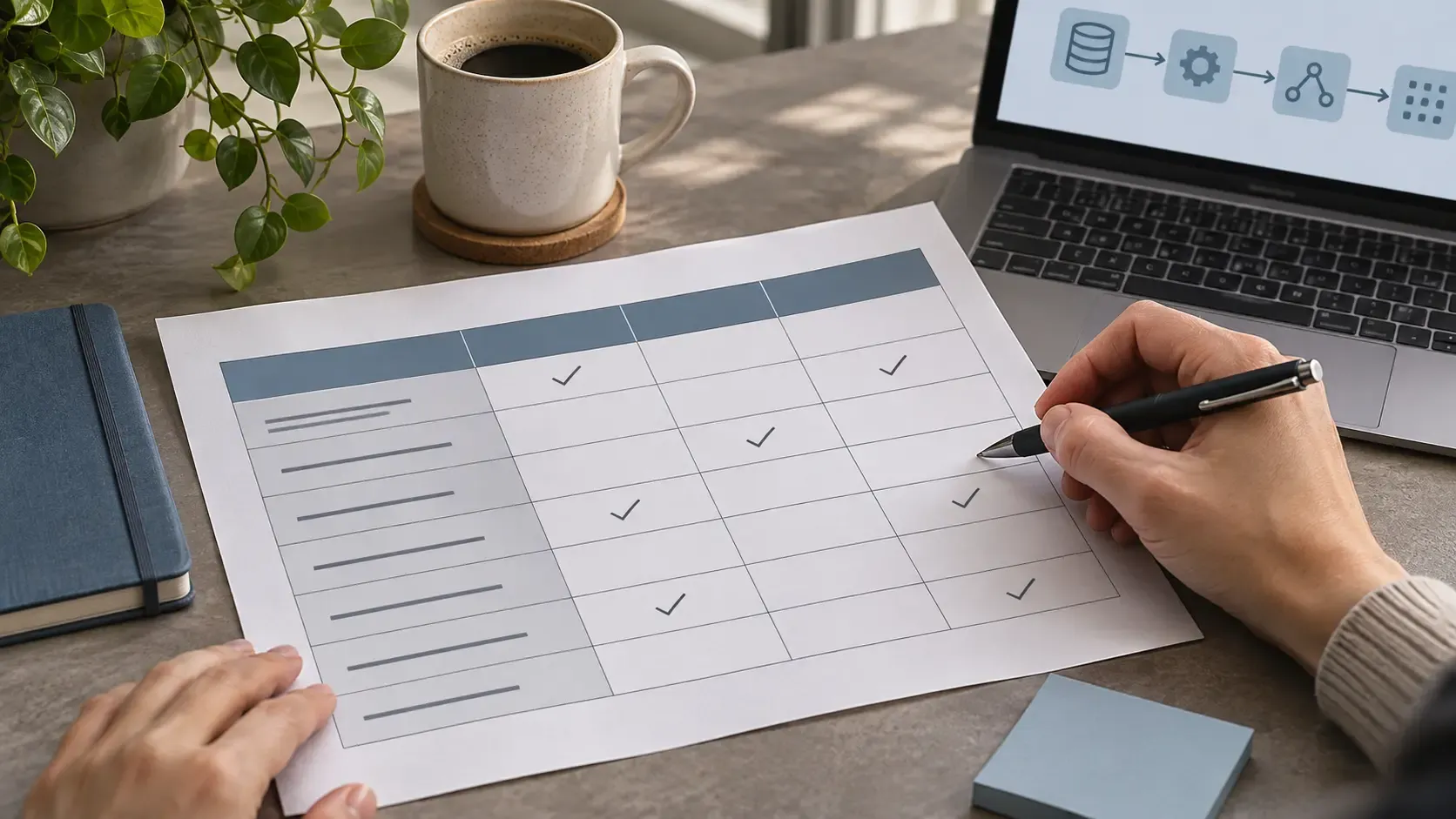
If you want to know how to choose an AI development company, start with twelve criteria in four groups: technical fit, delivery and governance, risk and trust, and commercials. The list below adapts the Capital Numbers framework for enterprise buyers. Score each vendor from 1 to 5 on every item to turn the list into a working scorecard.

Technical Fit

  1. Depth in AI technologies: The vendor needs proven skills in machine learning, deep learning, NLP, computer vision, and modern LLM stacks such as RAG, fine-tuning, and agents.
  2. Data readiness and integration: The vendor should audit, clean, and integrate your data, because AI runs on data first and models second.
  3. Customization and flexibility: Look for tailored models over templated solutions, with the ability to retrain and expand them over time.

Delivery and Governance

  1. Team composition: The team should include data scientists, ML engineers, software developers, and project managers, not just prompt engineers.
  2. Proof-of-concept capability: The vendor should build rapid prototypes with success metrics that both sides agree on before any scale-up.
  3. Agile delivery and communication: Expect short sprints, regular demos, and structured change management.
  4. Post-deployment MLOps: The vendor should monitor for model drift, run retraining pipelines, and commit to clear SLAs.

Risk and Trust

  1. Security and compliance: Check for SOC 2, GDPR, and HIPAA support, along with strong encryption and clear data-handling policies.
  2. Industry-specific experience: The team should know the regulations and workflows of your sector.
  3. Case studies with measurable outcomes: Ask for written references and past clients who will speak with you.
  4. Performance metrics and business alignment: The vendor should track technical measures like precision and recall alongside business KPIs.

Commercials

  1. Pricing and engagement models: Compare fixed-cost, dedicated team, and staff augmentation options, and insist on itemized quotes.

How to Evaluate Technical Depth, Security, and Compliance

The 12 criteria only help if you know which questions to ask. Use the set below in RFPs and vendor interviews.

On technical depth:

  • How many production AI systems have you shipped in the past 24 months?
  • Which LLMs, vector stores, and fine-tuning methods have you deployed in client environments?
  • Can you walk us through your MLOps stack, such as SageMaker, Azure ML, Vertex AI, or Databricks, and your approach to model-drift monitoring?

On team and delivery:

  • Who will work on the proposed team, by name and role, and what is the senior-to-junior ratio?
  • Do you subcontract any work, and if so, to whom?
  • What is your definition of done for an AI project, and how do you measure hallucination rates before production?

On compliance:

  • Which certifications do you hold, such as SOC 2 Type 2, ISO 27001, or HIPAA readiness?
  • How does your pipeline handle PHI, PII, and training data?
  • Will you sign a BAA for healthcare work or a DPA for GDPR?

On commercials:

  • Which engagement models do you support?
  • How do you price exploratory work compared with production work?

For enterprise projects, SOC 2 Type 2 now works as a minimum bar. Privacy-sensitive projects also require GDPR and CCPA support, and healthcare projects require HIPAA readiness with BAA capability. A strong vendor will also use AES-256 encryption for data in transit and at rest.

What Engagement Model Should Enterprises Choose?

Three engagement models dominate the enterprise AI market, and each one fits a different situation. The right pick depends on your internal leadership, your scope, and how much uncertainty the project carries.

Model

How It Works

Best For

Watch Out For

Dedicated team

The vendor leads a full embedded squad that aligns with your PM structure.

Multi-quarter AI programs and enterprise transformations that need senior leadership plus delivery in one package.

Higher monthly commitment; plan for ramp-up time.

Staff augmentation

Individual engineers join your existing team.

Companies with strong internal leadership whose main bottleneck is senior AI headcount.

Your team carries the delivery risk and the architecture decisions.

End-to-end project delivery

The vendor delivers a defined output against a scoped SOW at a fixed price.

Well-scoped MVPs, PoCs, and discrete production builds.

Open-ended AI R&D, which no vendor can honestly fix-price.


Many enterprises combine models over time. A common path starts with a fixed-scope PoC and then shifts to a dedicated team once the use case proves its value.

What Red Flags Should Enterprises Avoid During Vendor Selection?

The most expensive AI project is the one that failed because the team missed the warning signs at procurement. Watch for these red flags:

  • No defined success criteria before signing: 73% of failed AI projects had none, so agree on metrics before the contract.
  • No production AI case studies: A vendor that can demo but cannot operate at scale will stall after the pilot, so request project names, metrics, and references.
  • Prompt engineers without software or MLOps depth: These teams ship pilots that never reach production.
  • Hidden subcontracting and bench swapping: The senior engineer who sold the project should not disappear after kickoff.
  • Lock-in to a single foundation model: Mature partners choose among OpenAI, Anthropic, Gemini, LLaMA, Mistral, Qwen, and DeepSeek based on the use case, not reseller deals.
  • No MLOps or observability practice: Models drift within weeks, and nobody notices until users complain.
  • Fixed-price contracts for exploratory work: Research carries real uncertainty, and a fixed price either hides risk or cuts corners.
  • Missing compliance posture: The absence of SOC 2, HIPAA readiness, or DPA capability rules a vendor out in regulated industries.

Conclusion

Selecting an AI development partner requires more than comparing services, pricing, and technical capabilities. Enterprises should evaluate production experience, data integration expertise, security standards, delivery processes, and long-term support to ensure the partnership aligns with their business goals.

A structured evaluation process helps reduce implementation risks and identify vendors capable of delivering reliable AI systems beyond the proof-of-concept stage. Before committing, businesses should define measurable success criteria, review relevant case studies, verify compliance requirements, and choose an engagement model that supports their project's scope and complexity.

Share to:

Frequently Asked Questions

Find answers to common questions about our services

1.How much does an enterprise AI development partner cost?

Focused production builds often cost $150K to $500K, while enterprise-wide programs can reach several million dollars. Nearshore and dedicated-team models often cost 30% to 50% less than U.S. onshore rates and still keep time-zone alignment.

2.Which certifications should an enterprise AI partner hold?

SOC 2 Type 2 is the baseline, and GDPR and CCPA support matter for privacy-sensitive work. Healthcare projects need HIPAA readiness and BAA capability, and ISO/IEC 42001 is an emerging sign of AI governance maturity.

3.How long does it take to move from AI proof of concept to production?

Industry data puts the average at 18 to 24 months. Partners with mature MLOps pipelines and pre-built accelerators can often shorten this timeline.

Choosing the right AI development partner can determine whether an enterprise AI project delivers measurable business value or remains stuck in the pilot stage. Beyond technical expertise, companies need a partner that understands their data, existing systems, security requirements, and long-term business objectives.

However, evaluating AI development companies is not always straightforward. Many providers offer similar services, from custom AI applications and LLM development to AI agents, RAG, and MLOps. The real differences often lie in production experience, implementation capabilities, compliance readiness, and the ability to deliver measurable results.

This guide explains how to choose an AI development partner for enterprise projects, covering 12 evaluation criteria, technical and security requirements, engagement models, common red flags, and practical questions to ask before making a decision.

What Is an AI Development Partner for Enterprise Projects?

An AI development partner is a specialized engineering firm that designs, builds, and runs production-grade AI systems for enterprise clients. It is not a staffing agency, a tool reseller, or a prompt-engineering consultancy.

The scope usually covers custom AI applications, LLM fine-tuning, retrieval-augmented generation (RAG), autonomous AI agents, computer vision, natural language processing (NLP), and MLOps. MLOps refers to the practices and tools that deploy, monitor, and retrain models after they go live.

Two traits set these firms apart from other options:

  • Compared with a traditional dev shop: An AI partner owns the full lifecycle, from data readiness and model selection through evaluation, deployment, and monitoring.
  • Compared with an internal team: An external partner brings experience across industries, senior AI engineers who are hard to hire, and ready-made infrastructure such as evaluation frameworks that most internal teams lack on day one.

Demand for enterprise AI services keeps climbing. Gartner forecasts the AI services segment at $585.5 billion in 2026, up from $436.4 billion in 2025. A bigger market gives buyers more choice, but it also produces more vendors that look the same on paper.

How Does Azumo Fit the Enterprise AI Partner Criteria?

Azumo is one of several enterprise AI firms whose public disclosures are useful to review against the framework above. The figures below come from the company's own materials, so treat them as a starting point and verify them through references, audit reports, and a scoped PoC, just as you would with any enterprise AI partner.

  • Track record: Azumo launched in 2016 in San Francisco and reports 100+ customers, 300+ production deployments, and an average client engagement of more than 3.2 years.
  • Technical depth (criterion 1): The company lists 100+ production AI systems that span AI agents built with LangGraph, CrewAI, and Microsoft AutoGen, along with RAG, NLP, computer vision, LLM evaluation, MLOps, and fine-tuning methods such as SFT, RLHF, DPO, LoRA, and QLoRA.
  • Proof of concept (criterion 5): For an AI talent intelligence company, Azumo built an LLM proof of concept that classifies psychometric answers into 50 behavioral dimensions, using LoRA and QLoRA for fine-tuning.
  • Security and compliance (criterion 8): Azumo states that it holds SOC 2 certification with annual audits, supports GDPR and CCPA, offers HIPAA readiness with BAAs, and uses AES-256 encryption. Its security page provides more detail.
  • Vendor neutrality: The firm deploys across OpenAI, Anthropic Claude, Google Gemini, LLaMA, Mistral, Qwen, DeepSeek, Cohere, Grok, Amazon Nova, and Azure OpenAI.
  • Measurable case studies (criterion 10): For Angle Health, an LLM-powered RFP-to-quote system cut cycle time from 45 minutes to 5 minutes, a 90% reduction. For Centegix, Azumo used YOLO-based computer vision and OCR to extract driver's license data in real time, and for Meta it built a Named Entity Recognition system for supplier data. Its case study library also covers Stovell AI and Omnicom.
  • Social proof: Azumo reports a 4.9 verified rating across Clutch and DesignRush, 150% net retention, and a "Hot Vendor for AI" designation from Aragon Research.
  • Engagement models (criterion 12): The company offers dedicated teams, staff augmentation, and end-to-end delivery.

Why Does the Choice of AI Development Partner Matter in 2026?

The data on enterprise AI outcomes is sobering. Several research groups reached the same conclusion in 2025 and 2026: most AI projects fail to deliver what the business expected.

  • Gartner: A survey of 782 infrastructure and operations leaders, which Gartner ran in November and December 2025, found that only 28% of AI infrastructure projects fully succeed, while 20% fail outright.
  • MIT: Research from August 2025 found that 95% of generative AI pilots failed to deliver meaningful results.
  • RAND: In 2026, RAND reported that 33.8% of AI projects never reached production, and only 37.8% met their objectives.
  • McKinsey: According to McKinsey's State of AI 2026, 88% of organizations use AI, but only 37% can attribute any EBIT impact to it.

The root causes point straight at partner selection. In the Gartner survey, 38% of leaders cite skill gaps and another 38% cite poor data quality. The same analysis shows that 73% of failed projects had no agreed definition of success before kickoff.

Bottom line: Your choice of AI development partner is the biggest lever you control against these odds.

What Are the Key Criteria for Choosing an AI Development Partner?

If you want to know how to choose an AI development company, start with twelve criteria in four groups: technical fit, delivery and governance, risk and trust, and commercials. The list below adapts the Capital Numbers framework for enterprise buyers. Score each vendor from 1 to 5 on every item to turn the list into a working scorecard.

Technical Fit

  1. Depth in AI technologies: The vendor needs proven skills in machine learning, deep learning, NLP, computer vision, and modern LLM stacks such as RAG, fine-tuning, and agents.
  2. Data readiness and integration: The vendor should audit, clean, and integrate your data, because AI runs on data first and models second.
  3. Customization and flexibility: Look for tailored models over templated solutions, with the ability to retrain and expand them over time.

Delivery and Governance

  1. Team composition: The team should include data scientists, ML engineers, software developers, and project managers, not just prompt engineers.
  2. Proof-of-concept capability: The vendor should build rapid prototypes with success metrics that both sides agree on before any scale-up.
  3. Agile delivery and communication: Expect short sprints, regular demos, and structured change management.
  4. Post-deployment MLOps: The vendor should monitor for model drift, run retraining pipelines, and commit to clear SLAs.

Risk and Trust

  1. Security and compliance: Check for SOC 2, GDPR, and HIPAA support, along with strong encryption and clear data-handling policies.
  2. Industry-specific experience: The team should know the regulations and workflows of your sector.
  3. Case studies with measurable outcomes: Ask for written references and past clients who will speak with you.
  4. Performance metrics and business alignment: The vendor should track technical measures like precision and recall alongside business KPIs.

Commercials

  1. Pricing and engagement models: Compare fixed-cost, dedicated team, and staff augmentation options, and insist on itemized quotes.

How to Evaluate Technical Depth, Security, and Compliance

The 12 criteria only help if you know which questions to ask. Use the set below in RFPs and vendor interviews.

On technical depth:

  • How many production AI systems have you shipped in the past 24 months?
  • Which LLMs, vector stores, and fine-tuning methods have you deployed in client environments?
  • Can you walk us through your MLOps stack, such as SageMaker, Azure ML, Vertex AI, or Databricks, and your approach to model-drift monitoring?

On team and delivery:

  • Who will work on the proposed team, by name and role, and what is the senior-to-junior ratio?
  • Do you subcontract any work, and if so, to whom?
  • What is your definition of done for an AI project, and how do you measure hallucination rates before production?

On compliance:

  • Which certifications do you hold, such as SOC 2 Type 2, ISO 27001, or HIPAA readiness?
  • How does your pipeline handle PHI, PII, and training data?
  • Will you sign a BAA for healthcare work or a DPA for GDPR?

On commercials:

  • Which engagement models do you support?
  • How do you price exploratory work compared with production work?

For enterprise projects, SOC 2 Type 2 now works as a minimum bar. Privacy-sensitive projects also require GDPR and CCPA support, and healthcare projects require HIPAA readiness with BAA capability. A strong vendor will also use AES-256 encryption for data in transit and at rest.

What Engagement Model Should Enterprises Choose?

Three engagement models dominate the enterprise AI market, and each one fits a different situation. The right pick depends on your internal leadership, your scope, and how much uncertainty the project carries.

Model

How It Works

Best For

Watch Out For

Dedicated team

The vendor leads a full embedded squad that aligns with your PM structure.

Multi-quarter AI programs and enterprise transformations that need senior leadership plus delivery in one package.

Higher monthly commitment; plan for ramp-up time.

Staff augmentation

Individual engineers join your existing team.

Companies with strong internal leadership whose main bottleneck is senior AI headcount.

Your team carries the delivery risk and the architecture decisions.

End-to-end project delivery

The vendor delivers a defined output against a scoped SOW at a fixed price.

Well-scoped MVPs, PoCs, and discrete production builds.

Open-ended AI R&D, which no vendor can honestly fix-price.


Many enterprises combine models over time. A common path starts with a fixed-scope PoC and then shifts to a dedicated team once the use case proves its value.

What Red Flags Should Enterprises Avoid During Vendor Selection?

The most expensive AI project is the one that failed because the team missed the warning signs at procurement. Watch for these red flags:

  • No defined success criteria before signing: 73% of failed AI projects had none, so agree on metrics before the contract.
  • No production AI case studies: A vendor that can demo but cannot operate at scale will stall after the pilot, so request project names, metrics, and references.
  • Prompt engineers without software or MLOps depth: These teams ship pilots that never reach production.
  • Hidden subcontracting and bench swapping: The senior engineer who sold the project should not disappear after kickoff.
  • Lock-in to a single foundation model: Mature partners choose among OpenAI, Anthropic, Gemini, LLaMA, Mistral, Qwen, and DeepSeek based on the use case, not reseller deals.
  • No MLOps or observability practice: Models drift within weeks, and nobody notices until users complain.
  • Fixed-price contracts for exploratory work: Research carries real uncertainty, and a fixed price either hides risk or cuts corners.
  • Missing compliance posture: The absence of SOC 2, HIPAA readiness, or DPA capability rules a vendor out in regulated industries.

Conclusion

Selecting an AI development partner requires more than comparing services, pricing, and technical capabilities. Enterprises should evaluate production experience, data integration expertise, security standards, delivery processes, and long-term support to ensure the partnership aligns with their business goals.

A structured evaluation process helps reduce implementation risks and identify vendors capable of delivering reliable AI systems beyond the proof-of-concept stage. Before committing, businesses should define measurable success criteria, review relevant case studies, verify compliance requirements, and choose an engagement model that supports their project's scope and complexity.

Let’s Discuss Your Needs

Share your details with us. We’ll take it from there.

Get in Touch Now

Share to:

Related Articles

Let’s Discuss Your Needs

Tell us about your project. we'll take it from there

Phone
Choose Your Tech Stack

Click to upload or drag and drop

Top Web Development Companies in Mississauga
Software Development Company - Design Rush
Top Software Development Companies in Toronto, ON
Best Software Development Companies In 2021
Fatest growing app development companies
Top 100+ Software Development Companies in 2021
Finest Mobile App Developers in Canada - March 2021
Top eCommerce Development Companies in the USA
Top Web Development Companies