How Companies Vet Remote Developers Before Hiring (And What Most Skip)
A good remote developer is hard to judge from a resume. There are certain key aspects that you need to look out for to guarantee you get the best hire. This guide shows how forward-thinking companies vet remote developers before hiring, which checks actually matter, and the hidden gaps most teams completely miss.

“Furqan Aziz is CEO & Founder of InvoZone. He is a tech enthusiast by heart with 10+ years ...” See more
Don’t Have Time To Read Now? Download It For Later.
Table of Contents
- Why Most Vetting Processes Miss the Mark
- The 6-Stage Vetting Framework
- Stage One: Resume and Portfolio Review, But Not the Way Most Teams Do It
- Stage Two: The Async Written Assessment
- Stage Three: The Technical Interview Done Properly
- Stage Four: The Communication & Remote-Readiness Assessment
- Stage Five: Reference Checks (The Right Way)
- Stage Six: The Trial Project or Paid Test Period
- What the Best Vetting Processes Have in Common
- The Core Step Everyone Skips But Nobody Admits
- How InvoZone Eliminates the Vetting Overhead
- A Final Thought
You have probably been there.
During the interview call, the candidate matches your energy perfectly, walks through their engineering credentials flawlessly and answers every question with accuracy.
Once hired, you realize everything they claimed on their CV was exaggerated. Their actual output and problem-solving skills do not come anywhere close to what they showed during the interview.
The truth is, many developers have learned how to interview well for remote roles, but they do not know how to work in them.
Here is what a real, high-signal vetting process looks like in 2026 and the specific steps most teams skip.
Why Most Vetting Processes Miss the Mark
Let us be honest about something first. Most companies vet remote developers the same way they vet in-office ones. CV review, a technical test, one or two calls and then an offer.
That process probably works for in-office hires. For remote developers, it is genuinely not enough.
A remote developer is working without the organic visibility that comes from being in a room together. There are certain aspects that are too important to be overlooked:
- Communication discipline: Making their daily work and roadblocks visible without ever being asked.
- Self-direction: Knowing exactly what to prioritize and how to make progress without any micromanagement.
- Reliability: Showing up consistently across large time-zone gaps and complex asynchronous workflows.
The 6-Stage Vetting Framework
High-performing distributed teams treat engineering recruitment with the same rigor they apply to core product architecture. If you plan to build a sustainable pipeline independently or intend to hire dedicated remote developers, you must look past simple binary code evaluations.
Here is the step-by-step framework that separates top global engineers from the rest.

Stage One: Resume and Portfolio Review, But Not the Way Most Teams Do It
The first filter is always the CV. However, analyzing a resume for a remote developer requires a completely different perspective than evaluating someone for a local office.
What to actually look for:
- Does their stated experience match your stack specifically, or just generally?
- Do they have GitHub activity and are the repos real projects or tutorials?
- Have they worked with Western companies or remote-first teams before?
- Are there employment gaps? Ask about them directly.
That last point about remote-first experience matters more than most hiring managers realize. A developer who has never worked asynchronously with a distributed team is not a bad developer. But they will need more onboarding time, more process support, and more patience in the first month than someone who has done it before.
What most teams skip at this stage:
Treating a GitHub profile as a simple binary check (either they have one or they do not). The real test is checking whether their commit history reflects someone who builds things independently, or someone who pushed tutorial code three years ago and called it a portfolio.
Note: Sourcing through a top staff augmentation partner removes this initial work. Great candidate portfolios are pre-audited before you view them.
Stage Two: The Async Written Assessment
This is the step most companies skip entirely, and it is one of the highest-signal things you can do.
Send two to three questions and evaluate written communication quality as much as the answers themselves:
- A technical scenario: "We are facing an unexpected bottleneck with our database queries during peak traffic. Walk us through your diagnostic checklist."
- A past project reflection: "Tell us about a complex technical decision you made on a past project that you are genuinely proud of."
- A remote-specific challenge: "How do you structure your day and manage handoffs when your core team is located 6 to 8 time zones away?"
Think about that for a second. In a remote team, 90% of daily collaboration happens in writing i.e. Slack messages, pull request comments, technical documentation, and async updates. If your candidate cannot explain their thinking clearly in writing at the assessment stage, that should be alarming.
This is also a good early read on:
- Response time and professionalism
- Attention to detail in how they follow instructions
- Whether their answers are specific to your company or generic enough to send anywhere
Stage Three: The Technical Interview Done Properly
Here is where most companies waste the most time. LeetCode puzzles and timed algorithm tests are not the best predictors of real engineering performance.
The most effective technical assessment combines three things:
- A live architecture discussion: Give them a real scenario from your product. You are looking for how they think, not a textbook answer. Do they ask clarifying questions? Do they surface trade-offs? Senior engineers separate themselves here.
- A code review exercise: Show them a real, anonymized pull request and ask for feedback. This reveals whether they can read existing code, not just write new code. It also shows communication style.
- A debugging scenario: Give them a real bug from your codebase, sanitized as needed. Senior developers ask clarifying questions before writing a single line. They reason out loud. They surface assumptions. That behavior in an interview predicts a huge amount about how someone will operate when they are twelve time zones away and your product manager is offline
What most teams skip at this stage: The debugging scenario and the code review. Both are more revealing than anything that comes from a timed algorithm test and neither requires the developer to have prepared specifically for your interview to do well.
Stage Four: The Communication & Remote-Readiness Assessment
This is the step that most articles mention and most hiring processes ignore.
Ask specific questions about how they actually work remotely - not "are you comfortable with remote work" because everyone says yes to that:
- Walk me through how you handle a blocker when the person you need is offline.
- How do you communicate progress on a task that is taking longer than expected?
- What does your documentation habit look like when you join a new codebase?
- How do you handle unclear requirements when you cannot get an immediate answer?
What the answers tell you:
- Whether they have actually worked this way before
- Whether they default to transparency or silence when things get difficult
- Whether their async communication style will work inside your team's process
English proficiency is also real. Not perfect grammar but real-world ability to communicate clearly in writing and verbally. B2 level or above is a reasonable baseline for most product teams. If your remote developer hiring process skips this entirely, the first month of onboarding will surface at the worst possible time.
Stage Five: Reference Checks (The Right Way)
Most reference checks are a waste of time because most people ask the wrong questions to the wrong people.
Ask these instead of generic ones:
- Would you hire them again specifically for a remote role?
- How did they handle unclear requirements when they could not get immediate guidance?
- What was their communication like when something went wrong on a project?
- How visible was their work progress without being asked for updates?
A few rules that make reference checks actually useful:
- Talk to former managers, not peers. Managers know what the candidate struggled with. Peers only tell you what they are good at.
- Prioritize references from remote or distributed roles over in-office ones. These two working styles are genuinely different.
- Skip numerical ratings entirely. Ask for specific stories. Those are the ones that tell you something real.
What most teams skip at this stage: Asking specifically about remote work performance. A glowing reference from an in-office job is not the same as a glowing reference from someone who managed them asynchronously across time zones.
Stage Six: The Trial Project or Paid Test Period
Trial periods of one to two weeks allow both sides to evaluate fit before full commitment. Score them across:
- Technical implementation quality
- How they ask questions when stuck
- Communication clarity and update frequency
- Feedback responsiveness
- Whether they hit the agreed deadline or flagged problems early
If a developer pushes back hard against any form of reasonable trial, that is worth noting. Senior developers understand why vetting exists. Resistance to a 60 to 90 minute assessment is a yellow flag. The same logic applies to a short, well-compensated trial project.
A short trial project is vital when hiring for complex environments like enterprise software development where the cost of a wrong hire is high.
What the Best Vetting Processes Have in Common
Whether you are building your own process or working with a pre-vetted staffing partner, the high-performing vetting processes in 2026 share the same characteristics:
- They test judgment, not memorization. Real codebases, real scenarios, real architectural decisions.
- They treat communication as a first-class skill. Written communication quality gets evaluated from the first touchpoint.
- They involve the people who will actually work with the hire. Not the CTO or the VP. They involve the senior engineer on the team.
- They move fast after the decision is made. Remote candidates are usually in three pipelines at once. The slowest one always loses.
The Core Step Everyone Skips But Nobody Admits
Here is the honest version of what most companies actually skip: testing for autonomy under ambiguity.
Can this developer take a loosely defined ticket, ask the right clarifying questions, make a reasonable decision when they cannot get an answer immediately, and communicate what they did and why? That is what remote engineering actually looks like day to day. Most technical assessments do not test for it at all.
The way to test for it is simple:
- Give them a problem that is intentionally underspecified
- Watch whether they ask smart clarifying questions or just start solving
- See if they surface the assumptions they are making
- Check whether they propose a path forward rather than waiting for clarity that may never come
An engineer who handles ambiguity well during an interview exercise is highly likely to operate successfully when they are twelve time zones away.
Pro-Tip: Vetting for ambiguity is just one piece of the puzzle. To run a flawless recruitment pipeline from scratch without making expensive mistakes, one should have the complete guide when hiring remote devs before spending thousands on salaries.
How InvoZone Eliminates the Vetting Overhead
Building and maintaining a multi-stage vetting pipeline across global borders requires massive internal hours. Your technical leaders can easily spend weeks filtering profiles just to find one engineer with the right blend of skills, timezone alignment, and communication habits.
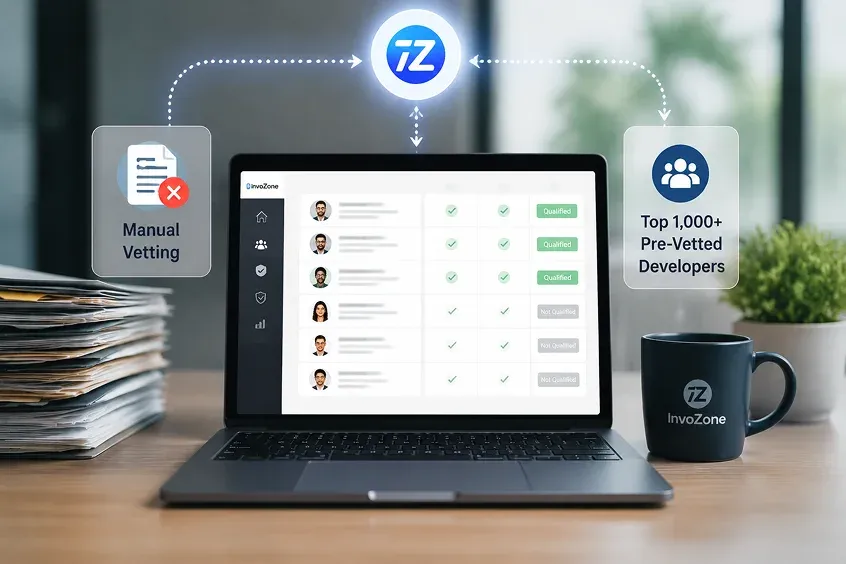
InvoZone compresses this entire workflow down to a 24-to-48-hour pipeline.
Instead of filtering through hundreds of unvetted resumes or running manual checks, you can leverage InvoZone's pre-vetted global network. Every engineer undergoes rigorous technical screening, live architecture challenges, remote-readiness assessments, and communication audits before they meet your team.
Whether your architecture requires you to hire dedicated Java developers for enterprise stability, or secure high-end algorithmic depth to hire backend developers, the pipeline matches engineers directly to your daily management style.
A Final Thought
The developers who perform best in remote roles are not always the ones who are interviewed best. They are the ones who communicate proactively, document their thinking, handle ambiguity without freezing, and make their work visible without being asked.
A good vetting process screens for all of those things - not just the code. The companies that have figured this out are not spending less time on hiring. They are spending it differently, on the signals that actually predict success instead of the ones that are easiest to measure.
The rest are rehiring for the same role six months later and wondering what went wrong.
If you want to skip the vetting overhead entirely, InvoZone pre-screens every engineer across technical ability, communication quality, and remote work readiness before you see a single profile. Most clients meet their first matched developer within 24 hours.
Share to:
Frequently Asked Questions
Find answers to common questions about our services
1.How can you tell if a remote developer is senior or just good at interviewing?
Look closely at how they handle technical questions. Senior developers focus heavily on context, system trade-offs, and business constraints rather than just syntax. During architecture and debugging reviews, they will ask detailed clarifying questions about data volume and historical constraints before writing code. If a candidate instantly jumps to an idealized textbook solution without analyzing constraints, they likely lack deep production experience.
2.What is the average timeframe to source and onboard a vetted remote engineer?
When running an in-house pipeline, the standard timeline to source, interview, vet, and onboard a senior developer averages 45 to 63 days. However, working with a specialized talent partner shortens this lifecycle dramatically. With pre-vetted pools, companies typically interview matched candidates within 24 to 48 hours, with contract execution and repository access finalized within the same business week.
3.How do you prevent remote developers from working multiple jobs simultaneously?
"Moonlighting" is driven by weak vetting and a lack of delivery visibility. You can minimize this risk through three specific measures: avoid hiring low-rate freelancers from general bidding marketplaces, build a vetting process that filters heavily for personal accountability, and structure clear output metrics with short sprint deliverables. When an engineer is deeply embedded within your team's daily communication loops, dual-employment becomes impossible to sustain without a drop in performance.
4.How much does a fully vetted remote developer cost compared to local hiring?
Global developer rates vary based on region and tech stack, but they consistently offer significant cost efficiencies over local tech hubs. On average, highly vetted senior remote engineers across Latin America, Eastern Europe, and top Asian tech hubs cost 50% to 70% less than an equivalent in-house engineer in major US or Western European cities. You should have a detailed breakdown of hourly rates and regional salaries with comprehensive pricing analysis.
5.Should you hire freelance remote developers or use dedicated remote teams?
It depends entirely on your project goals. Freelancers are good for short-term, basic tasks or simple prototypes where your internal team can manage all the daily tasks. However, freelancers can be hard to track and might drop your project for a better offer. Dedicated remote teams or agency developers are better because they are pre-vetted, sign strict non-disclosure agreements, and come with built-in backup support. This makes them much more reliable for long-term product development.
6.How do you handle a massive timezone difference with remote developers?
You do not need a perfect 8-hour match, but you should look for at least 2 to 4 hours of daily work overlap. Use this shared time for live syncs, quick blockers, and sprint planning. For the rest of the day, rely on strict asynchronous habits. This means developers must write detailed notes in Jira tickets and pull requests so the team can move forward without waiting for a live meeting.
7.Why are automated coding tests bad for vetting senior developers?
Automated tests focus on textbook algorithms and memory tricks that developers rarely use in everyday work. These tests cannot check architectural judgment, clean code structure, or how an engineer solves real bugs. Even worse, many candidates practice for these exact tests, meaning they pass the exam but freeze completely when face-to-face with an unclear, live codebase.
8.Do remote development agencies protect your project's intellectual property (IP)?
Yes, reputable software partners protect your code. Before sharing any details about your codebase, make sure the agency signs a comprehensive Non-Disclosure Agreement (NDA) and an IP Transfer Agreement. This legally ensures that all code, system architecture, and product designs created by the remote developer belong 100% to your company from day one.
For example, enterprise-grade partners like InvoZone enforce strict legal guardrails, ensuring that all code, system architecture, and product designs created by the remote developer belong 100% to your company from day one.
Table of Contents
- Why Most Vetting Processes Miss the Mark
- The 6-Stage Vetting Framework
- Stage One: Resume and Portfolio Review, But Not the Way Most Teams Do It
- Stage Two: The Async Written Assessment
- Stage Three: The Technical Interview Done Properly
- Stage Four: The Communication & Remote-Readiness Assessment
- Stage Five: Reference Checks (The Right Way)
- Stage Six: The Trial Project or Paid Test Period
- What the Best Vetting Processes Have in Common
- The Core Step Everyone Skips But Nobody Admits
- How InvoZone Eliminates the Vetting Overhead
- A Final Thought
You have probably been there.
During the interview call, the candidate matches your energy perfectly, walks through their engineering credentials flawlessly and answers every question with accuracy.
Once hired, you realize everything they claimed on their CV was exaggerated. Their actual output and problem-solving skills do not come anywhere close to what they showed during the interview.
The truth is, many developers have learned how to interview well for remote roles, but they do not know how to work in them.
Here is what a real, high-signal vetting process looks like in 2026 and the specific steps most teams skip.
Why Most Vetting Processes Miss the Mark
Let us be honest about something first. Most companies vet remote developers the same way they vet in-office ones. CV review, a technical test, one or two calls and then an offer.
That process probably works for in-office hires. For remote developers, it is genuinely not enough.
A remote developer is working without the organic visibility that comes from being in a room together. There are certain aspects that are too important to be overlooked:
- Communication discipline: Making their daily work and roadblocks visible without ever being asked.
- Self-direction: Knowing exactly what to prioritize and how to make progress without any micromanagement.
- Reliability: Showing up consistently across large time-zone gaps and complex asynchronous workflows.
The 6-Stage Vetting Framework
High-performing distributed teams treat engineering recruitment with the same rigor they apply to core product architecture. If you plan to build a sustainable pipeline independently or intend to hire dedicated remote developers, you must look past simple binary code evaluations.
Here is the step-by-step framework that separates top global engineers from the rest.

Stage One: Resume and Portfolio Review, But Not the Way Most Teams Do It
The first filter is always the CV. However, analyzing a resume for a remote developer requires a completely different perspective than evaluating someone for a local office.
What to actually look for:
- Does their stated experience match your stack specifically, or just generally?
- Do they have GitHub activity and are the repos real projects or tutorials?
- Have they worked with Western companies or remote-first teams before?
- Are there employment gaps? Ask about them directly.
That last point about remote-first experience matters more than most hiring managers realize. A developer who has never worked asynchronously with a distributed team is not a bad developer. But they will need more onboarding time, more process support, and more patience in the first month than someone who has done it before.
What most teams skip at this stage:
Treating a GitHub profile as a simple binary check (either they have one or they do not). The real test is checking whether their commit history reflects someone who builds things independently, or someone who pushed tutorial code three years ago and called it a portfolio.
Note: Sourcing through a top staff augmentation partner removes this initial work. Great candidate portfolios are pre-audited before you view them.
Stage Two: The Async Written Assessment
This is the step most companies skip entirely, and it is one of the highest-signal things you can do.
Send two to three questions and evaluate written communication quality as much as the answers themselves:
- A technical scenario: "We are facing an unexpected bottleneck with our database queries during peak traffic. Walk us through your diagnostic checklist."
- A past project reflection: "Tell us about a complex technical decision you made on a past project that you are genuinely proud of."
- A remote-specific challenge: "How do you structure your day and manage handoffs when your core team is located 6 to 8 time zones away?"
Think about that for a second. In a remote team, 90% of daily collaboration happens in writing i.e. Slack messages, pull request comments, technical documentation, and async updates. If your candidate cannot explain their thinking clearly in writing at the assessment stage, that should be alarming.
This is also a good early read on:
- Response time and professionalism
- Attention to detail in how they follow instructions
- Whether their answers are specific to your company or generic enough to send anywhere
Stage Three: The Technical Interview Done Properly
Here is where most companies waste the most time. LeetCode puzzles and timed algorithm tests are not the best predictors of real engineering performance.
The most effective technical assessment combines three things:
- A live architecture discussion: Give them a real scenario from your product. You are looking for how they think, not a textbook answer. Do they ask clarifying questions? Do they surface trade-offs? Senior engineers separate themselves here.
- A code review exercise: Show them a real, anonymized pull request and ask for feedback. This reveals whether they can read existing code, not just write new code. It also shows communication style.
- A debugging scenario: Give them a real bug from your codebase, sanitized as needed. Senior developers ask clarifying questions before writing a single line. They reason out loud. They surface assumptions. That behavior in an interview predicts a huge amount about how someone will operate when they are twelve time zones away and your product manager is offline
What most teams skip at this stage: The debugging scenario and the code review. Both are more revealing than anything that comes from a timed algorithm test and neither requires the developer to have prepared specifically for your interview to do well.
Stage Four: The Communication & Remote-Readiness Assessment
This is the step that most articles mention and most hiring processes ignore.
Ask specific questions about how they actually work remotely - not "are you comfortable with remote work" because everyone says yes to that:
- Walk me through how you handle a blocker when the person you need is offline.
- How do you communicate progress on a task that is taking longer than expected?
- What does your documentation habit look like when you join a new codebase?
- How do you handle unclear requirements when you cannot get an immediate answer?
What the answers tell you:
- Whether they have actually worked this way before
- Whether they default to transparency or silence when things get difficult
- Whether their async communication style will work inside your team's process
English proficiency is also real. Not perfect grammar but real-world ability to communicate clearly in writing and verbally. B2 level or above is a reasonable baseline for most product teams. If your remote developer hiring process skips this entirely, the first month of onboarding will surface at the worst possible time.
Stage Five: Reference Checks (The Right Way)
Most reference checks are a waste of time because most people ask the wrong questions to the wrong people.
Ask these instead of generic ones:
- Would you hire them again specifically for a remote role?
- How did they handle unclear requirements when they could not get immediate guidance?
- What was their communication like when something went wrong on a project?
- How visible was their work progress without being asked for updates?
A few rules that make reference checks actually useful:
- Talk to former managers, not peers. Managers know what the candidate struggled with. Peers only tell you what they are good at.
- Prioritize references from remote or distributed roles over in-office ones. These two working styles are genuinely different.
- Skip numerical ratings entirely. Ask for specific stories. Those are the ones that tell you something real.
What most teams skip at this stage: Asking specifically about remote work performance. A glowing reference from an in-office job is not the same as a glowing reference from someone who managed them asynchronously across time zones.
Stage Six: The Trial Project or Paid Test Period
Trial periods of one to two weeks allow both sides to evaluate fit before full commitment. Score them across:
- Technical implementation quality
- How they ask questions when stuck
- Communication clarity and update frequency
- Feedback responsiveness
- Whether they hit the agreed deadline or flagged problems early
If a developer pushes back hard against any form of reasonable trial, that is worth noting. Senior developers understand why vetting exists. Resistance to a 60 to 90 minute assessment is a yellow flag. The same logic applies to a short, well-compensated trial project.
A short trial project is vital when hiring for complex environments like enterprise software development where the cost of a wrong hire is high.
What the Best Vetting Processes Have in Common
Whether you are building your own process or working with a pre-vetted staffing partner, the high-performing vetting processes in 2026 share the same characteristics:
- They test judgment, not memorization. Real codebases, real scenarios, real architectural decisions.
- They treat communication as a first-class skill. Written communication quality gets evaluated from the first touchpoint.
- They involve the people who will actually work with the hire. Not the CTO or the VP. They involve the senior engineer on the team.
- They move fast after the decision is made. Remote candidates are usually in three pipelines at once. The slowest one always loses.
The Core Step Everyone Skips But Nobody Admits
Here is the honest version of what most companies actually skip: testing for autonomy under ambiguity.
Can this developer take a loosely defined ticket, ask the right clarifying questions, make a reasonable decision when they cannot get an answer immediately, and communicate what they did and why? That is what remote engineering actually looks like day to day. Most technical assessments do not test for it at all.
The way to test for it is simple:
- Give them a problem that is intentionally underspecified
- Watch whether they ask smart clarifying questions or just start solving
- See if they surface the assumptions they are making
- Check whether they propose a path forward rather than waiting for clarity that may never come
An engineer who handles ambiguity well during an interview exercise is highly likely to operate successfully when they are twelve time zones away.
Pro-Tip: Vetting for ambiguity is just one piece of the puzzle. To run a flawless recruitment pipeline from scratch without making expensive mistakes, one should have the complete guide when hiring remote devs before spending thousands on salaries.
How InvoZone Eliminates the Vetting Overhead
Building and maintaining a multi-stage vetting pipeline across global borders requires massive internal hours. Your technical leaders can easily spend weeks filtering profiles just to find one engineer with the right blend of skills, timezone alignment, and communication habits.
InvoZone compresses this entire workflow down to a 24-to-48-hour pipeline.
Instead of filtering through hundreds of unvetted resumes or running manual checks, you can leverage InvoZone's pre-vetted global network. Every engineer undergoes rigorous technical screening, live architecture challenges, remote-readiness assessments, and communication audits before they meet your team.
Whether your architecture requires you to hire dedicated Java developers for enterprise stability, or secure high-end algorithmic depth to hire backend developers, the pipeline matches engineers directly to your daily management style.

A Final Thought
The developers who perform best in remote roles are not always the ones who are interviewed best. They are the ones who communicate proactively, document their thinking, handle ambiguity without freezing, and make their work visible without being asked.
A good vetting process screens for all of those things - not just the code. The companies that have figured this out are not spending less time on hiring. They are spending it differently, on the signals that actually predict success instead of the ones that are easiest to measure.
The rest are rehiring for the same role six months later and wondering what went wrong.
If you want to skip the vetting overhead entirely, InvoZone pre-screens every engineer across technical ability, communication quality, and remote work readiness before you see a single profile. Most clients meet their first matched developer within 24 hours.
Share to:
Related Articles
Let’s Discuss Your Needs
Tell us about your project. we'll take it from there
