For staff
Too much time lost to repetitive administrative work. Clinics were manually identifying non-compliant patients, enrolling them in RPM programs, and managing resupply workflows, all without automation to speed things up.
An AI-driven automation engine that detects at-risk patients early, triggers RPM enrollment automatically, and handles resupply workflows without manual intervention.
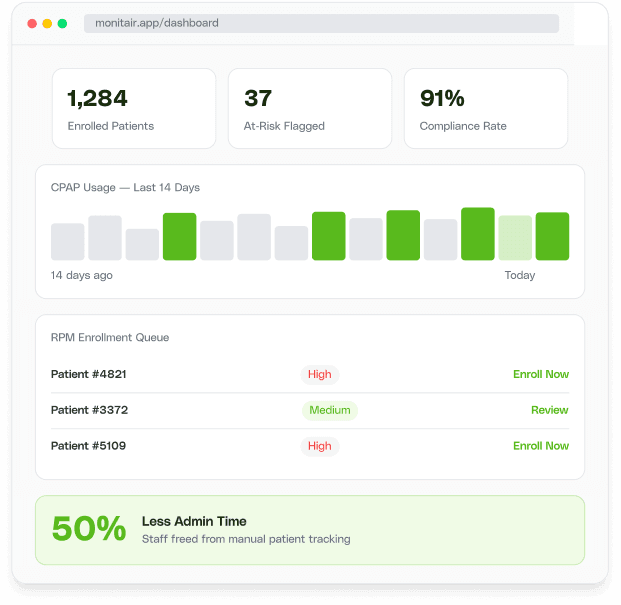
A growing remote patient monitoring (RPM) platform was struggling with the same problem plaguing healthcare practices worldwide: too much manual work, too little automation. Clinical teams spent hours tracking patients, managing RPM enrollment, handling resupply requests, and chasing follow-ups.
Too much time lost to repetitive administrative work. Clinics were manually identifying non-compliant patients, enrolling them in RPM programs, and managing resupply workflows, all without automation to speed things up.
Delays in identifying at-risk patients meant slower follow-ups and gaps in treatment. The reactive approach meant patients often weren't flagged for intervention until after therapy compliance had already slipped.
move from reactive, manual processes to proactive, data-driven workflows that could identify risk earlier and automate the steps that followed.
InvoZone partnered with the platform to build intelligent automation around the entire patient journey, transforming their system into a unified command center. The platform now connects healthcare systems, communication tools, payment platforms, and telemedicine infrastructure into one unified ecosystem that brings patient data and workflows together.
Detects at-risk patients early and initiates enrollment workflows without manual intervention.
Real-time visibility into CPAP/PAP therapy compliance and usage patterns.
Identifies when patients need supplies and triggers the resupply workflow automatically.
Supports CPAP, CCM, and other therapy pathways.
Uses patient data to surface at-risk cases before they become problems.
Automated outreach and digital consent workflows.
ML models that analyze historical patterns to predict non-compliance risk.
A dedicated AI/ML team built a predictive analytics module designed to identify patients who may become non-compliant before therapy failure occurs. Using approximately 8,000 to 9,000 historical patient records, the model identifies patterns such as skipped usage, behavioral trends, and other risk indicators. The ML workflow included historical data auditing, feature engineering, compliance labeling, predictive model training, and model explainability using SHAP and LIME.
Clinics reduced time spent tracking patients and managing RPM enrollment by more than half.
Automated workflows helped teams identify at-risk patients and begin follow-ups sooner, closing the gap between risk detection and intervention.
Automation gave clinical teams more time for patient-focused tasks instead of manual tracking and data entry.
The model surfaces patients showing early signs of non-compliance, helping teams intervene sooner.
Tell us about your project. we'll take it from there
