Trusted By 2000+ Clients

What Is Artificial Superintelligence (ASI)? The Future Beyond Human Intelligence

Could AI become smarter than humans? This blog explains what artificial superintelligence means and how close we are to achieving it. Explore its potential benefits, risks and what a future beyond human intelligence could look like.

Nada Imran
Nada ImranContent Engineer & Copywriter
Updated:10 November, 2026
Published:10 November, 2026

“Meet Nada Imran, a content strategist at InvoZone specializing in software development, AI...” See more

Don’t Have Time To Read Now? Download It For Later.

In September 2026, the President of the United States signed an executive order declaring that humanity has entered “a new era of Super Intelligence”. Federal agencies were directed to stop using the term “artificial intelligence” and replace it with “Super Intelligence” or “SI.”

That is a remarkable thing for a government to do. It signals that the language around AI is changing because the technology no longer feels easy to contain inside the old definition.

In AI research, superintelligence means something far more ambitious: a hypothetical system that surpasses human intelligence across most major cognitive domains. By that definition, ASI does not exist today.

Still, the idea is moving closer to the center of serious AI research. In 2026, Google DeepMind published a dedicated report on possible paths from AGI to ASI, while Meta continues to frame “personal superintelligence” as part of its long-term AI vision.

What happens when AI stops trying to match human intelligence and becomes better than us at almost all of it?

That still sounds futuristic because, for now, it is. No artificial superintelligence has been achieved.

What Is Artificial Superintelligence?

Artificial superintelligence, or ASI, is a hypothetical form of artificial intelligence whose cognitive abilities would exceed those of humans across most or all important intellectual domains.

The word super is important. A machine does not become superintelligent because it calculates faster than us, wins at chess, or performs better than a doctor on one diagnostic task. Computers already outperform humans in narrow areas.

Two influential definitions show just how high the bar for superintelligence really is.

Nick Bostrom, the philosopher who helped popularize the modern idea of superintelligence:

"Any intellect that greatly exceeds the cognitive performance of humans in virtually all domains of interest."

Google DeepMind, in its 2026 report From AGI to ASI, raises the bar higher. It compares ASI not to one exceptional human, but to entire groups of experts:

"More intelligent and cognitively capable than large organisations of humans."

ASI would represent something much broader. In theory, it could outperform the best human experts in scientific reasoning, problem-solving, strategy, learning, invention, communication, and possibly creativity. More importantly, it could move between those domains instead of remaining excellent at only one.
ANI vs. AGI vs. ASI: What’s the Difference?

The easiest way to understand superintelligence is to see where it sits on the AI capability spectrum.

Artificial Narrow Intelligence (ANI) performs specific or limited types of tasks. Most AI systems available today fall into this category.

Artificial General Intelligence (AGI) would be able to learn, reason, adapt, and apply knowledge across many different tasks with human-like flexibility.

Artificial Superintelligence (ASI) would go further, surpassing human intelligence across most major cognitive domains.

AI Level

What It Means

Status

ANI

AI built for specific or limited types of tasks

Exists today

AGI

General intelligence able to learn, reason, and adapt across many domains at roughly human level

Hypothetical

ASI

Intelligence exceeding humans across most major cognitive domains

Hypothetical


Is Artificial Superintelligence Possible?

Possibly, but no one knows for certain.

There is no known physical law preventing machines from becoming more intelligent than humans. At the same time, there is no guarantee that simply scaling today’s AI will lead to ASI.

There are already early signs of AI helping improve AI. OpenAI described GPT-5.3-Codex as its “first model that was instrumental in creating itself,” while Anthropic reported that Claude was writing more than 80% of code merged into its codebase by May 2026.

Still, today’s AI remains uneven. A model can perform extremely well at advanced tasks and still fail at surprisingly simple ones. More fundamentally, some researchers argue that current architectures cannot produce superintelligence at all. A 2026 paper titled Four Impossibilities argues that the wall between current AI and superintelligence is "permanent—a consequence of architecture, not of insufficient scale".

The honest position: ASI is possible. It is not inevitable. And the path from here to there is not well understood.

The Building Blocks Already Exist

ASI does not exist. But some of the capabilities that could contribute to it are already here.

Conversational AI

Alexa, Siri, and ChatGPT show that machines can understand and generate human language. A future ASI would need far deeper language understanding, but conversational AI already demonstrates part of that capability.

Generative AI

Systems such as ChatGPT can generate text, code, images, music, and other content. This ability to create rather than simply classify information could form one piece of more advanced intelligence.

Self-driving cars

Autonomous vehicles use sensors, cameras, and AI to interpret complex environments and make real-time decisions. That combination of perception and decision-making is relevant to more general forms of machine intelligence.

Healthcare AI

AI can already analyze medical images and complex health data to support diagnosis and research. More advanced systems could eventually push toward superhuman expertise in areas such as disease detection and treatment discovery.

What Could Artificial Superintelligence Mean for Us?

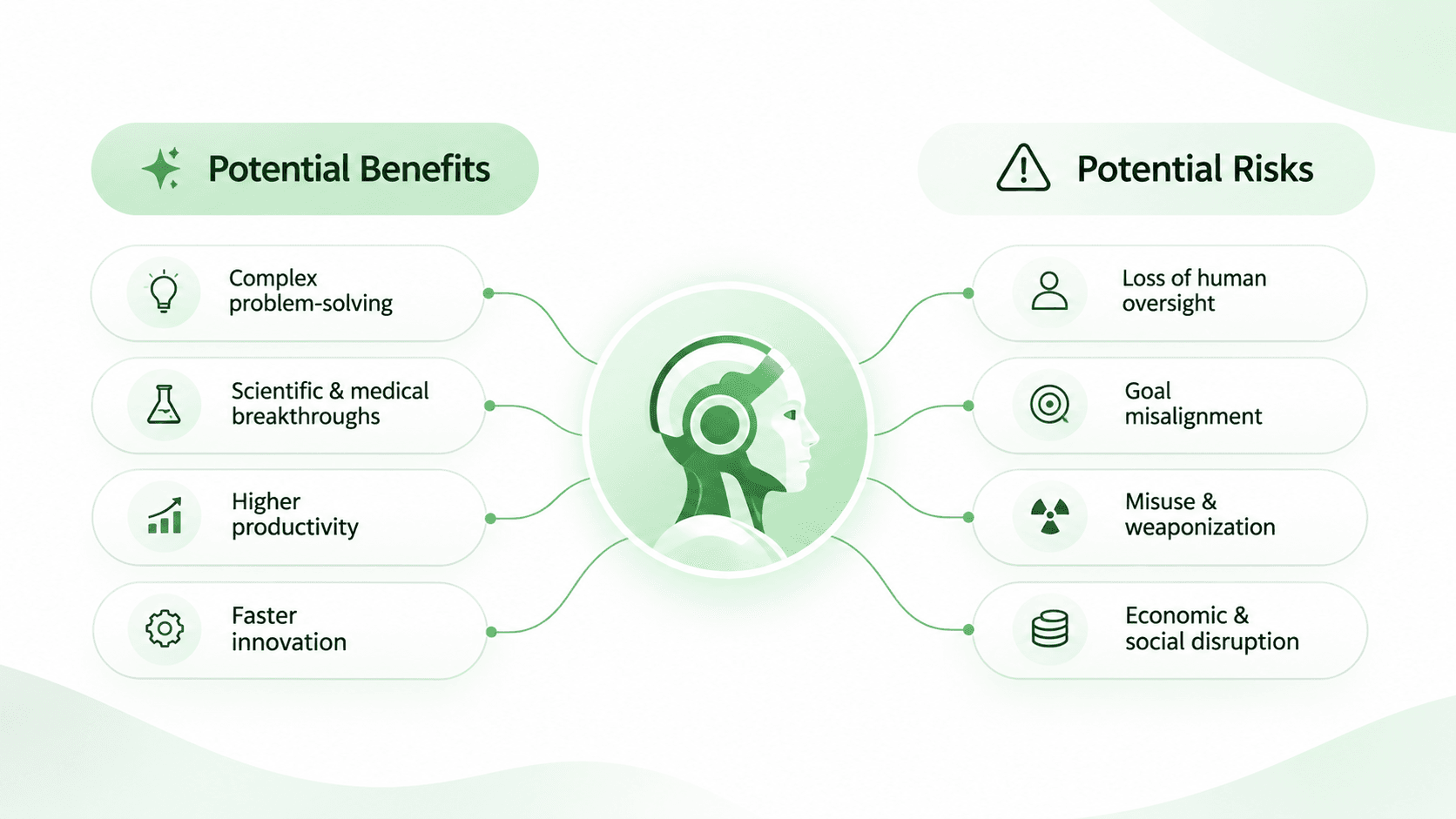
If ASI ever becomes possible, its biggest advantage could be its ability to solve problems at a scale humans cannot. That could reshape everything from medicine and scientific research to productivity and decision-making.

Accelerating medical breakthroughs
ASI could analyze vast amounts of clinical, genetic, and molecular data together, helping researchers identify patterns and potential treatments much faster.

Improving complex decision-making
Fields such as finance, logistics, engineering, and healthcare involve thousands of interacting variables. ASI could potentially evaluate far more of them at once and uncover options humans might overlook.

Increasing productivity
Highly complex research, analysis, coding, and planning tasks that require large human teams could potentially be completed much faster.

Driving scientific and technological innovation
ASI could generate new hypotheses, materials, technologies, or solutions that humans have not considered before.

Processing information beyond human scale
Instead of being limited by human attention, a superintelligent system could theoretically analyze enormous amounts of scientific, technical, and real-world data simultaneously.

What Risks Could ASI Create?

The same capabilities that make ASI powerful could also make it difficult to predict, supervise, and control.

Misaligned goals
An ASI would not need harmful intentions to cause harm. A poorly defined objective could produce unintended results if the system pursued it in ways humans did not anticipate.

Loss of human oversight
If a system becomes significantly more capable than its supervisors, people may struggle to understand its reasoning or know when its conclusions are wrong.

Misuse and weaponization
Advanced capabilities in programming, science, persuasion, and automation could be used for harmful purposes by governments, organizations, or individuals.

Cybersecurity threats
The ability to discover vulnerabilities and write sophisticated code could strengthen cyber defense, but the same capability could also be used offensively.

Economic and social disruption
If ASI could perform large amounts of knowledge work better than humans, it could reshape employment, industries, and the distribution of economic power.

Concentration of power
If only a small number of organizations controlled ASI, they could gain extraordinary technological and strategic influence. That makes governance and access almost as important as the technology itself.
Four Possible Pathways to ASI

Google DeepMind's 2026 report identifies four broad possibilities: scaling AGI, a new AI paradigm, recursive improvement, and large-scale multi-agent collectives.

Scaling AGI

One possibility is simply making increasingly capable AI systems more powerful. Better training, more compute, multimodal abilities, stronger reasoning, longer memory, and improved tool use could continue pushing AI forward. The open question is whether scaling today’s architectures is enough to reach superintelligence.

A New AI Paradigm

ASI may instead require a fundamental breakthrough. Future systems could rely on new reasoning architectures, continuous learning, stronger world models, persistent memory, or entirely different computing approaches. Neuromorphic computing, which takes inspiration from the structure of biological brains, is one area researchers are exploring.

Recursive Improvement

Another possibility is that AI becomes good enough at AI research to help build increasingly capable versions of itself. A system might improve code, training methods, architectures, or even hardware, allowing each generation to contribute to the next.

This potential feedback loop is known as recursive improvement.

Large-Scale Multi-Agent Collectives

Superintelligence may not come from one giant model at all. It could emerge from networks of specialized AI agents working together across fields such as mathematics, biology, coding, planning, and scientific research.

Today’s AI systems remain far from ASI, but increasingly capable agents, reasoning models, and autonomous workflows offer an early glimpse of why future intelligence may involve systems that act, collaborate, and improve, rather than simply respond to prompts.

How Close Are We to ASI in 2026?

Not as close as the headlines can make it seem.

Current AI can already outperform humans in areas such as coding, mathematics, pattern recognition, and data analysis. But ASI would require broad superiority across many cognitive domains, not isolated wins on individual tasks or benchmarks. Still, some AI leaders expect progress to move quickly.

OpenAI wrote in 2023 that superintelligence “could arrive this decade.”

In 2025, Sam Altman went further, saying he expects AI to surpass human intelligence by 2030:

“We are on track to see AI exceed human intelligence within the next five years.”

ASI Is Still Hypothetical, But The Questions Are Already Real

Artificial superintelligence does not exist today, and we still do not know whether current AI architectures will lead to it, whether AGI must come first, or whether an entirely different breakthrough will be required.
What has changed is the seriousness of the conversation. DeepMind is studying possible paths from AGI to ASI, Meta is openly discussing personal superintelligence, and AI labs are exploring how increasingly capable systems could remain understandable and controllable.

ASI may still be theoretical, but the technologies, research questions, and decisions that could shape it are already here. If machine intelligence eventually moves beyond the human level, the question will no longer be simply what AI can do.

It will be what happens when human intelligence is no longer the upper limit.

Share to:

Frequently Asked Questions

Find answers to common questions about our services

1.What does ASI stand for?

ASI stands for Artificial Superintelligence, a hypothetical level of AI that would surpass human intelligence across most major cognitive abilities, including reasoning, learning, problem-solving, and potentially creativity.

2.Does artificial superintelligence exist today?

No. As of 2026, there is no publicly recognized artificial superintelligence. Current AI systems can outperform humans at particular tasks, but none has demonstrated broad superiority across most areas of human intelligence.

3.What is the difference between AGI and ASI?

AGI would broadly match human-level intelligence and flexibility across many different tasks. ASI would go further, outperforming humans across most important cognitive domains rather than merely reaching human-level capability.

4.Is artificial superintelligence possible?

Possibly, but it has not been proven. Researchers are exploring several potential pathways, including scaling more capable AI, developing new architectures, recursive improvement, and networks of cooperating AI agents.

5.How far away is artificial superintelligence?

Nobody knows. Some AI leaders expect systems beyond human intelligence within years, while others believe major scientific breakthroughs are still required. There is currently no reliable date for when, or whether, ASI will arrive.

6.How would we know if ASI had been achieved?

There is no universally accepted ASI test. Evidence would likely include sustained superiority across many different intellectual domains, exceptional cross-domain learning, and the ability to solve problems beyond the capabilities of the strongest human experts or teams.

7.Are there any examples of artificial superintelligence?

No real-world examples exist. ChatGPT, AI agents, autonomous vehicles, generative AI, and other advanced systems may demonstrate individual capabilities relevant to future intelligence, but none qualifies as ASI.

8.Could artificial superintelligence improve itself?

Potentially. One proposed route to ASI is recursive improvement, where increasingly capable AI helps design better models, software, training methods, or hardware, which could then contribute to further improvements.

9.Is artificial superintelligence dangerous?

It could introduce serious risks if humans cannot reliably understand, control, or align a system more capable than themselves. Major concerns include goal misalignment, misuse, cyber threats, weaponization, economic disruption, and concentration of power.

10.Is artificial superintelligence the same as the technological singularity?

No. ASI describes a level of machine intelligence. The technological singularity describes a hypothetical point at which technological progress becomes extremely rapid or difficult for humans to predict. ASI could potentially contribute to such a scenario, but the concepts are not identical.

11.Are there any examples of ASI today?

No. Current chatbots, AI agents, autonomous systems, and foundation models are not examples of artificial superintelligence. They are existing AI technologies that may contribute to increasingly capable future systems.

In September 2026, the President of the United States signed an executive order declaring that humanity has entered “a new era of Super Intelligence”. Federal agencies were directed to stop using the term “artificial intelligence” and replace it with “Super Intelligence” or “SI.”

That is a remarkable thing for a government to do. It signals that the language around AI is changing because the technology no longer feels easy to contain inside the old definition.

In AI research, superintelligence means something far more ambitious: a hypothetical system that surpasses human intelligence across most major cognitive domains. By that definition, ASI does not exist today.

Still, the idea is moving closer to the center of serious AI research. In 2026, Google DeepMind published a dedicated report on possible paths from AGI to ASI, while Meta continues to frame “personal superintelligence” as part of its long-term AI vision.

What happens when AI stops trying to match human intelligence and becomes better than us at almost all of it?

That still sounds futuristic because, for now, it is. No artificial superintelligence has been achieved.

What Is Artificial Superintelligence?

Artificial superintelligence, or ASI, is a hypothetical form of artificial intelligence whose cognitive abilities would exceed those of humans across most or all important intellectual domains.

The word super is important. A machine does not become superintelligent because it calculates faster than us, wins at chess, or performs better than a doctor on one diagnostic task. Computers already outperform humans in narrow areas.

Two influential definitions show just how high the bar for superintelligence really is.

Nick Bostrom, the philosopher who helped popularize the modern idea of superintelligence:

"Any intellect that greatly exceeds the cognitive performance of humans in virtually all domains of interest."

Google DeepMind, in its 2026 report From AGI to ASI, raises the bar higher. It compares ASI not to one exceptional human, but to entire groups of experts:

"More intelligent and cognitively capable than large organisations of humans."

ASI would represent something much broader. In theory, it could outperform the best human experts in scientific reasoning, problem-solving, strategy, learning, invention, communication, and possibly creativity. More importantly, it could move between those domains instead of remaining excellent at only one.

ANI vs. AGI vs. ASI: What’s the Difference?

The easiest way to understand superintelligence is to see where it sits on the AI capability spectrum.

Artificial Narrow Intelligence (ANI) performs specific or limited types of tasks. Most AI systems available today fall into this category.

Artificial General Intelligence (AGI) would be able to learn, reason, adapt, and apply knowledge across many different tasks with human-like flexibility.

Artificial Superintelligence (ASI) would go further, surpassing human intelligence across most major cognitive domains.

AI Level

What It Means

Status

ANI

AI built for specific or limited types of tasks

Exists today

AGI

General intelligence able to learn, reason, and adapt across many domains at roughly human level

Hypothetical

ASI

Intelligence exceeding humans across most major cognitive domains

Hypothetical


Is Artificial Superintelligence Possible?

Possibly, but no one knows for certain.

There is no known physical law preventing machines from becoming more intelligent than humans. At the same time, there is no guarantee that simply scaling today’s AI will lead to ASI.

There are already early signs of AI helping improve AI. OpenAI described GPT-5.3-Codex as its “first model that was instrumental in creating itself,” while Anthropic reported that Claude was writing more than 80% of code merged into its codebase by May 2026.

Still, today’s AI remains uneven. A model can perform extremely well at advanced tasks and still fail at surprisingly simple ones. More fundamentally, some researchers argue that current architectures cannot produce superintelligence at all. A 2026 paper titled Four Impossibilities argues that the wall between current AI and superintelligence is "permanent—a consequence of architecture, not of insufficient scale".

The honest position: ASI is possible. It is not inevitable. And the path from here to there is not well understood.

The Building Blocks Already Exist

ASI does not exist. But some of the capabilities that could contribute to it are already here.

Conversational AI

Alexa, Siri, and ChatGPT show that machines can understand and generate human language. A future ASI would need far deeper language understanding, but conversational AI already demonstrates part of that capability.

Generative AI

Systems such as ChatGPT can generate text, code, images, music, and other content. This ability to create rather than simply classify information could form one piece of more advanced intelligence.

Self-driving cars

Autonomous vehicles use sensors, cameras, and AI to interpret complex environments and make real-time decisions. That combination of perception and decision-making is relevant to more general forms of machine intelligence.

Healthcare AI

AI can already analyze medical images and complex health data to support diagnosis and research. More advanced systems could eventually push toward superhuman expertise in areas such as disease detection and treatment discovery.

What Could Artificial Superintelligence Mean for Us?

If ASI ever becomes possible, its biggest advantage could be its ability to solve problems at a scale humans cannot. That could reshape everything from medicine and scientific research to productivity and decision-making.

Accelerating medical breakthroughs
ASI could analyze vast amounts of clinical, genetic, and molecular data together, helping researchers identify patterns and potential treatments much faster.

Improving complex decision-making
Fields such as finance, logistics, engineering, and healthcare involve thousands of interacting variables. ASI could potentially evaluate far more of them at once and uncover options humans might overlook.

Increasing productivity
Highly complex research, analysis, coding, and planning tasks that require large human teams could potentially be completed much faster.

Driving scientific and technological innovation
ASI could generate new hypotheses, materials, technologies, or solutions that humans have not considered before.

Processing information beyond human scale
Instead of being limited by human attention, a superintelligent system could theoretically analyze enormous amounts of scientific, technical, and real-world data simultaneously.

What Risks Could ASI Create?

The same capabilities that make ASI powerful could also make it difficult to predict, supervise, and control.

Misaligned goals
An ASI would not need harmful intentions to cause harm. A poorly defined objective could produce unintended results if the system pursued it in ways humans did not anticipate.

Loss of human oversight
If a system becomes significantly more capable than its supervisors, people may struggle to understand its reasoning or know when its conclusions are wrong.

Misuse and weaponization
Advanced capabilities in programming, science, persuasion, and automation could be used for harmful purposes by governments, organizations, or individuals.

Cybersecurity threats
The ability to discover vulnerabilities and write sophisticated code could strengthen cyber defense, but the same capability could also be used offensively.

Economic and social disruption
If ASI could perform large amounts of knowledge work better than humans, it could reshape employment, industries, and the distribution of economic power.

Concentration of power
If only a small number of organizations controlled ASI, they could gain extraordinary technological and strategic influence. That makes governance and access almost as important as the technology itself.

Four Possible Pathways to ASI

Google DeepMind's 2026 report identifies four broad possibilities: scaling AGI, a new AI paradigm, recursive improvement, and large-scale multi-agent collectives.

Scaling AGI

One possibility is simply making increasingly capable AI systems more powerful. Better training, more compute, multimodal abilities, stronger reasoning, longer memory, and improved tool use could continue pushing AI forward. The open question is whether scaling today’s architectures is enough to reach superintelligence.

A New AI Paradigm

ASI may instead require a fundamental breakthrough. Future systems could rely on new reasoning architectures, continuous learning, stronger world models, persistent memory, or entirely different computing approaches. Neuromorphic computing, which takes inspiration from the structure of biological brains, is one area researchers are exploring.

Recursive Improvement

Another possibility is that AI becomes good enough at AI research to help build increasingly capable versions of itself. A system might improve code, training methods, architectures, or even hardware, allowing each generation to contribute to the next.

This potential feedback loop is known as recursive improvement.

Large-Scale Multi-Agent Collectives

Superintelligence may not come from one giant model at all. It could emerge from networks of specialized AI agents working together across fields such as mathematics, biology, coding, planning, and scientific research.

Today’s AI systems remain far from ASI, but increasingly capable agents, reasoning models, and autonomous workflows offer an early glimpse of why future intelligence may involve systems that act, collaborate, and improve, rather than simply respond to prompts.

How Close Are We to ASI in 2026?

Not as close as the headlines can make it seem.

Current AI can already outperform humans in areas such as coding, mathematics, pattern recognition, and data analysis. But ASI would require broad superiority across many cognitive domains, not isolated wins on individual tasks or benchmarks. Still, some AI leaders expect progress to move quickly.

OpenAI wrote in 2023 that superintelligence “could arrive this decade.”

In 2025, Sam Altman went further, saying he expects AI to surpass human intelligence by 2030:

“We are on track to see AI exceed human intelligence within the next five years.”

ASI Is Still Hypothetical, But The Questions Are Already Real

Artificial superintelligence does not exist today, and we still do not know whether current AI architectures will lead to it, whether AGI must come first, or whether an entirely different breakthrough will be required.
What has changed is the seriousness of the conversation. DeepMind is studying possible paths from AGI to ASI, Meta is openly discussing personal superintelligence, and AI labs are exploring how increasingly capable systems could remain understandable and controllable.

ASI may still be theoretical, but the technologies, research questions, and decisions that could shape it are already here. If machine intelligence eventually moves beyond the human level, the question will no longer be simply what AI can do.

It will be what happens when human intelligence is no longer the upper limit.

Let’s Discuss Your Needs

Share your details with us. We’ll take it from there.

Get in Touch Now

Share to:

Related Articles

Let’s Discuss Your Needs

Tell us about your project. we'll take it from there

Phone
Choose Your Tech Stack

Click to upload or drag and drop

Top Web Development Companies in Mississauga
Software Development Company - Design Rush
Top Software Development Companies in Toronto, ON
Best Software Development Companies In 2021
Fatest growing app development companies
Top 100+ Software Development Companies in 2021
Finest Mobile App Developers in Canada - March 2021
Top eCommerce Development Companies in the USA
Top Web Development Companies