Top Countries to Hire Remote Developers From in 2026
The global developer market has more options than ever. It’s hard to find the right developers for your specific timezone, budget, and technical requirements and working style. This guide gives you a clear country-by-country breakdown of where to hire remote developers in 2026, what each market is good at, and how to choose the right fit for your team.

“Furqan Aziz is CEO & Founder of InvoZone. He is a tech enthusiast by heart with 10+ years ...” See more
Don’t Have Time To Read Now? Download It For Later.
Table of Contents
- What Actually Changed Between 2024 and 2026
- The Countries Worth Knowing About in 2026
- India — The Deepest Talent Pool on the Planet
- Poland - Where Quality Meets EU Standards
- Ukraine - Senior Engineering Depth at Competitive Rates
- Romania - The Quiet Performer
- Mexico - The Best Option for US Timezone Alignment
- Brazil - LATAM's Largest Tech Market
- Philippines - Communication-First Engineering
- Vietnam - Southeast Asia's Fastest Growing Option
- What the Data Actually Says About Rates in 2026
- A Quick Framework Before You Decide
- One Thing Most Articles Skip
- How InvoZone Eliminates the Sourcing Overhead
- Final Thought
A few months back, I watched a well-funded startup completely fail to get their major product launch done on time.
Why?
It was simply because they ended up hiring developers from the wrong country.
So let's be blunt: the debate over whether to hire remote developers is completely over.
The real question is: Where should you look?
Every country has different engineering skills and unique strengths. This guide breaks down the top tech hubs so you can make the right choice for your business.
Don’t miss out on making a wise decision for your team.
What Actually Changed Between 2024 and 2026
Five years ago, hiring a remote developer meant India or Eastern Europe and not much else.
That is no longer the case.
Latin America has become a serious nearshore option for US companies, especially for teams comparing LATAM developer hiring with offshore markets in Asia and Eastern Europe.
Three things accelerated this shift. First, US developer salaries hit levels that pushed even well-funded startups to look elsewhere. Second, remote collaboration tools matured enough that timezone overlap became more important than physical proximity. Third, a new generation of engineers in LATAM and Southeast Asia started contributing to serious production systems.
Geography is still the single biggest driver of remote developer rates in 2026. A senior backend engineer in New York and one in Bogotá may produce comparable code, but their rates differ by three to five times.
That is not a small thing.
The Countries Worth Knowing About in 2026
Not all remote talent is the same. Every tech hub excels at something different. Here is exactly what you need to know about the top countries before you hire.

India — The Deepest Talent Pool on the Planet
India is considered as the deepest tech talent pool globally, with over 3.5 million active software developers. It has strong computer science university programs and a tech ecosystem that produces engineers experienced with Western development practices. Senior full-stack developers run $25,000 to $45,000 per year, roughly 70% below US equivalents.
The timezone gap is the real conversation. US West Coast teams get about two to three hours of real-time overlap at best. For async-first teams building products in sprints, that works fine. However, for teams that run on synchronous standups and pair programming, planning is required.
India is best for scale. If you need multiple engineers across different stacks quickly, no other country matches the depth of the available pool.
What India is particularly strong at:
- Full-stack web development across React, Node.js, Python, and Java
- AI and ML engineering with growing depth in LLM integration and data pipelines
- Mobile app development for both iOS and Android at volume
- Enterprise software, SaaS product development, and cloud infrastructure
Average rate: $15 to $25 per hour
Poland - Where Quality Meets EU Standards
Poland is the go-to choice for European companies and US companies that need engineers comfortable with GDPR and EU compliance requirements. Warsaw and Kraków have dense tech communities with strong senior engineering talent across Java, Python, and cloud infrastructure. English proficiency is high. Timezone overlap with both the EU and East Coast US is solid.
The rates are higher than Asia or LATAM, but the seniority and systems thinking you get in return are consistently strong. Poland, Ukraine, Romania, and Bulgaria are considered top countries for offshore development due to their excellent price-to-quality ratio, robust STEM education, and innovation-driven mindset.
What Poland is particularly strong at:
- Java, Python, PHP, and .NET backend development at senior level
- Fintech and enterprise software with EU compliance requirements
- Cybersecurity engineering and secure systems architecture
- Cross-border product teams where EU timezone alignment is non-negotiable
Average rate: $40 to $60 per hour
Ukraine - Senior Engineering Depth at Competitive Rates
Ukraine has a long history of producing engineers who are particularly strong in AI, distributed systems and complex backend work. The pool is large, the engineers are experienced, and the rates remain significantly below Western Europe. Companies that work with Ukrainian teams consistently report strong problem-solving and architectural capability.
If you go this route, work with partners who have risk mitigation and knowledge transfer built into the engagement from day one. The talent is there. The operational structure around it needs to be planned carefully given the current geopolitical situation.
What Ukraine is particularly strong at:
- AI, machine learning, and TensorFlow or PyTorch engineering
- Complex backend systems and distributed architecture
- DevOps and cloud infrastructure across AWS and Azure
- Senior-level engineers who can own architecture decisions, not just execute them
Average rate: $35 to $50 per hour
Romania - The Quiet Performer
Romania does not get talked about as much as Poland or Ukraine, but it should. Bucharest, Cluj-Napoca, and Timisoara produce engineers trained in strong theoretical computer science programs. The talent pool covers 250,000 IT specialists with particular strength in fintech, cybersecurity, and healthtech.
Romania also has some of the best internet infrastructure in Europe at cost. Rates are competitive, English proficiency is strong, ranked 12th globally, and the EU timezone works well for both European and East Coast US teams.
What Romania is particularly strong at:
- JavaScript, Python, Java, and C# across web and enterprise development
- Backend systems engineering with strong theoretical foundations
- Fintech, cybersecurity, and healthtech product development
- Senior developers comfortable working across international product teams
Average rate: $30 to $45 per hour
Mexico - The Best Option for US Timezone Alignment
If real-time collaboration with a US team is non-negotiable, Mexico is the most practical choice on this list. Same-day timezones overlap with US Central and Mountain, one hour from Pacific and Eastern. Guadalajara, Monterrey, and Mexico City have robust tech ecosystems with developers experienced in working with US companies.
Senior developer salaries sit between $35,000 and $60,000 per year, still 50 to 65% below US rates. The one thing to verify before committing is internet infrastructure. Fiber is available but building-by-building coverage is inconsistent. Test before you sign any long-term engagement.
What Mexico is particularly strong at:
- Full-stack web and mobile development with strong US market familiarity
- Bilingual engineers comfortable in English-first product environments
- Frontend development with React, Vue, and modern JavaScript frameworks
- Nearshore collaboration with real-time availability during US business hours
Average rate: $30 to $45 per hour
Brazil - LATAM's Largest Tech Market
Brazil has matured significantly as a nearshore destination. The talent pool exceeds 640,000 developers with real depth in Java, Python, and JavaScript. The timezone works well for US East Coast teams and overlaps cleanly with Central Europe.
Brazil is particularly useful for companies that need nearshore delivery capacity with a team that can grow over time. The tech scene is particularly strong in fintech and cybersecurity, which makes it a natural fit for companies building financial or security-critical products.
What Brazil is particularly strong at:
- Fintech and payments infrastructure engineering
- Cybersecurity and security-focused product development
- Java, Python, and JavaScript full-stack development
- Product teams serving both US and European markets from a single timezone
Average rate: $30 to $45 per hour
Philippines - Communication-First Engineering
The Philippines is worth considering when clear communication, fast response times, and cultural alignment with US teams matter as much as technical depth. Filipino professionals frequently adjust their work hours to overlap with Western time zones, ensuring smooth communication and productivity, while their familiarity with Western work practices makes them easy to integrate into global teams.
The talent pool is strong for frontend development, QA engineering, and technical support roles. For highly specialized backend or AI work, the pool thins faster than India or Eastern Europe. But for product teams that need a reliable, communicative engineering presence, the Philippines consistently delivers.
What the Philippines is particularly strong at:
- Frontend development and UI implementation
- QA engineering, manual testing, and test automation
- Technical support, DevOps assistance, and maintenance engineering
- Customer-facing technical roles where English fluency and communication quality matter most
Average rate: $20 to $35 per hour
Vietnam - Southeast Asia's Fastest Growing Option
Vietnam is the one to watch. A young, technically strong workforce, serious STEM education investment, and rates that remain well below most other markets. Vietnam is one of Asia's fastest-growing software outsourcing countries with particular strength in mobile development, backend systems, and software testing.
The timezone creates a gap with US teams similar to India, so it works best for async-first organizations or companies that have already built the process infrastructure to manage distributed teams across large time differences.
What Vietnam is particularly strong at:
- Mobile app development for iOS and Android
- Backend systems and API development
- Software testing, QA automation, and quality engineering
- Cost-efficient development for startups and scale-ups running lean budgets
Average rate: $20 to $35 per hour
What the Data Actually Says About Rates in 2026
Before you map countries to budgets, one important nuance. The 2026 market strongly favors hiring fewer, more capable developers at higher rates. AI-augmented senior developers produce dramatically more output per hour. Entry-level remote roles are increasingly scarce with only 7% of remote postings and the management overhead of junior developers erodes any rate savings quickly.
The real math is not "India at $20 per hour vs Poland at $50 per hour." It is "one strong senior engineer in Romania at $40 per hour vs two junior engineers in Vietnam at $20 per hour each." Most teams that have run both models end up at the same conclusion. The senior engineer wins almost every time.
Specialization also drives rates beyond location. AI and ML engineers command a 15 to 50% premium over general software engineers in every region. DevOps specialists with AWS, Azure, or Kubernetes expertise earn $15 to $25 per hour above mid-level generalists. Build those numbers into your hiring budget before you make the final hiring decisions.
A Quick Framework Before You Decide
Most companies overcomplicate this decision. Here is a simple way to cut through it:
You need real-time collaboration with a US team
Mexico or Brazil. The timezone overlap is worth the slightly higher rate compared to Asia.
You need strong technical depth at the best possible cost
India for scale, Romania or Ukraine for senior engineering quality at moderate cost.
You need EU timezone alignment and compliance familiarity
Poland or Romania. Both have strong senior talent and work cleanly with European clients.
You need cost efficiency above everything else
Vietnam or Philippines, with the understanding that you need async-first processes in place before you start.
You are building a long-term AI or ML capability
India, Ukraine, and increasingly Brazil all have growing pools of AI engineers. Expect to pay a 15 to 50% premium over general engineering rates in those markets.
One Thing Most Articles Skip
Choosing the country is the easy part. The hiring model matters just as much.
A developer in Poland working as a long-term dedicated engineer on your product builds context over months. A developer in India hired through a project-based outsourcing engagement ships deliverables and moves on. Both are valid. They serve completely different purposes.
According to Deloitte, companies that align their outsourcing strategy with business goals significantly improve efficiency and reduce operational costs. That alignment starts not with the country, but with being clear about whether you need someone embedded in your team long-term or someone to execute a defined scope and hand it over.
That is why it is absolutely vital to look over a comprehensive guide on how to hire developers so you have a complete strategic blueprint before spending thousands on salaries. Make sure you get this foundational step right.
How InvoZone Eliminates the Sourcing Overhead
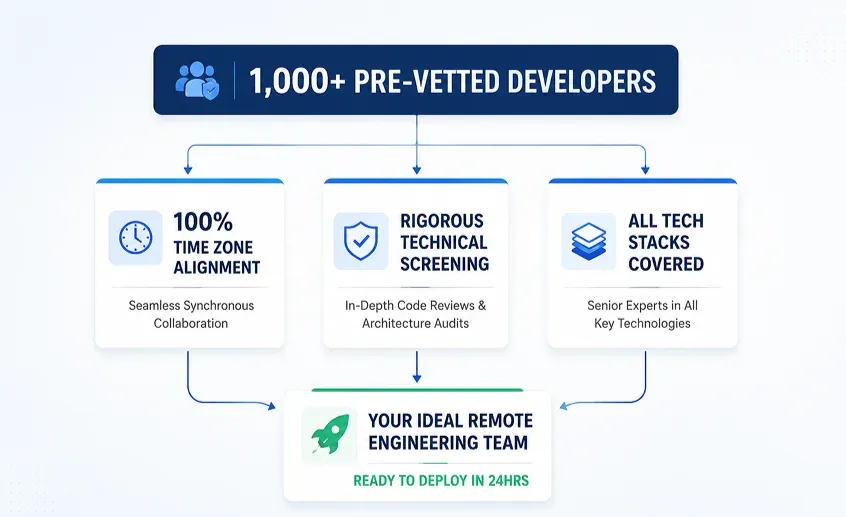
Trying to run this complex vetting and matching pipeline across multiple countries by yourself is incredibly time-consuming. You have to interview dozens of candidates just to find one developer who actually understands your specific time-zone requirements, possesses deep technical capability, and has excellent communication habits.
InvoZone shortens this entire workflow down to 24 hours. Instead of waiting weeks to filter through unvetted options, you can use the InvoZone approach to secure highly capable talent that actively matches your daily management style.
Final Thought
The best country to hire a remote developer from in 2026 is the one that matches what you actually need. Don’t opt for the ones with the lowest hourly rate on a comparison table.
Geography shapes your cost, your communication rhythm, your access to specific skills, and your ability to retain talent over time. All four of those things matter to whether a remote engineering hire works out. The companies building the strongest distributed teams in 2026 are the ones treating that decision with the same rigor they apply to product architecture. The ones struggling are still optimizing for the cheapest line on the invoice.
Share to:
Frequently Asked Questions
Find answers to common questions about our services
1.How much does it cost to hire a remote developer in 2026?
Rates vary significantly by region. Developers in India and Vietnam typically run $15 to $25 per hour. Eastern European engineers in Poland, Romania, and Ukraine range from $30 to $60 per hour depending on seniority. LATAM developers in Mexico and Brazil typically fall between $30 and $45 per hour. For context, the average US-based senior software developer earns $111,845 per year according to ZipRecruiter. Remote developers in most global markets cost 50 to 70 percent less for equivalent seniority.
2.Is it better to hire remote developers from Eastern Europe or Asia?
Eastern Europe and Asia solve different problems. Eastern European developers, particularly in Poland, Romania, and Ukraine, are strong for senior engineering roles, complex systems work, and EU timezone alignment. Asian markets, particularly India and Vietnam, offer better depth for scale and cost efficiency. If your priority is building a long-term dedicated team with strong product context, Eastern Europe tends to perform better. If you need to scale a team quickly across multiple stacks, India is hard to match.
3.How do you manage a remote development team across time zones?
Time zone management is a process decision more than a technology one. Teams that work well across large time zone gaps share three things: async-first communication with documented decisions, structured sprint reviews that do not require real-time presence, and clear ownership at the individual engineer level so nothing waits on a standup to move forward. For teams that need synchronous collaboration, hiring in LATAM or Eastern Europe gives you the most working-hours overlap with US and EU teams.
4.How long does it take to hire a remote developer in 2026?
With the right partner, most companies meet matched candidates within 24 to 48 hours of a scoping call. Contracts, onboarding, and repository access typically follow within the same week. Compare that to in-house hiring, where the average US recruitment cycle for a senior developer runs 63 days from job post to start date. The speed advantage of working with a vetted staffing partner is one of the most underestimated factors in this decision.
5.Who owns the code written by a remote developer?
Full legal ownership of source code, repositories, and design assets should transfer to your company from day one. This is written into a Master Services Agreement before any work begins. It is not a verbal assurance. It is a contractual clause. Any remote staffing partner worth working with will have this as standard. If they do not, that is a reason to stop the conversation.
6.How do you vet a remote developer before hiring them?
The vetting process matters more than the platform. Look for partners that run live coding assessments on real problems, architecture evaluations, past project reviews, and English proficiency testing before introducing a candidate to you. By the time you interview someone through InvoZone, they have already cleared every stage of our technical screening. You are choosing between strong options, not filtering out weak ones.
7.What is the difference between hiring a remote developer and outsourcing a project?
Remote developer hiring means adding an engineer directly into your existing team. They work your hours, follow your process, and report to your leads. You keep full control of daily workflow and product direction. Outsourcing means handing a project to an external team who manages their own delivery. Remote hiring is the right model when you want product continuity, IP ownership, and a developer who builds institutional knowledge over time. Outsourcing fits when the scope is clearly defined and you need delivery without managing the team.
8.Which country is best for hiring remote developers for US-based companies?
Mexico is the most practical choice for US companies that need real-time collaboration. The timezone is essentially identical to US Central and Mountain times, and sits just one hour away from Pacific and Eastern shores. Brazil and Argentina also work exceptionally well for US East Coast product teams.
For companies comfortable with async-first processes, India and Vietnam offer significantly lower rates alongside deep technical proficiency. As a premier global staffing partner, InvoZone works with US-based clients across all of these prominent engineering markets and matches developers based on your exact timezone requirements by default.
9.How do companies protect intellectual property when hiring remote developers internationally?
IP protection starts with the contract. Every engagement should include a signed NDA before any technical documentation is shared, explicit source code ownership clauses that transfer all rights to your company on milestone completion, and restricted access controls that limit repository permissions to what the developer actually needs. For regulated industries like fintech and healthcare, data processing agreements and compliance clauses need to be added on top of the standard IP protections. InvoZone includes all of this in the standard agreement.
Table of Contents
- What Actually Changed Between 2024 and 2026
- The Countries Worth Knowing About in 2026
- India — The Deepest Talent Pool on the Planet
- Poland - Where Quality Meets EU Standards
- Ukraine - Senior Engineering Depth at Competitive Rates
- Romania - The Quiet Performer
- Mexico - The Best Option for US Timezone Alignment
- Brazil - LATAM's Largest Tech Market
- Philippines - Communication-First Engineering
- Vietnam - Southeast Asia's Fastest Growing Option
- What the Data Actually Says About Rates in 2026
- A Quick Framework Before You Decide
- One Thing Most Articles Skip
- How InvoZone Eliminates the Sourcing Overhead
- Final Thought
A few months back, I watched a well-funded startup completely fail to get their major product launch done on time.
Why?
It was simply because they ended up hiring developers from the wrong country.
So let's be blunt: the debate over whether to hire remote developers is completely over.
The real question is: Where should you look?
Every country has different engineering skills and unique strengths. This guide breaks down the top tech hubs so you can make the right choice for your business.
Don’t miss out on making a wise decision for your team.
What Actually Changed Between 2024 and 2026
Five years ago, hiring a remote developer meant India or Eastern Europe and not much else.
That is no longer the case.
Latin America has become a serious nearshore option for US companies, especially for teams comparing LATAM developer hiring with offshore markets in Asia and Eastern Europe.
Three things accelerated this shift. First, US developer salaries hit levels that pushed even well-funded startups to look elsewhere. Second, remote collaboration tools matured enough that timezone overlap became more important than physical proximity. Third, a new generation of engineers in LATAM and Southeast Asia started contributing to serious production systems.
Geography is still the single biggest driver of remote developer rates in 2026. A senior backend engineer in New York and one in Bogotá may produce comparable code, but their rates differ by three to five times.
That is not a small thing.
The Countries Worth Knowing About in 2026
Not all remote talent is the same. Every tech hub excels at something different. Here is exactly what you need to know about the top countries before you hire.

India — The Deepest Talent Pool on the Planet
India is considered as the deepest tech talent pool globally, with over 3.5 million active software developers. It has strong computer science university programs and a tech ecosystem that produces engineers experienced with Western development practices. Senior full-stack developers run $25,000 to $45,000 per year, roughly 70% below US equivalents.
The timezone gap is the real conversation. US West Coast teams get about two to three hours of real-time overlap at best. For async-first teams building products in sprints, that works fine. However, for teams that run on synchronous standups and pair programming, planning is required.
India is best for scale. If you need multiple engineers across different stacks quickly, no other country matches the depth of the available pool.
What India is particularly strong at:
- Full-stack web development across React, Node.js, Python, and Java
- AI and ML engineering with growing depth in LLM integration and data pipelines
- Mobile app development for both iOS and Android at volume
- Enterprise software, SaaS product development, and cloud infrastructure
Average rate: $15 to $25 per hour
Poland - Where Quality Meets EU Standards
Poland is the go-to choice for European companies and US companies that need engineers comfortable with GDPR and EU compliance requirements. Warsaw and Kraków have dense tech communities with strong senior engineering talent across Java, Python, and cloud infrastructure. English proficiency is high. Timezone overlap with both the EU and East Coast US is solid.
The rates are higher than Asia or LATAM, but the seniority and systems thinking you get in return are consistently strong. Poland, Ukraine, Romania, and Bulgaria are considered top countries for offshore development due to their excellent price-to-quality ratio, robust STEM education, and innovation-driven mindset.
What Poland is particularly strong at:
- Java, Python, PHP, and .NET backend development at senior level
- Fintech and enterprise software with EU compliance requirements
- Cybersecurity engineering and secure systems architecture
- Cross-border product teams where EU timezone alignment is non-negotiable
Average rate: $40 to $60 per hour
Ukraine - Senior Engineering Depth at Competitive Rates
Ukraine has a long history of producing engineers who are particularly strong in AI, distributed systems and complex backend work. The pool is large, the engineers are experienced, and the rates remain significantly below Western Europe. Companies that work with Ukrainian teams consistently report strong problem-solving and architectural capability.
If you go this route, work with partners who have risk mitigation and knowledge transfer built into the engagement from day one. The talent is there. The operational structure around it needs to be planned carefully given the current geopolitical situation.
What Ukraine is particularly strong at:
- AI, machine learning, and TensorFlow or PyTorch engineering
- Complex backend systems and distributed architecture
- DevOps and cloud infrastructure across AWS and Azure
- Senior-level engineers who can own architecture decisions, not just execute them
Average rate: $35 to $50 per hour
Romania - The Quiet Performer
Romania does not get talked about as much as Poland or Ukraine, but it should. Bucharest, Cluj-Napoca, and Timisoara produce engineers trained in strong theoretical computer science programs. The talent pool covers 250,000 IT specialists with particular strength in fintech, cybersecurity, and healthtech.
Romania also has some of the best internet infrastructure in Europe at cost. Rates are competitive, English proficiency is strong, ranked 12th globally, and the EU timezone works well for both European and East Coast US teams.
What Romania is particularly strong at:
- JavaScript, Python, Java, and C# across web and enterprise development
- Backend systems engineering with strong theoretical foundations
- Fintech, cybersecurity, and healthtech product development
- Senior developers comfortable working across international product teams
Average rate: $30 to $45 per hour
Mexico - The Best Option for US Timezone Alignment
If real-time collaboration with a US team is non-negotiable, Mexico is the most practical choice on this list. Same-day timezones overlap with US Central and Mountain, one hour from Pacific and Eastern. Guadalajara, Monterrey, and Mexico City have robust tech ecosystems with developers experienced in working with US companies.
Senior developer salaries sit between $35,000 and $60,000 per year, still 50 to 65% below US rates. The one thing to verify before committing is internet infrastructure. Fiber is available but building-by-building coverage is inconsistent. Test before you sign any long-term engagement.
What Mexico is particularly strong at:
- Full-stack web and mobile development with strong US market familiarity
- Bilingual engineers comfortable in English-first product environments
- Frontend development with React, Vue, and modern JavaScript frameworks
- Nearshore collaboration with real-time availability during US business hours
Average rate: $30 to $45 per hour
Brazil - LATAM's Largest Tech Market
Brazil has matured significantly as a nearshore destination. The talent pool exceeds 640,000 developers with real depth in Java, Python, and JavaScript. The timezone works well for US East Coast teams and overlaps cleanly with Central Europe.
Brazil is particularly useful for companies that need nearshore delivery capacity with a team that can grow over time. The tech scene is particularly strong in fintech and cybersecurity, which makes it a natural fit for companies building financial or security-critical products.
What Brazil is particularly strong at:
- Fintech and payments infrastructure engineering
- Cybersecurity and security-focused product development
- Java, Python, and JavaScript full-stack development
- Product teams serving both US and European markets from a single timezone
Average rate: $30 to $45 per hour
Philippines - Communication-First Engineering
The Philippines is worth considering when clear communication, fast response times, and cultural alignment with US teams matter as much as technical depth. Filipino professionals frequently adjust their work hours to overlap with Western time zones, ensuring smooth communication and productivity, while their familiarity with Western work practices makes them easy to integrate into global teams.
The talent pool is strong for frontend development, QA engineering, and technical support roles. For highly specialized backend or AI work, the pool thins faster than India or Eastern Europe. But for product teams that need a reliable, communicative engineering presence, the Philippines consistently delivers.
What the Philippines is particularly strong at:
- Frontend development and UI implementation
- QA engineering, manual testing, and test automation
- Technical support, DevOps assistance, and maintenance engineering
- Customer-facing technical roles where English fluency and communication quality matter most
Average rate: $20 to $35 per hour
Vietnam - Southeast Asia's Fastest Growing Option
Vietnam is the one to watch. A young, technically strong workforce, serious STEM education investment, and rates that remain well below most other markets. Vietnam is one of Asia's fastest-growing software outsourcing countries with particular strength in mobile development, backend systems, and software testing.
The timezone creates a gap with US teams similar to India, so it works best for async-first organizations or companies that have already built the process infrastructure to manage distributed teams across large time differences.
What Vietnam is particularly strong at:
- Mobile app development for iOS and Android
- Backend systems and API development
- Software testing, QA automation, and quality engineering
- Cost-efficient development for startups and scale-ups running lean budgets
Average rate: $20 to $35 per hour
What the Data Actually Says About Rates in 2026
Before you map countries to budgets, one important nuance. The 2026 market strongly favors hiring fewer, more capable developers at higher rates. AI-augmented senior developers produce dramatically more output per hour. Entry-level remote roles are increasingly scarce with only 7% of remote postings and the management overhead of junior developers erodes any rate savings quickly.
The real math is not "India at $20 per hour vs Poland at $50 per hour." It is "one strong senior engineer in Romania at $40 per hour vs two junior engineers in Vietnam at $20 per hour each." Most teams that have run both models end up at the same conclusion. The senior engineer wins almost every time.
Specialization also drives rates beyond location. AI and ML engineers command a 15 to 50% premium over general software engineers in every region. DevOps specialists with AWS, Azure, or Kubernetes expertise earn $15 to $25 per hour above mid-level generalists. Build those numbers into your hiring budget before you make the final hiring decisions.
A Quick Framework Before You Decide
Most companies overcomplicate this decision. Here is a simple way to cut through it:
You need real-time collaboration with a US team
Mexico or Brazil. The timezone overlap is worth the slightly higher rate compared to Asia.
You need strong technical depth at the best possible cost
India for scale, Romania or Ukraine for senior engineering quality at moderate cost.
You need EU timezone alignment and compliance familiarity
Poland or Romania. Both have strong senior talent and work cleanly with European clients.
You need cost efficiency above everything else
Vietnam or Philippines, with the understanding that you need async-first processes in place before you start.
You are building a long-term AI or ML capability
India, Ukraine, and increasingly Brazil all have growing pools of AI engineers. Expect to pay a 15 to 50% premium over general engineering rates in those markets.
One Thing Most Articles Skip
Choosing the country is the easy part. The hiring model matters just as much.
A developer in Poland working as a long-term dedicated engineer on your product builds context over months. A developer in India hired through a project-based outsourcing engagement ships deliverables and moves on. Both are valid. They serve completely different purposes.
According to Deloitte, companies that align their outsourcing strategy with business goals significantly improve efficiency and reduce operational costs. That alignment starts not with the country, but with being clear about whether you need someone embedded in your team long-term or someone to execute a defined scope and hand it over.
That is why it is absolutely vital to look over a comprehensive guide on how to hire developers so you have a complete strategic blueprint before spending thousands on salaries. Make sure you get this foundational step right.
How InvoZone Eliminates the Sourcing Overhead
Trying to run this complex vetting and matching pipeline across multiple countries by yourself is incredibly time-consuming. You have to interview dozens of candidates just to find one developer who actually understands your specific time-zone requirements, possesses deep technical capability, and has excellent communication habits.
InvoZone shortens this entire workflow down to 24 hours. Instead of waiting weeks to filter through unvetted options, you can use the InvoZone approach to secure highly capable talent that actively matches your daily management style.

Final Thought
The best country to hire a remote developer from in 2026 is the one that matches what you actually need. Don’t opt for the ones with the lowest hourly rate on a comparison table.
Geography shapes your cost, your communication rhythm, your access to specific skills, and your ability to retain talent over time. All four of those things matter to whether a remote engineering hire works out. The companies building the strongest distributed teams in 2026 are the ones treating that decision with the same rigor they apply to product architecture. The ones struggling are still optimizing for the cheapest line on the invoice.
Share to:
Related Articles
Let’s Discuss Your Needs
Tell us about your project. we'll take it from there
