The Remote Developer Interview Process: Questions, Assessments & Red Flags
This guide walks you through a better remote developer interview process. You will know which questions to ask, which assessments to use, and which red flags to catch before the contract is signed. Ultimately, you’ll know how to verify that the person behind the screen is genuine and highly capable.

“Furqan Aziz is CEO & Founder of InvoZone. He is a tech enthusiast by heart with 10+ years ...” See more
Don’t Have Time To Read Now? Download It For Later.
Table of Contents
To protect your business, you need to uncover the red flags candidates try to hide.
Hiring a remote developer looks pretty simple from the outside. You believe you ask a few questions, run a technical test, check availability and make the offer.
If you’re looking for an expert software developer, it's not that simple.
To hire the perfect candidate, you need a standardized and multi-stage process with a focus on specific questions instead of mere fit.
Let us help you identify how to screen candidates with perfect interview questions designed to reveal a candidate's true qualification and character.
No more hidden red flags so you only extend offers to the right people.
Remote Developer Interview Questions
One should have a guide for hiring remote developers that walks you through building a better, highly efficient vetting process. Follow these steps below and we guarantee that you’ll land an expert developer.

Step 1: Start With a Basic Screening Call
The first call is not a technical exam. Use it to check fit before you invest more time on either side.
Ask these:
- Tell me about a recent project you worked on.
- What tech stack do you use most?
- Have you worked with remote teams before?
- What working hours can you keep?
- How do you usually share progress updates?
- What do you do when you are blocked?
- Which tools do you use for task tracking and communication?
Listen closely here. A strong remote developer gives specific answers. They describe exactly how they work, what they use, and what they do when things go wrong.
A weak answer sounds like this: "I am flexible with everything." That is not reassuring.
Step 2: Ask Questions That Reveal How They Think
Most interviews ask about years of experience. That tells you almost nothing about how someone works.
Ask questions that show judgment:
- Walk me through a feature you built recently.
- What was your exact role in that project?
- What was the hardest part?
- What would you do differently now?
- Tell me about a bug that was hard to find. How did you solve it?
- Tell me about a project that did not go well. What did you learn?
Strong candidates give specific answers. They tell you what happened, what they decided, and what changed because of it.
Weak candidates talk around the work. They describe what the project was, but cannot explain what they personally did or why.
Pay attention to that gap.
Step 3: Ask Remote-Specific Questions
This is the section most interviewers skip entirely. That is why so many remote hires fail.
Ask:
- How do you update your team when working remotely?
- What do you include in a daily progress update?
- What do you do when requirements are unclear and no one replies right away?
- How do you manage work when your team is in a different time zone?
- How do you explain a technical problem to a non-technical client?
- What do you document after finishing a task?
Here is what you are checking: can this developer keep a team informed without being asked? Remote teams run on written communication. A developer who writes poor updates will create delays even if their code is good.
InvoZone matches companies with 1,000+ pre-vetted remote developers, each screened for communication habits and project fit before any client introduction. Every developer works 100% aligned to your time zone, so standups, code reviews, and urgent questions get handled the same day.
Step 4: Ask Technical Questions That Test Judgment
In 2026, asking a developer to write a sorting algorithm from memory on a video call tests the wrong thing. AI can answer those questions in seconds. The job no longer rewards memorization.
What the job actually needs is judgment.
Ask questions that show how they think:
- How would you approach a slow API that affects user experience?
- How would you review a pull request with messy code from a junior developer?
- How would you handle a feature where the requirements keep changing mid-sprint?
- How do you decide between two technical approaches when both could work?
- How do you know when a feature is ready to ship?
Don’t skip the AI judgement question
Where do AI coding tools help you most, and where do you not trust them?
This question matters more than most interviewers realize. Developers who use GitHub Copilot, Cursor, or Claude Code well can explain exactly where those tools save time so watch for how they reason. Are they well aware of what each AI tool is proficient in? Do they ask clarifying questions? Do they mention trade-offs?
That thinking process is what you are hiring.
Step 5: Use a Practical Assessment
A great technical assessment should respect the candidate's time while accurately predicting on-the-job performance. Avoid unpaid, multi-hour take-home projects that drive away top talent.
A useful short assessment includes one of these:
- Review a pull request and explain what should change and why
- Debug a small issue in an existing codebase
- Build a small feature with clear requirements
- Write test cases for a simple function
- Talk through how they would improve a piece of existing code
Instead, use a focused 60-to-90-minute exercise, followed by a written summary to evaluate their communication skills.
Immediately after the assessment, require a short, written summary detailing:
- Changes Made: Exactly what code they altered and why.
- Testing: How they verified their work.
- Ambiguities: What was unclear or required assumptions.
- Next Steps: What they would improve if they had more time.
Why this matters: This written handoff is a direct simulation of how they will write Slack updates, pull request descriptions and project documentation. If their summary is vague, you can expect the same communication style during regular sprints.
Step 6: Confirm Time Zone Fit Before the Final Round
Do this early. Many companies leave it until the offer stage and then discover the overlap does not work.
Ask directly:
- What hours do you work and in which time zone?
- How many hours per day overlap with our core team?
- Can you attend daily standups and sprint planning?
- What is your usual response time for urgent questions during your working hours?
- How do you handle production issues that come up outside your normal hours?
Harvard Business School research found that every single hour of time zone difference reduces real-time collaboration by 11%. A three-hour drift translates directly to a 33% drop in synchronous communication.
Expert Advice: Don't rely on assumptions or vague promises of flexibility. Make absolutely sure that you hire someone who works according to your exact business hours.
Remote Developer Red Flags
Distributed hiring warning signs manifest early in the vetting process. You can isolate them during initial interactions if you know exactly how to categorize candidate behavior. Remote hiring red flags are visible during the interview itself if you know what to look for.
Vague project explanations
They describe what the project was but cannot explain what they built, why they made specific decisions, or what their role actually was.
Slow replies during the hiring process
Pre-hire is when candidates are at their most responsive. If async communication is slow now, it will not improve once they have the job.
No clarifying questions
You give them an ambiguous task and they start guessing rather than asking. That is exactly what they will do with unclear sprint tickets.
Cannot explain their own code
When you ask why they wrote a specific section a certain way, they cannot answer. In 2026, using AI assistance during an assessment is fine. Being unable to defend the output is a red flag.
Timezone mismatch
They claim to be available during your business hours but their responses consistently arrive at the wrong times.
Blaming past teams for everything
Every failed project had someone else responsible. That pattern usually continues so watch out for that.
No questions for you
A developer who does not ask about your codebase, your team process, your review cycle, or your product does not have enough curiosity to work well remotely.
Overconfidence without specifics
They claim they can do everything but cannot give a concrete example of anything.
Bonus Insight: Pay close attention to how a candidate manages their focus during live remote interviews.
Pay close attention to how they manage their physical and digital remote environment during live interviews. A candidate who takes a video interview in a loud public space without warning, constantly looks at a second screen reading text, or receives visible phone notifications is showing you how they respect focus time. Remote work requires high self-management; a chaotic interview environment often predicts a chaotic work style.
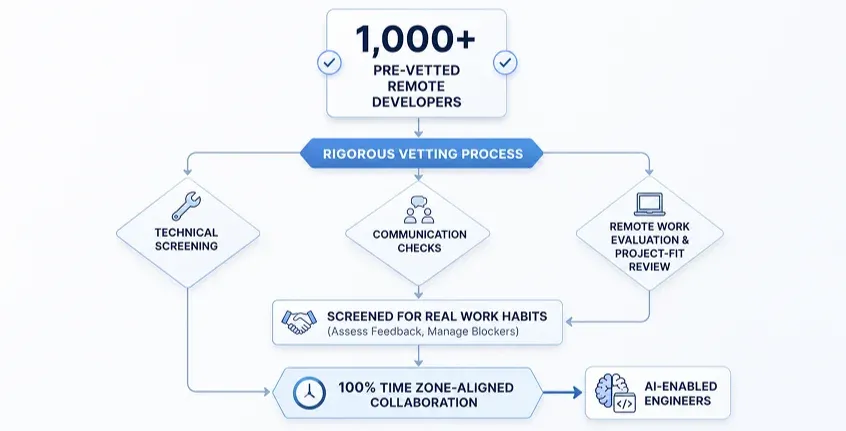
How InvoZone Screens Remote Developers Before You Interview Them
Running this interview process for every candidate takes time. You have to check technical skill, communication, ownership, time zone fit and project fit before you can trust someone with your codebase.
InvoZone shortens that process by giving you access to pre-vetted developers within 24 hours who have passed rigorously screening.
The Bottom Line
Considering the aforementioned points, hiring a remote developer should never be based on a quick call or a low hourly rate alone. Before you make the final decision, make sure the basics are properly checked: technical skills, communication style, time zone overlap, previous work, references, AI proficiency, onboarding documents, and legal terms. Once that checklist is clear, you can hire with much less stress. A little more checking before hiring can save you from hiring unvetted developers.
Share to:
Frequently Asked Questions
Find answers to common questions about our services
1.What is the single most important thing to test in a remote developer interview?
Written communication. A developer who cannot explain their work clearly in writing will create delays in every sprint. Their pull request descriptions, daily updates, and handoff notes are the main way your team stays informed without live meetings. Test this with a short written summary after the technical assessment.
2.Should I still run technical assessments if a developer has a strong portfolio?
Yes, but adjust the format. A strong portfolio tells you what they built. A short assessment tells you how they work, how they explain their decisions, and how they handle feedback. Use a 60 to 90 minute task that reflects actual work on your team, not a timed algorithm puzzle.
3.How do I test AI tool proficiency during an interview?
Ask directly: where do AI tools like GitHub Copilot, Cursor, or Claude Code help you most, and where do you not trust the output? Strong developers give specific, honest answers. They can name tasks where AI saves time and describe cases where it produced incorrect code that required manual correction. Vague answers here usually mean they are using AI but not reviewing the output carefully.
4.How many hours of daily overlap do I actually need with a remote developer?
A minimum of three to four hours per day covers standups, code reviews, and urgent blockers. If your project involves frequent live discussion, architecture decisions, or rapid iteration, four to six hours is more practical. Less than three hours of overlap means most issues get resolved the following day, which compounds into sprint delays over time.
5.What is the fastest way to skip this process for multiple hires?
Work with a pre-vetted agency. InvoZone gives companies access to 1,000+ developers already screened for technical skill, communication, and time zone alignment. Developers are matched within 24 hours and start contributing from day one, without the multi-week screening process you would otherwise run yourself.
6.How do I handle a candidate who performed well technically but raised communication red flags?
Take the red flags seriously. Technical skill is easier to verify than communication habits, and communication habits are much harder to change after hiring. If a candidate writes vague answers, responds slowly, or cannot explain their own work during the interview, those patterns will affect every sprint. A short paid trial can help you verify whether the concern is real before you commit.
7.What questions should I always ask a developer's references?
Ask whether they would hire this person again specifically for a remote role. Ask how they communicated when things went wrong, how they handled unclear requirements, and whether they ever surprised the reference positively or negatively. Ask for specific stories rather than ratings. A pause before the answer to the first question tells you more than anything they say after it.
Table of Contents
To protect your business, you need to uncover the red flags candidates try to hide.
Hiring a remote developer looks pretty simple from the outside. You believe you ask a few questions, run a technical test, check availability and make the offer.
If you’re looking for an expert software developer, it's not that simple.
To hire the perfect candidate, you need a standardized and multi-stage process with a focus on specific questions instead of mere fit.
Let us help you identify how to screen candidates with perfect interview questions designed to reveal a candidate's true qualification and character.
No more hidden red flags so you only extend offers to the right people.
Remote Developer Interview Questions
One should have a guide for hiring remote developers that walks you through building a better, highly efficient vetting process. Follow these steps below and we guarantee that you’ll land an expert developer.

Step 1: Start With a Basic Screening Call
The first call is not a technical exam. Use it to check fit before you invest more time on either side.
Ask these:
- Tell me about a recent project you worked on.
- What tech stack do you use most?
- Have you worked with remote teams before?
- What working hours can you keep?
- How do you usually share progress updates?
- What do you do when you are blocked?
- Which tools do you use for task tracking and communication?
Listen closely here. A strong remote developer gives specific answers. They describe exactly how they work, what they use, and what they do when things go wrong.
A weak answer sounds like this: "I am flexible with everything." That is not reassuring.
Step 2: Ask Questions That Reveal How They Think
Most interviews ask about years of experience. That tells you almost nothing about how someone works.
Ask questions that show judgment:
- Walk me through a feature you built recently.
- What was your exact role in that project?
- What was the hardest part?
- What would you do differently now?
- Tell me about a bug that was hard to find. How did you solve it?
- Tell me about a project that did not go well. What did you learn?
Strong candidates give specific answers. They tell you what happened, what they decided, and what changed because of it.
Weak candidates talk around the work. They describe what the project was, but cannot explain what they personally did or why.
Pay attention to that gap.
Step 3: Ask Remote-Specific Questions
This is the section most interviewers skip entirely. That is why so many remote hires fail.
Ask:
- How do you update your team when working remotely?
- What do you include in a daily progress update?
- What do you do when requirements are unclear and no one replies right away?
- How do you manage work when your team is in a different time zone?
- How do you explain a technical problem to a non-technical client?
- What do you document after finishing a task?
Here is what you are checking: can this developer keep a team informed without being asked? Remote teams run on written communication. A developer who writes poor updates will create delays even if their code is good.
InvoZone matches companies with 1,000+ pre-vetted remote developers, each screened for communication habits and project fit before any client introduction. Every developer works 100% aligned to your time zone, so standups, code reviews, and urgent questions get handled the same day.
Step 4: Ask Technical Questions That Test Judgment
In 2026, asking a developer to write a sorting algorithm from memory on a video call tests the wrong thing. AI can answer those questions in seconds. The job no longer rewards memorization.
What the job actually needs is judgment.
Ask questions that show how they think:
- How would you approach a slow API that affects user experience?
- How would you review a pull request with messy code from a junior developer?
- How would you handle a feature where the requirements keep changing mid-sprint?
- How do you decide between two technical approaches when both could work?
- How do you know when a feature is ready to ship?
Don’t skip the AI judgement question
Where do AI coding tools help you most, and where do you not trust them?
This question matters more than most interviewers realize. Developers who use GitHub Copilot, Cursor, or Claude Code well can explain exactly where those tools save time so watch for how they reason. Are they well aware of what each AI tool is proficient in? Do they ask clarifying questions? Do they mention trade-offs?
That thinking process is what you are hiring.
Step 5: Use a Practical Assessment
A great technical assessment should respect the candidate's time while accurately predicting on-the-job performance. Avoid unpaid, multi-hour take-home projects that drive away top talent.
A useful short assessment includes one of these:
- Review a pull request and explain what should change and why
- Debug a small issue in an existing codebase
- Build a small feature with clear requirements
- Write test cases for a simple function
- Talk through how they would improve a piece of existing code
Instead, use a focused 60-to-90-minute exercise, followed by a written summary to evaluate their communication skills.
Immediately after the assessment, require a short, written summary detailing:
- Changes Made: Exactly what code they altered and why.
- Testing: How they verified their work.
- Ambiguities: What was unclear or required assumptions.
- Next Steps: What they would improve if they had more time.
Why this matters: This written handoff is a direct simulation of how they will write Slack updates, pull request descriptions and project documentation. If their summary is vague, you can expect the same communication style during regular sprints.
Step 6: Confirm Time Zone Fit Before the Final Round
Do this early. Many companies leave it until the offer stage and then discover the overlap does not work.
Ask directly:
- What hours do you work and in which time zone?
- How many hours per day overlap with our core team?
- Can you attend daily standups and sprint planning?
- What is your usual response time for urgent questions during your working hours?
- How do you handle production issues that come up outside your normal hours?
Harvard Business School research found that every single hour of time zone difference reduces real-time collaboration by 11%. A three-hour drift translates directly to a 33% drop in synchronous communication.
Expert Advice: Don't rely on assumptions or vague promises of flexibility. Make absolutely sure that you hire someone who works according to your exact business hours.
Remote Developer Red Flags
Distributed hiring warning signs manifest early in the vetting process. You can isolate them during initial interactions if you know exactly how to categorize candidate behavior. Remote hiring red flags are visible during the interview itself if you know what to look for.
Vague project explanations
They describe what the project was but cannot explain what they built, why they made specific decisions, or what their role actually was.
Slow replies during the hiring process
Pre-hire is when candidates are at their most responsive. If async communication is slow now, it will not improve once they have the job.
No clarifying questions
You give them an ambiguous task and they start guessing rather than asking. That is exactly what they will do with unclear sprint tickets.
Cannot explain their own code
When you ask why they wrote a specific section a certain way, they cannot answer. In 2026, using AI assistance during an assessment is fine. Being unable to defend the output is a red flag.
Timezone mismatch
They claim to be available during your business hours but their responses consistently arrive at the wrong times.
Blaming past teams for everything
Every failed project had someone else responsible. That pattern usually continues so watch out for that.
No questions for you
A developer who does not ask about your codebase, your team process, your review cycle, or your product does not have enough curiosity to work well remotely.
Overconfidence without specifics
They claim they can do everything but cannot give a concrete example of anything.
Bonus Insight: Pay close attention to how a candidate manages their focus during live remote interviews.
Pay close attention to how they manage their physical and digital remote environment during live interviews. A candidate who takes a video interview in a loud public space without warning, constantly looks at a second screen reading text, or receives visible phone notifications is showing you how they respect focus time. Remote work requires high self-management; a chaotic interview environment often predicts a chaotic work style.
How InvoZone Screens Remote Developers Before You Interview Them
Running this interview process for every candidate takes time. You have to check technical skill, communication, ownership, time zone fit and project fit before you can trust someone with your codebase.
InvoZone shortens that process by giving you access to pre-vetted developers within 24 hours who have passed rigorously screening.

The Bottom Line
Considering the aforementioned points, hiring a remote developer should never be based on a quick call or a low hourly rate alone. Before you make the final decision, make sure the basics are properly checked: technical skills, communication style, time zone overlap, previous work, references, AI proficiency, onboarding documents, and legal terms. Once that checklist is clear, you can hire with much less stress. A little more checking before hiring can save you from hiring unvetted developers.
Share to:
Related Articles
Let’s Discuss Your Needs
Tell us about your project. we'll take it from there
