AI in Banking: How Banks Are Getting Smarter with Tech
In this blog, we will show you how banks are getting evolved with the usage of AI. We will see some core differences between banking without the usage of AI and banking with the usage of AI, some key insights and some valuable tips to enhance your banking experience if you are a banker.

“Harram is like a walking encyclopedia who loves to write about various genres but at the t...” See more
Don’t Have Time To Read Now? Download It For Later.
Table of Contents
- AI in Banking: From Rule-Based Systems to Smarter Decisions
- Credit Scores That Look Beyond the Numbers
- AI vs. traditional banking software
- Where AI Is Changing the Banking Experience
- Traditional Banking vs AI-Powered Banking Comparison
- AI Transformations that improve banking’s entire value chain
- AI Based Use Cases in Banking
- How AI Helps Banks Spots Fraud Before it Becomes a Bigger Problem
- How AI Fits Into the Banking Customer Journey
- Benefits of AI in Banking
- Faster decision making:AI has the ability to process large amounts of data quickly and help banks make fraud related decisions faster.
- Better Fraud Detection:AI can identify unusual patterns and some customer behaviours
- More Personalized Banking:Banks can use customer data to provide more relevant recommendations, products, and financial insights.
- Scalable Operations:AI systems can handle growing volumes of transactions.
- Improved Risk Management:AI can analyze changing patterns and identify potential risks earlier.
- 24/7 Customer Support: AI assistants can handle common questions and routine banking requests at any time.
- AI in Banking with the services of Invozone
- Wrap Up
AI has evolved so much in today’s time, AI is being used in so many daily activities like in smartphones & messaging, online shopping, streaming & entertainment etc but when it comes to banking it will be a much different picture made here. Today many banking systems are working under the usage of AI for different purposes but
How are banks getting smarter with tech?
How are the banks using AI in their daily routine tasks?
How are banks getting benefit by using AI in their systems?
All your answers are in this guide, you will clearly understand the concept of AI in banking and in which specific functions AI has evolved so much in banking sectors.
AI in Banking: From Rule-Based Systems to Smarter Decisions
AI in banking actually means that shifting from rigid, manual rules to the systems that learn from
Data to make smarter, adaptive decisions. The evolution of banking systems from rigid structure to AI-driven intelligences has fundamentally changed which shows how banks today manage risks, process data and interact with customers.
Today banks are getting evolved from traditional automation to AI based automation because basic software is rigid and blind to context while traditional automation efficiently repeats simple, repetitive tasks (like moving data from a spreadsheet to a database), it fails completely when faced with messy data, unpredictable human behavior, or rapidly changing financial regulations.
According to a McKinsey & Company report, only about 2% of global financial crime flows are detected despite financial institutions increasing spending on financial-crime compliance by as much as 10% annually in some advanced markets. This is a strong statistic showing why traditional rule-heavy approaches struggle with increasingly complex financial crime.
And this is where AI in banking takes its role, AI changes this by looking beyond fixed rules and identifying unauthorized transactions patterns across each and every type of transactions, customer behaviours and other data points.
Credit Scores That Look Beyond the Numbers
Your financial habits say much more about you than a traditional credit score ever could. AI-powered credit assessment helps lenders understand how people actually manage their finances rather than relying entirely on past borrowing records. Here's how AI brings a fresh perspective to credit assessment

A Better Picture of Your Financial Habits
One missed payment shouldn't define your entire financial future. AI can analyze broader financial patterns, including spending behavior, repayment consistency, and cash flow, to help lenders make more informed decisions.
More Opportunities for First-Time Borrowers
Having little or no credit history doesn't necessarily mean someone is financially irresponsible. With appropriate data and safeguards, AI can help lenders identify creditworthy individuals who might otherwise struggle to qualify for traditional loans.
Lending Decisions That Make More Sense
AI helps banks evaluate borrowing risks by identifying patterns that traditional scoring methods might overlook. This can support more responsible lending decisions while helping eligible borrowers access suitable financial products.
Know What Shapes Your Creditworthiness
Understanding your financial standing shouldn't feel like solving a puzzle. AI-powered tools can help explain the factors influencing your credit score and suggest practical ways to strengthen your financial profile over time.
AI vs. traditional banking software
AI banking uses machine learning to adapt and operate complex tasks in real time while traditional banking software depends on static rules, traditional work flows. Some of the core differences between AI vs traditional banking software are discussed below.
|
Features |
AI Banking Software |
Traditional Banking Software |
|---|---|---|
|
Data Processing |
Handles complex, unstructured data. |
Restricted to specific structured data only. |
|
Decision Making |
Adaptive and automated insights |
Rigid and static rules |
|
Customer Support |
24/7 personalized help through AI-powered personal assistants. |
Basic support depends on call, branches and predefined responses. |
|
Infrastructure |
Event-driven, cloud native |
Basic infrastructure with some legacy mainframes |
|
Compliance & Trust |
Clear explanations and proper insights |
Established processes and regulatory checks |
In these, Invozone also plays its part in enhancing the involvement of AI in banking sectors to help banking sectors generate more revenue and resolve daily life queries much faster and in more efficient way, For instance InvoZone’s AI-powered KYC solution shows how document processing and identity verification can be automated to enhance accuracy, scalability, security and efficiency in modern and efficient way.
Where AI Is Changing the Banking Experience
AI is changing the way in which it determines how customers are interacting with banks, make everyday transactions, enhancing the financial services and strongly based on personalized services, some of the key insights related to these are.

Personalized Banking Recommendations:
With the usage of AI and machine learning, these recommendations analyze the account activity to suggest relevant products and financial actions.
AI-Powered Customer Support:
This AI-Powered customer support plays an important role in providing quick, context-aware responses and handling common questions 24/7. Questions such as what’s my current account balance? Why was my card declined? What are my most recent transactions? Etc.
Faster Loan and Credit decision:
This AI-powered feature helps in analyzing financial information and application data more quickly. Also enhances the speed of lending decisions.
Smarter Fraud Alerts
Identify unusual transactions and flag those activities that look suspicious for example if a card is used for multiple purchases at different locations within minutes then AI will immediately flag that kind of activity and alert the bank
Personalized Financial Insights
AI can turn transaction data into useful insights such as budgeting suggestions and the potential ways to manage money better.
Traditional Banking vs AI-Powered Banking Comparison
Traditional banking was very limited and it had many loopholes by which people found difficulties in various banking tasks but AI-Powered banking overcame those challenges and enhanced the productivity of banking sectors. Some of the key differences between these two terms are listed below
|
Banking Area |
Traditional Approach |
AI-Driven Approach |
|---|---|---|
|
Customer Queries |
Limited responses with human based support |
Conversational AI with quick responses |
|
Risk Detection |
Predefined rules |
Real time analysis |
|
Credit Decisions |
Manual review of application |
Data-driven risk assessment |
|
Customer offers |
Genetic products based on customer segments |
Recommendations based on individual needs |
|
Data Handling |
Based on set intervals |
Based on continuous analysis |
|
Banking Operations |
Repetitive processes follow fixed workflows |
AI adapt processes based on data and context |
AI Transformations that improve banking’s entire value chain
AI is changing how banks work from the inside out. It helps teams make better decisions and automate repetitive tasks and give customers more personalized experience and services. Below is the pictorial representation.
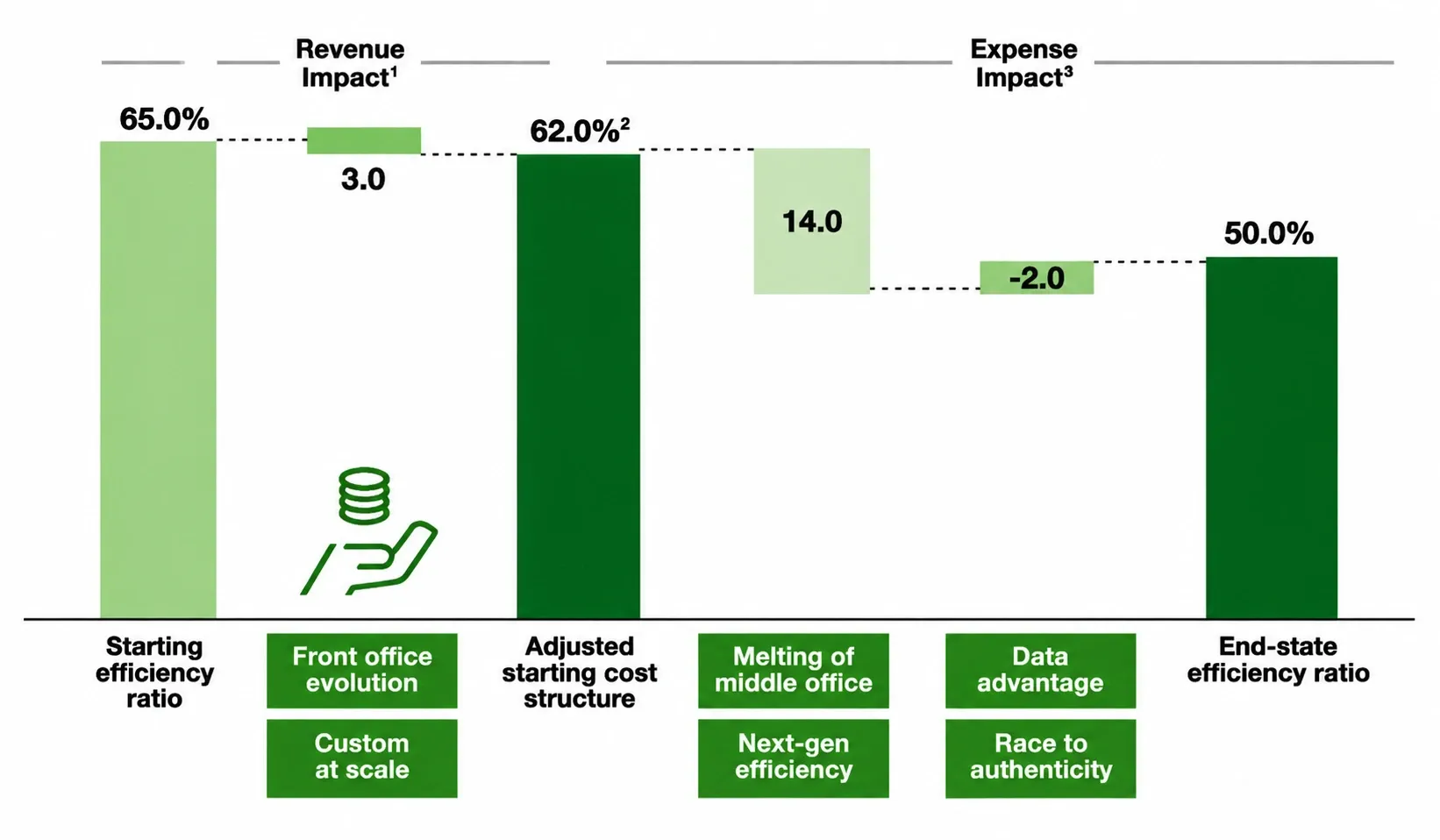
This picture clearly shows how AI is playing its role in various banking sectors and enhancing the productivity of banks. AI-powered banking is already receiving strong feedback from customers. A 2024 EPAM survey found that 96% of consumers who had used AI banking tools were satisfied with the experience, showing the potential of AI to make everyday banking more convenient and personalized.
AI Based Use Cases in Banking
AI is moving beyond basic traditional banking workflows to enhanced AI based procedures to make banking procedures relatively easy and comprehensive for everyone, below are some of them.
Fraud Detection:
Spots unusual behaviours and fraud transactions in real time for instance a customer who usually makes local purchases suddenly makes several high-value purchases in another country, triggering a fraud alert.
AI Customer Support:
Handles common queries and routine requests through 24/7 virtual assistants for instance a customer asks, “Why was my card declined?” and the AI assistant checks the account and explains the possible reason instantly.
Credit Scoring:
Analyze financial data to reduce lending risks for instance AI reviews a customer's income, repayment history, and existing debts to help determine their eligibility for a personal loan.
Personalized Banking:
Recommends products, services and financial actions based on customer behaviours for instance a bank notices that a customer regularly saves money and recommends a savings account with a better interest rate.
KYC Automation:
Extracts and verifies info from identity documents to speed up customer onboarding process for instance a customer uploads their ID, and AI extracts their name, date of birth, and ID number and checks the information automatically.
AML Monitoring:
Identifies unusual transaction patterns that may require further investigation for instance AI notices multiple small transfers moving between several accounts and flags the pattern for the compliance team.
Financial Insights:
Helps customers understand spending habits, budgets, and financial trends. For example, AI analyzes monthly transactions and tells a customer that their dining expenses have increased significantly compared with previous months.
Risk Management
Processes large amounts of data to identify potential financial and operational risks for instance AI detects that a particular type of loan is showing an unusual rise in late payments, allowing the bank to investigate the risk early.
Predictive Analytics:
Uses historical data to anticipate customer needs, market changes, and potential risks.
For example AI predicts that a customer may need additional credit based on their previous spending and borrowing patterns.
Back-Office Automation:
Reduces manual work in areas such as document processing, data entry, reporting, and reconciliation. For example AI extracts information from hundreds of loan documents and automatically enters the relevant data into the bank's system.
How AI Helps Banks Spots Fraud Before it Becomes a Bigger Problem
Some frauds may occur and identifying these frauds is very crucial before they become a bigger problem and cause major concerns for banking sectors.
Some of them are:
- Real-time transactions monitoring
- Behavioral anomaly detection
- Identity verification
- Account takeover detection
- AI-powered fraud scoring
Invozone also plays a major role in detecting fraud like InvoZone brings AI into fraud prevention through real-world security and fintech solutions. Its AI cybersecurity services include real-time threat detection and machine-learning-based threat intelligence, while its fintech projects use AI for KYC, identity verification, and fraud prevention which definitely helps in banking sectors.
How AI Fits Into the Banking Customer Journey
AI stands tall in turning customers' journey in banking to the experience that the customer will remember for a long time, some of them are listed below.
|
Customer Stage |
AI Role |
|---|---|
|
Account opening |
Identity Verification |
|
Daily Banking |
Personalized insights |
|
Payments |
Fraud Monitoring |
|
Loan Application |
Risk Assessment |
|
Financial Planning |
Predictive recommendations |
|
Customer Support |
AI assistance |
These steps are showing how AI provides its productivity to the banking sector to give each and every customer an experience to remember without causing them to face any flaws, challenges and difficulties.
Benefits of AI in Banking
So far in this blog we have discussed a lot about how far AI has shaped banking sectors to use advanced features in all banking related tasks to enhance the productivity and avoid all flaws to give customers as much satisfaction as possible, now we will look at some specific benefits.
Faster decision making:
AI has the ability to process large amounts of data quickly and help banks make fraud related decisions faster.
Better Fraud Detection:
AI can identify unusual patterns and some customer behaviours
More Personalized Banking:
Banks can use customer data to provide more relevant recommendations, products, and financial insights.
Scalable Operations:
AI systems can handle growing volumes of transactions.
Improved Risk Management:
AI can analyze changing patterns and identify potential risks earlier.
24/7 Customer Support:
AI assistants can handle common questions and routine banking requests at any time.
AI is already making a noticeable difference in financial services. According to Invoca's 2026 report, 58% of financial-services consumers said AI improved their buying experience, up from 53% in 2025. This change is very important in addressing how AI is very beneficial and adding its value in banking sectors.
AI in Banking with the services of Invozone
InvoZone helps banks bring AI into everyday operations, from fraud detection and KYC automation to smarter customer experiences. Its AI and fintech expertise supports solutions that can analyze financial data, automate repetitive work, and improve decision-making. InvoZone can also integrate AI into existing banking systems instead of requiring businesses to start from scratch. This helps financial institutions adopt AI in a practical and scalable way.
Wrap Up
In the end we can say that traditional banking contains many flaws and customers facing difficulties and challenges while dealing with traditional banking but the involvement of AI in banking, banking sector’s productivity enhanced so much as AI brings so many benefits, key insights to provide banking customer’s smoothless banking experience to remember
With tech companies like Invozone, it will help banks explore these opportunities through AI development and fraud detection solutions. The goal is simple: use AI where it can make banking more efficient, secure, and customer-friendly.
Share to:
Frequently Asked Questions
Find answers to common questions about our services
1.What problems have customers faced with traditional banking?
Traditional banking can involve slow manual processes, long wait times, limited support outside banking hours, generic financial services, and repeated paperwork. Customers may also have to visit branches or speak with agents for tasks that can now be handled digitally.
2.What is artificial intelligence in banking?
Artificial intelligence in banking means using AI systems to analyze financial data, recognize patterns, automate routine tasks, and support faster decisions. Banks use it for things like fraud detection, customer support, credit assessment, personalized recommendations, and risk management.
3.How can InvoZone help banks implement AI solutions?
InvoZone can help banks build and integrate AI solutions for areas such as fraud detection, KYC automation, customer support, financial analysis, and other banking workflows. Its AI expertise covers model development, integration, and deployment.
4.Can InvoZone build AI-powered KYC solutions for banks?
Yes. InvoZone has worked on an AI-powered OCR solution that can extract and verify information from identity documents and support facial recognition. This can help reduce manual work involved in KYC and customer onboarding.
5.Can InvoZone integrate AI into an existing banking system?
Yes. InvoZone can integrate AI models with existing banking applications, payment platforms, lending systems, and other financial technology infrastructure instead of requiring businesses to rebuild everything from scratch.
6.How does AI help banks make faster decisions?
AI can process large amounts of customer and financial data much faster than manual reviews. This helps banks speed up decisions related to loans, fraud alerts, customer requests, and risk assessment.
7. Can AI detect unusual banking activity?
Yes. AI can learn normal transaction patterns and flag activity that looks unusual, such as unexpected locations, unusually large payments, or multiple transactions within a short period.
8.How does AI personalize banking services?
AI analyzes customer behavior, spending patterns, and financial activity to provide more relevant recommendations, such as savings options, budgeting suggestions, or suitable financial products.
9.Can AI reduce false fraud alerts in banking?
AI can help reduce unnecessary alerts by looking at more than fixed transaction rules. It can consider patterns and context to distinguish potentially suspicious activity from normal customer behavior.
10.How does AI help banks with KYC and customer onboarding?
AI can extract information from identity documents, verify customer details, and automate parts of the KYC process. This can reduce manual paperwork and make account onboarding faster.
Table of Contents
- AI in Banking: From Rule-Based Systems to Smarter Decisions
- Credit Scores That Look Beyond the Numbers
- AI vs. traditional banking software
- Where AI Is Changing the Banking Experience
- Traditional Banking vs AI-Powered Banking Comparison
- AI Transformations that improve banking’s entire value chain
- AI Based Use Cases in Banking
- How AI Helps Banks Spots Fraud Before it Becomes a Bigger Problem
- How AI Fits Into the Banking Customer Journey
- Benefits of AI in Banking
- Faster decision making:AI has the ability to process large amounts of data quickly and help banks make fraud related decisions faster.
- Better Fraud Detection:AI can identify unusual patterns and some customer behaviours
- More Personalized Banking:Banks can use customer data to provide more relevant recommendations, products, and financial insights.
- Scalable Operations:AI systems can handle growing volumes of transactions.
- Improved Risk Management:AI can analyze changing patterns and identify potential risks earlier.
- 24/7 Customer Support: AI assistants can handle common questions and routine banking requests at any time.
- AI in Banking with the services of Invozone
- Wrap Up
AI has evolved so much in today’s time, AI is being used in so many daily activities like in smartphones & messaging, online shopping, streaming & entertainment etc but when it comes to banking it will be a much different picture made here. Today many banking systems are working under the usage of AI for different purposes but
How are banks getting smarter with tech?
How are the banks using AI in their daily routine tasks?
How are banks getting benefit by using AI in their systems?
All your answers are in this guide, you will clearly understand the concept of AI in banking and in which specific functions AI has evolved so much in banking sectors.
AI in Banking: From Rule-Based Systems to Smarter Decisions
AI in banking actually means that shifting from rigid, manual rules to the systems that learn from
Data to make smarter, adaptive decisions. The evolution of banking systems from rigid structure to AI-driven intelligences has fundamentally changed which shows how banks today manage risks, process data and interact with customers.
Today banks are getting evolved from traditional automation to AI based automation because basic software is rigid and blind to context while traditional automation efficiently repeats simple, repetitive tasks (like moving data from a spreadsheet to a database), it fails completely when faced with messy data, unpredictable human behavior, or rapidly changing financial regulations.
According to a McKinsey & Company report, only about 2% of global financial crime flows are detected despite financial institutions increasing spending on financial-crime compliance by as much as 10% annually in some advanced markets. This is a strong statistic showing why traditional rule-heavy approaches struggle with increasingly complex financial crime.
And this is where AI in banking takes its role, AI changes this by looking beyond fixed rules and identifying unauthorized transactions patterns across each and every type of transactions, customer behaviours and other data points.
Credit Scores That Look Beyond the Numbers
Your financial habits say much more about you than a traditional credit score ever could. AI-powered credit assessment helps lenders understand how people actually manage their finances rather than relying entirely on past borrowing records. Here's how AI brings a fresh perspective to credit assessment
A Better Picture of Your Financial Habits
One missed payment shouldn't define your entire financial future. AI can analyze broader financial patterns, including spending behavior, repayment consistency, and cash flow, to help lenders make more informed decisions.
More Opportunities for First-Time Borrowers
Having little or no credit history doesn't necessarily mean someone is financially irresponsible. With appropriate data and safeguards, AI can help lenders identify creditworthy individuals who might otherwise struggle to qualify for traditional loans.
Lending Decisions That Make More Sense
AI helps banks evaluate borrowing risks by identifying patterns that traditional scoring methods might overlook. This can support more responsible lending decisions while helping eligible borrowers access suitable financial products.
Know What Shapes Your Creditworthiness
Understanding your financial standing shouldn't feel like solving a puzzle. AI-powered tools can help explain the factors influencing your credit score and suggest practical ways to strengthen your financial profile over time.
AI vs. traditional banking software
AI banking uses machine learning to adapt and operate complex tasks in real time while traditional banking software depends on static rules, traditional work flows. Some of the core differences between AI vs traditional banking software are discussed below.
|
Features |
AI Banking Software |
Traditional Banking Software |
|---|---|---|
|
Data Processing |
Handles complex, unstructured data. |
Restricted to specific structured data only. |
|
Decision Making |
Adaptive and automated insights |
Rigid and static rules |
|
Customer Support |
24/7 personalized help through AI-powered personal assistants. |
Basic support depends on call, branches and predefined responses. |
|
Infrastructure |
Event-driven, cloud native |
Basic infrastructure with some legacy mainframes |
|
Compliance & Trust |
Clear explanations and proper insights |
Established processes and regulatory checks |
In these, Invozone also plays its part in enhancing the involvement of AI in banking sectors to help banking sectors generate more revenue and resolve daily life queries much faster and in more efficient way, For instance InvoZone’s AI-powered KYC solution shows how document processing and identity verification can be automated to enhance accuracy, scalability, security and efficiency in modern and efficient way.
Where AI Is Changing the Banking Experience
AI is changing the way in which it determines how customers are interacting with banks, make everyday transactions, enhancing the financial services and strongly based on personalized services, some of the key insights related to these are.
Personalized Banking Recommendations:
With the usage of AI and machine learning, these recommendations analyze the account activity to suggest relevant products and financial actions.
AI-Powered Customer Support:
This AI-Powered customer support plays an important role in providing quick, context-aware responses and handling common questions 24/7. Questions such as what’s my current account balance? Why was my card declined? What are my most recent transactions? Etc.
Faster Loan and Credit decision:
This AI-powered feature helps in analyzing financial information and application data more quickly. Also enhances the speed of lending decisions.
Smarter Fraud Alerts
Identify unusual transactions and flag those activities that look suspicious for example if a card is used for multiple purchases at different locations within minutes then AI will immediately flag that kind of activity and alert the bank
Personalized Financial Insights
AI can turn transaction data into useful insights such as budgeting suggestions and the potential ways to manage money better.
Traditional Banking vs AI-Powered Banking Comparison
Traditional banking was very limited and it had many loopholes by which people found difficulties in various banking tasks but AI-Powered banking overcame those challenges and enhanced the productivity of banking sectors. Some of the key differences between these two terms are listed below
|
Banking Area |
Traditional Approach |
AI-Driven Approach |
|---|---|---|
|
Customer Queries |
Limited responses with human based support |
Conversational AI with quick responses |
|
Risk Detection |
Predefined rules |
Real time analysis |
|
Credit Decisions |
Manual review of application |
Data-driven risk assessment |
|
Customer offers |
Genetic products based on customer segments |
Recommendations based on individual needs |
|
Data Handling |
Based on set intervals |
Based on continuous analysis |
|
Banking Operations |
Repetitive processes follow fixed workflows |
AI adapt processes based on data and context |
AI Transformations that improve banking’s entire value chain
AI is changing how banks work from the inside out. It helps teams make better decisions and automate repetitive tasks and give customers more personalized experience and services. Below is the pictorial representation.
This picture clearly shows how AI is playing its role in various banking sectors and enhancing the productivity of banks. AI-powered banking is already receiving strong feedback from customers. A 2024 EPAM survey found that 96% of consumers who had used AI banking tools were satisfied with the experience, showing the potential of AI to make everyday banking more convenient and personalized.
AI Based Use Cases in Banking
AI is moving beyond basic traditional banking workflows to enhanced AI based procedures to make banking procedures relatively easy and comprehensive for everyone, below are some of them.
Fraud Detection:
Spots unusual behaviours and fraud transactions in real time for instance a customer who usually makes local purchases suddenly makes several high-value purchases in another country, triggering a fraud alert.
AI Customer Support:
Handles common queries and routine requests through 24/7 virtual assistants for instance a customer asks, “Why was my card declined?” and the AI assistant checks the account and explains the possible reason instantly.
Credit Scoring:
Analyze financial data to reduce lending risks for instance AI reviews a customer's income, repayment history, and existing debts to help determine their eligibility for a personal loan.
Personalized Banking:
Recommends products, services and financial actions based on customer behaviours for instance a bank notices that a customer regularly saves money and recommends a savings account with a better interest rate.
KYC Automation:
Extracts and verifies info from identity documents to speed up customer onboarding process for instance a customer uploads their ID, and AI extracts their name, date of birth, and ID number and checks the information automatically.
AML Monitoring:
Identifies unusual transaction patterns that may require further investigation for instance AI notices multiple small transfers moving between several accounts and flags the pattern for the compliance team.
Financial Insights:
Helps customers understand spending habits, budgets, and financial trends. For example, AI analyzes monthly transactions and tells a customer that their dining expenses have increased significantly compared with previous months.
Risk Management
Processes large amounts of data to identify potential financial and operational risks for instance AI detects that a particular type of loan is showing an unusual rise in late payments, allowing the bank to investigate the risk early.
Predictive Analytics:
Uses historical data to anticipate customer needs, market changes, and potential risks.
For example AI predicts that a customer may need additional credit based on their previous spending and borrowing patterns.
Back-Office Automation:
Reduces manual work in areas such as document processing, data entry, reporting, and reconciliation. For example AI extracts information from hundreds of loan documents and automatically enters the relevant data into the bank's system.
How AI Helps Banks Spots Fraud Before it Becomes a Bigger Problem
Some frauds may occur and identifying these frauds is very crucial before they become a bigger problem and cause major concerns for banking sectors.
Some of them are:
- Real-time transactions monitoring
- Behavioral anomaly detection
- Identity verification
- Account takeover detection
- AI-powered fraud scoring
Invozone also plays a major role in detecting fraud like InvoZone brings AI into fraud prevention through real-world security and fintech solutions. Its AI cybersecurity services include real-time threat detection and machine-learning-based threat intelligence, while its fintech projects use AI for KYC, identity verification, and fraud prevention which definitely helps in banking sectors.
How AI Fits Into the Banking Customer Journey
AI stands tall in turning customers' journey in banking to the experience that the customer will remember for a long time, some of them are listed below.
|
Customer Stage |
AI Role |
|---|---|
|
Account opening |
Identity Verification |
|
Daily Banking |
Personalized insights |
|
Payments |
Fraud Monitoring |
|
Loan Application |
Risk Assessment |
|
Financial Planning |
Predictive recommendations |
|
Customer Support |
AI assistance |
These steps are showing how AI provides its productivity to the banking sector to give each and every customer an experience to remember without causing them to face any flaws, challenges and difficulties.
Benefits of AI in Banking
So far in this blog we have discussed a lot about how far AI has shaped banking sectors to use advanced features in all banking related tasks to enhance the productivity and avoid all flaws to give customers as much satisfaction as possible, now we will look at some specific benefits.
Faster decision making:
AI has the ability to process large amounts of data quickly and help banks make fraud related decisions faster.
Better Fraud Detection:
AI can identify unusual patterns and some customer behaviours
More Personalized Banking:
Banks can use customer data to provide more relevant recommendations, products, and financial insights.
Scalable Operations:
AI systems can handle growing volumes of transactions.
Improved Risk Management:
AI can analyze changing patterns and identify potential risks earlier.
24/7 Customer Support:
AI assistants can handle common questions and routine banking requests at any time.
AI is already making a noticeable difference in financial services. According to Invoca's 2026 report, 58% of financial-services consumers said AI improved their buying experience, up from 53% in 2025. This change is very important in addressing how AI is very beneficial and adding its value in banking sectors.
AI in Banking with the services of Invozone
InvoZone helps banks bring AI into everyday operations, from fraud detection and KYC automation to smarter customer experiences. Its AI and fintech expertise supports solutions that can analyze financial data, automate repetitive work, and improve decision-making. InvoZone can also integrate AI into existing banking systems instead of requiring businesses to start from scratch. This helps financial institutions adopt AI in a practical and scalable way.
Wrap Up
In the end we can say that traditional banking contains many flaws and customers facing difficulties and challenges while dealing with traditional banking but the involvement of AI in banking, banking sector’s productivity enhanced so much as AI brings so many benefits, key insights to provide banking customer’s smoothless banking experience to remember
With tech companies like Invozone, it will help banks explore these opportunities through AI development and fraud detection solutions. The goal is simple: use AI where it can make banking more efficient, secure, and customer-friendly.
Share to:
Related Articles
Let’s Discuss Your Needs
Tell us about your project. we'll take it from there
