How to Ensure Productivity with Remote Developers in 2026
In this guide, you will learn what developer productivity means and what usually hinders productivity in remote teams. You’ll understand how the S.P.A.C.E. framework helps measure real output and which management practices help remote developers work most efficiently.

“Furqan Aziz is CEO & Founder of InvoZone. He is a tech enthusiast by heart with 10+ years ...” See more
Don’t Have Time To Read Now? Download It For Later.
Table of Contents
Many founders and engineering managers look at remote work the wrong way.
They try to measure productivity by the hours a developer is online or how busy they seem during the day. However, that does not guarantee that the hired developer is working to its optimum potential.
Read below to see exactly what you can do to guarantee how your remote software developer operates at maximum productivity and efficiency.
Master these strategies to make sure that the next time you hire, you'll know exactly how to get top-tier remote productivity.
What is Developer Productivity?
In everyday language, "productivity" is simply the ability to produce. In software development, developer productivity refers to a team's ability to achieve outlined business objectives through developing, improving, and maintaining software.
We surveyed developers to understand better how they viewed this concept in the context of software development. The overwhelming majority agreed that it is a "combination of processes and tools and people and skills."
Despite this, the most common method of measuring productivity and for a surprising number of teams, the only method is throughput (i.e., the sheer amount of units of work completed). There is a massive discrepancy between how we define a developer’s productivity and how we actually measure it.
To fix this, we have to look closely at the challenges clients face when working with remote teams.
The Core Challenges Clients Face with Remote Model

Before you can fix remote developer productivity, you have to know what is actually breaking it on your end.
-
Communication Barriers: Without face-to-face contact, a client's technical requirements and feedback tone get completely lost in plain text messages.
-
Limited Visibility: Clients often feel blind, leading them to micromanage because they don't know the actual status of a feature.
-
Time Zone Delays: Waiting twelve hours for a remote developer to answer a critical project is extremely frustrating.
-
Developer Burnout: When clients send requests 24/7, remote developers burn out. This leads to exhaustion with more sudden project dropouts.
-
Poor Tool Setups: Forcing teams to use clunky, slow or outdated tracking systems creates massive administrative friction for both client and developer.
-
Weak Team Connection: Isolated developers stop caring about the client's business vision and treat tasks like mindless tickets.
To fix these problems, you need an objective system that tracks true progress while giving engineers the space they need to build.
Use the SPACE Framework to Measure Productivity
To tie all of these management habits together into a real actionable system, smart clients use the S.P.A.C.E. Framework. Developed by tech researchers at GitHub and Microsoft, this system provides clear categories to measure remote output without resorting to micromanagement.
When managing your remote developer, track performance across these five dimensions:
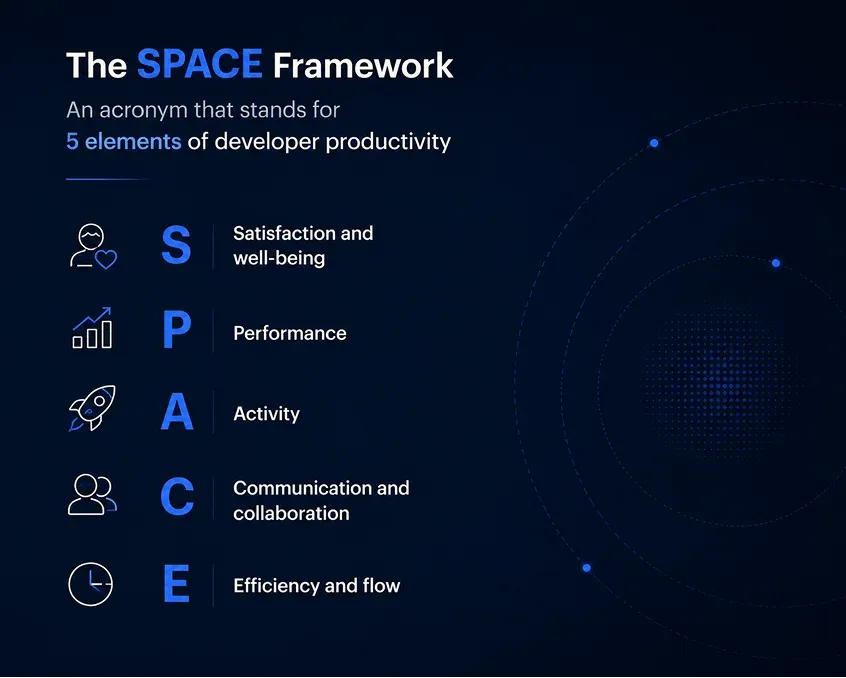
Space Framework Metrics
Use these five metrics to measure remote developer productivity without relying only on online hours, task counts or constant check-ins.
-
Satisfaction & Well-being: Measure satisfaction, head off burnout risk, and continuously improve the workplace.
-
Performance: Measure overall outcomes - product quality, reliability, customer satisfaction - rather than individual output.
-
Activity: Tracking output metrics matters, but the focus should be on outcomes like what quality of work is achieved.
-
Communication and Collaboration: Aligned cross-functional teams communicating and achieving greater productivity and delivering superior outcomes.
-
Efficiency and Flow: Efficiency is measured by the quality and quantity of uninterrupted output over time.
7 Ultimate Tips for Managing Your Remote Software Developers Effectively
1. Onboard a Competent Remote Developer
High productivity starts during the vetting and hiring process.
A productive remote developer may include hiring a project manager, business analyst, software engineers, QA engineer, UI/UX designer, and DevOps engineer depending on the project.
Before hiring, check whether the developer can work independently, communicate clearly, document work properly, and stay available during your required working hours.
Make sure they are checked for:
- Technical skills
- Communication habits
- Project fit
- Time zone availability
- AI tool fluency
This is where outsourcing to an agency that lets you hire remote developers helps reduce hiring friction by giving companies immediate access to 1,000+ pre-vetted remote developers who are strictly screened for technical skills, communication, and project fit.
2. Set Goals and Assess Performance Clearly
Remote teams work better when expectations are clear from the start.
Do not assign vague tasks like “work on the app” or “fix the dashboard.” Break the work into clear goals with deadlines, ownership, and success criteria.
For example:
- What is the specific outcome?
- Who owns the task?
- What is the firm deadline?
- What does “done” actually look like (acceptance criteria)?
- Who is responsible for the final review?
- What documentation is required?
- What is the escalation path if the task gets blocked?
Why this matters: Research from 2026 engineering performance studies highlights that developers provided with clear, output-based goals report a 40% higher sense of autonomy and engagement compared to those working from ambiguous criterias.
Track performance through output, not online hours. Useful performance signals include sprint progress, cycle time, pull request review time, bug rate, completed tickets, blocked tasks and release progress.
This keeps the focus on real product movement instead of micromanaging the developer’s day.
3. Streamline Processes and Procedures
A remote team needs a clear workflow. If the process is messy, developers lose time asking repeated questions, waiting for approvals, or guessing what to do next. If you lack the internal resources to scale this structure, looking into a talented development team can provide an established workflow right out of the box.
Keep the process clear by defining:
- Sprint workflow
- Git and branch rules
- Code review process
- QA steps
- Deployment process
- Documentation rules
This reduces repeated questions and helps developers complete tasks with speed and high efficiency..
4. Select the Right Collaboration Tools
Use tools that make work visible without creating extra admin work.
A simple remote software team stack can include Slack or Teams for communication, Zoom or Google Meet for calls, Jira or Linear for tasks, GitHub or GitLab for code, Notion or Confluence for documentation, and Figma for design work.
Keep in Mind
The goal is not to use more tools. The goal is to make sure everyone knows exactly where tasks, updates, files, code reviews and decisions live. To maximize output, you can focus your infrastructure on specific operations. For instance, setting up a clear DevOps strategy automates your testing and release pipelines which helps your remote developers ship features much more efficiently.
5. Schedule Regular Meetings Across Time Zones
Remote teams need regular check-ins, but not too many meetings. Use meetings to remove blockers, align priorities, and build trust.
Useful meetings include:
- Daily standups
- Weekly planning
- Backlog grooming
- Demo calls
- Sprint retrospectives
- One-on-one check-ins
Time zone alignment matters here. Look for agencies like InvoZone’s with 100% time zone-aligned collaboration that helps remote developers stay active during the client’s business hours. This way feedback, approvals and blockers can be handled on time.
6. Track Project Progress with Timelines
Use timelines and dashboards to see where the project stands. Track sprint progress, blocked tasks, pull requests, QA status, release dates, and upcoming deadlines.
Tools like Jira, Asana, Trello, ClickUp or Linear can help leaders see progress without constantly asking developers for updates.
Good tracking answers simple questions:
- What is done?
- What is blocked?
- What needs review?
- What is delayed?
- What is ready for release?
This gives both the client and the remote software developer a clear view of progress.
7. Regularly Evaluate and Improve the Workflow
Remote productivity improves when you keep reviewing the system.
Research shows that the most successful remote setups aren't static but they are constantly tuned to prevent "process decay." When you proactively evaluate your hiring and remote management patterns, you catch alignment issues and get them resolved on time.
High output isn't a one-time setup; it happens when you consistently remove the small friction points blocking your developer's progress.
Want Productive Remote Developers Without Any Hassle?
If you want to hire efficient pre-vetted remote developers who are completely screened for technical skills, communication and project fit, InvoZone is a great pick. Their AI-enabled developers are integrated into your workflow within just 24-hour. Not only that, you get 100% time zone-aligned collaboration with developers who follow your timezone and business hours.

The Bottom Line
Ensuring productivity with remote developers starts with the right setup. If goals are unclear, documentation is missing, tools are scattered, or time zones do not align, even skilled developers can struggle to deliver consistent work. Remote development works best when companies stop managing hours and start managing clarity and efficient output. With the right process and the right talent, remote software developers can become a reliable extension of your team and help projects achieve outcomes on time. A clear view of remote hiring costs and engagement options can help you choose developers who fit your long-term goals.
Share to:
Frequently Asked Questions
Find answers to common questions about our services
1.What is the single most important metric in the SPACE framework?
There isn't one, and that is the whole point of the framework! Relying on just one metric backfires because developers will naturally change their behavior to change that number. To get an accurate picture, you must pick 1–2 simple metrics from at least three different categories (like combining sprint progress, bug rates and a quick weekly satisfaction score).
2.How often should we review our workflow and tools?
Review the workflow every 2 to 4 weeks, usually during a sprint retrospective. You do not need to change tools every month. Look for repeated issues like unclear task briefs, slow reviews, missing documentation, delayed QA or too many meetings.
3.Will using AI coding tools make my remote developer twice as fast?
Not exactly. While AI helps developers write initial drafts of code or test routines much quicker, industry data shows it also introduces major quality risks, like a massive jump in code churn (code that has to be rewritten or thrown out because it didn't work right). AI speeds up individual coding tasks, but human code reviews and solid testing pipelines are still required to ship stable software.
4.What tools help manage remote developer productivity?
Useful tools include Slack or Teams for communication, Zoom or Google Meet for calls, Jira or Linear for task tracking, GitHub or GitLab for code, Notion or Confluence for documentation, and Figma for design. The goal is not more tools. The goal is to keep tasks, updates, files, code reviews, and decisions easy to find.
5.What is the fastest way to onboard a new remote developer and get them up to speed?
The best metric to track here is Time-to-First-Commit (how many days it takes a new hire to deploy their first small line of code). To make this fast, provide a clear setup checklist, automated local environment scripts, and updated documentation on day one so they can start contributing immediately instead of chasing access passwords.
Table of Contents
Many founders and engineering managers look at remote work the wrong way.
They try to measure productivity by the hours a developer is online or how busy they seem during the day. However, that does not guarantee that the hired developer is working to its optimum potential.
Read below to see exactly what you can do to guarantee how your remote software developer operates at maximum productivity and efficiency.
Master these strategies to make sure that the next time you hire, you'll know exactly how to get top-tier remote productivity.
What is Developer Productivity?
In everyday language, "productivity" is simply the ability to produce. In software development, developer productivity refers to a team's ability to achieve outlined business objectives through developing, improving, and maintaining software.
We surveyed developers to understand better how they viewed this concept in the context of software development. The overwhelming majority agreed that it is a "combination of processes and tools and people and skills."
Despite this, the most common method of measuring productivity and for a surprising number of teams, the only method is throughput (i.e., the sheer amount of units of work completed). There is a massive discrepancy between how we define a developer’s productivity and how we actually measure it.
To fix this, we have to look closely at the challenges clients face when working with remote teams.
The Core Challenges Clients Face with Remote Model

Before you can fix remote developer productivity, you have to know what is actually breaking it on your end.
-
Communication Barriers: Without face-to-face contact, a client's technical requirements and feedback tone get completely lost in plain text messages.
-
Limited Visibility: Clients often feel blind, leading them to micromanage because they don't know the actual status of a feature.
-
Time Zone Delays: Waiting twelve hours for a remote developer to answer a critical project is extremely frustrating.
-
Developer Burnout: When clients send requests 24/7, remote developers burn out. This leads to exhaustion with more sudden project dropouts.
-
Poor Tool Setups: Forcing teams to use clunky, slow or outdated tracking systems creates massive administrative friction for both client and developer.
-
Weak Team Connection: Isolated developers stop caring about the client's business vision and treat tasks like mindless tickets.
To fix these problems, you need an objective system that tracks true progress while giving engineers the space they need to build.
Use the SPACE Framework to Measure Productivity
To tie all of these management habits together into a real actionable system, smart clients use the S.P.A.C.E. Framework. Developed by tech researchers at GitHub and Microsoft, this system provides clear categories to measure remote output without resorting to micromanagement.
When managing your remote developer, track performance across these five dimensions:

Space Framework Metrics
Use these five metrics to measure remote developer productivity without relying only on online hours, task counts or constant check-ins.
-
Satisfaction & Well-being: Measure satisfaction, head off burnout risk, and continuously improve the workplace.
-
Performance: Measure overall outcomes - product quality, reliability, customer satisfaction - rather than individual output.
-
Activity: Tracking output metrics matters, but the focus should be on outcomes like what quality of work is achieved.
-
Communication and Collaboration: Aligned cross-functional teams communicating and achieving greater productivity and delivering superior outcomes.
-
Efficiency and Flow: Efficiency is measured by the quality and quantity of uninterrupted output over time.
7 Ultimate Tips for Managing Your Remote Software Developers Effectively
1. Onboard a Competent Remote Developer
High productivity starts during the vetting and hiring process.
A productive remote developer may include hiring a project manager, business analyst, software engineers, QA engineer, UI/UX designer, and DevOps engineer depending on the project.
Before hiring, check whether the developer can work independently, communicate clearly, document work properly, and stay available during your required working hours.
Make sure they are checked for:
- Technical skills
- Communication habits
- Project fit
- Time zone availability
- AI tool fluency
This is where outsourcing to an agency that lets you hire remote developers helps reduce hiring friction by giving companies immediate access to 1,000+ pre-vetted remote developers who are strictly screened for technical skills, communication, and project fit.
2. Set Goals and Assess Performance Clearly
Remote teams work better when expectations are clear from the start.
Do not assign vague tasks like “work on the app” or “fix the dashboard.” Break the work into clear goals with deadlines, ownership, and success criteria.
For example:
- What is the specific outcome?
- Who owns the task?
- What is the firm deadline?
- What does “done” actually look like (acceptance criteria)?
- Who is responsible for the final review?
- What documentation is required?
- What is the escalation path if the task gets blocked?
Why this matters: Research from 2026 engineering performance studies highlights that developers provided with clear, output-based goals report a 40% higher sense of autonomy and engagement compared to those working from ambiguous criterias.
Track performance through output, not online hours. Useful performance signals include sprint progress, cycle time, pull request review time, bug rate, completed tickets, blocked tasks and release progress.
This keeps the focus on real product movement instead of micromanaging the developer’s day.
3. Streamline Processes and Procedures
A remote team needs a clear workflow. If the process is messy, developers lose time asking repeated questions, waiting for approvals, or guessing what to do next. If you lack the internal resources to scale this structure, looking into a talented development team can provide an established workflow right out of the box.
Keep the process clear by defining:
- Sprint workflow
- Git and branch rules
- Code review process
- QA steps
- Deployment process
- Documentation rules
This reduces repeated questions and helps developers complete tasks with speed and high efficiency..
4. Select the Right Collaboration Tools
Use tools that make work visible without creating extra admin work.
A simple remote software team stack can include Slack or Teams for communication, Zoom or Google Meet for calls, Jira or Linear for tasks, GitHub or GitLab for code, Notion or Confluence for documentation, and Figma for design work.
Keep in Mind
The goal is not to use more tools. The goal is to make sure everyone knows exactly where tasks, updates, files, code reviews and decisions live. To maximize output, you can focus your infrastructure on specific operations. For instance, setting up a clear DevOps strategy automates your testing and release pipelines which helps your remote developers ship features much more efficiently.
5. Schedule Regular Meetings Across Time Zones
Remote teams need regular check-ins, but not too many meetings. Use meetings to remove blockers, align priorities, and build trust.
Useful meetings include:
- Daily standups
- Weekly planning
- Backlog grooming
- Demo calls
- Sprint retrospectives
- One-on-one check-ins
Time zone alignment matters here. Look for agencies like InvoZone’s with 100% time zone-aligned collaboration that helps remote developers stay active during the client’s business hours. This way feedback, approvals and blockers can be handled on time.
6. Track Project Progress with Timelines
Use timelines and dashboards to see where the project stands. Track sprint progress, blocked tasks, pull requests, QA status, release dates, and upcoming deadlines.
Tools like Jira, Asana, Trello, ClickUp or Linear can help leaders see progress without constantly asking developers for updates.
Good tracking answers simple questions:
- What is done?
- What is blocked?
- What needs review?
- What is delayed?
- What is ready for release?
This gives both the client and the remote software developer a clear view of progress.
7. Regularly Evaluate and Improve the Workflow
Remote productivity improves when you keep reviewing the system.
Research shows that the most successful remote setups aren't static but they are constantly tuned to prevent "process decay." When you proactively evaluate your hiring and remote management patterns, you catch alignment issues and get them resolved on time.
High output isn't a one-time setup; it happens when you consistently remove the small friction points blocking your developer's progress.
Want Productive Remote Developers Without Any Hassle?
If you want to hire efficient pre-vetted remote developers who are completely screened for technical skills, communication and project fit, InvoZone is a great pick. Their AI-enabled developers are integrated into your workflow within just 24-hour. Not only that, you get 100% time zone-aligned collaboration with developers who follow your timezone and business hours.

The Bottom Line
Ensuring productivity with remote developers starts with the right setup. If goals are unclear, documentation is missing, tools are scattered, or time zones do not align, even skilled developers can struggle to deliver consistent work. Remote development works best when companies stop managing hours and start managing clarity and efficient output. With the right process and the right talent, remote software developers can become a reliable extension of your team and help projects achieve outcomes on time. A clear view of remote hiring costs and engagement options can help you choose developers who fit your long-term goals.
Share to:
Related Articles
Let’s Discuss Your Needs
Tell us about your project. we'll take it from there
