

Top Enterprise Compliance Automation Platforms for Healthcare: Comparing GRC Tools & Software
Healthcare compliance automation is now essential. This guide compares Vanta, OneTrust, AuditBoard, LogicGate Risk Cloud, and MetricStream to help healthcare teams manage risk and stay HIPAA-ready.


Published On: 11 November, 2025


8 min read
Table of Contents
- How we compared the platforms
- Vanta: Best overall compliance automation for healthcare
- OneTrust: best for merging privacy and security in one pane
- AuditBoard: Best fit for large hospital audit and compliance teams
- LogicGate Risk Cloud: best when you need custom GRC workflows
- MetricStream: best for enterprise-scale, AI-powered compliance
- Emerging trends in healthcare compliance automation
- Conclusion: Turning software into sustained compliance
Breaches keep getting pricier. In 2024, attackers exposed 133 million patient records and drove the average cost of a healthcare breach to $11 million. Now the White House is reviewing the first major update to the HIPAA Security Rule in a decade, one that would bake continuous cyber safeguards into daily care.Understanding the role of AI in healthcare compliance has never been more critical for protecting patient data at scale.
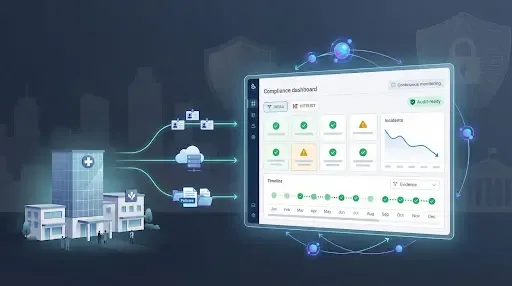
If you’re responsible for protecting patient data and satisfying auditors, spreadsheets no longer cut it. This guide compares leading enterprise compliance automation platforms built for healthcare so you can stay secure, stay audit-ready, and keep pace with every new rule.
How we compared the platforms
Most compliance platforms look great in a demo. The difference shows up when an auditor asks for evidence, a new clinic comes online, or a new privacy rule drops mid-quarter. To keep this comparison grounded, we scored every vendor against the same six criteria.
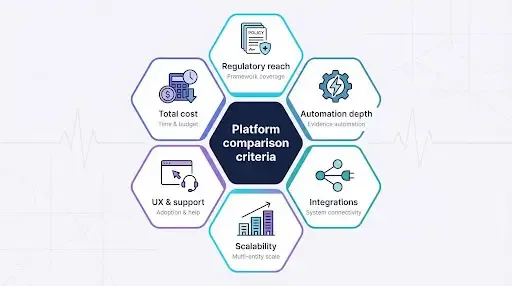
- Regulatory reach: HIPAA is the baseline. We scored higher when platforms also support HITRUST, GDPR, and emerging state privacy requirements without awkward add-ons.
- Automation depth: We looked for systems that collect and validate evidence continuously, not tools that turn your team into professional screenshot-takers.
- Integrations: Healthcare environments are a patchwork of EHRs, cloud services, and identity systems. We favored platforms with ready-made connectors over solutions that depend on custom scripts.
- Scalability: A single clinic and a 30-facility health system have very different rollout needs. We prioritized tools that can support multi-entity deployments without creating disconnected workspaces.
- User experience and support: Adoption matters. Clear dashboards and responsive support reduce stalled controls and last-minute fire drills.
- Total cost of ownership: Subscription price is only part of the math. We weighed onboarding effort and ongoing staff time saved to reflect real ROI.
The outcome is a side-by-side view designed for healthcare teams, focused on day-to-day audit readiness rather than vendor promises.
Vanta: Best overall compliance automation for healthcare
Vanta takes the top spot for healthcare teams because it turns compliance from a periodic scramble into a continuous system. If your reality is constant auditor requests, changing HIPAA expectations, and a growing cloud footprint, Vanta’s core strength is simple: it keeps evidence collection running in the background so your team can focus on fixing risk, not chasing screenshots.
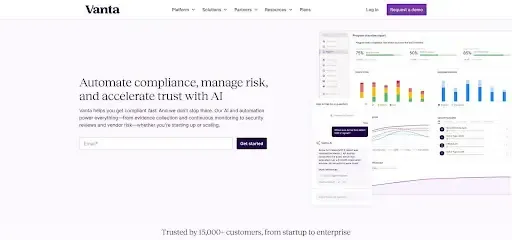
What it is: Vanta is an automated GRC and trust management platform built around continuous compliance automation, audit readiness, and trust reporting.
Why healthcare teams choose it
Vanta supports 35+ out-of-the-box frameworks, including HIPAA, and it is designed to map controls across multiple standards so you can implement once and reuse evidence across overlapping requirements. That matters if you need to show HIPAA readiness while also pursuing SOC 2, ISO 27001, or other frameworks used in vendor and payer security reviews. Teams exploring AI predictive analytics use cases in healthcare will find this multi-framework approach especially useful when layering compliance on top of data-driven workflows.
On the automation side, Vanta runs 1,300+ automated tests hourly and pairs that with 400+ native integrations across cloud, identity, HR, security, and engineering systems. The practical outcome is fewer manual evidence requests and faster drift detection when configurations change.
Company snapshot and proof points
Vanta was founded in 2018 and is headquartered in San Francisco, CA, with offices in Dublin, London, New York, and Sydney. It has more than 14,000 customers in over 60 countries and was positioned as a Leader in the 2025 IDC MarketScape for worldwide GRC software. IDC’s Business Value study reported 526% three-year ROI with an approximately three-month payback.
AI and trust workflows (where it goes beyond checklists)
Vanta’s AI capabilities are embedded across common compliance bottlenecks, including:
- AI Agent designed to execute compliance tasks
- AI-powered Trust Center chatbot for real-time Q&A
- AI questionnaire automation that helps teams respond faster to security reviews
- Smart Policy Builder plus AI-assisted control mapping and evidence evaluation
- AI-assisted vendor review workflows, including document scanning
Enterprise readiness and rollout
For larger provider groups and multi-entity environments, Vanta includes enterprise controls such as custom role-based access control (RBAC), SCIM provisioning, multiple identity provider support, Workspaces, and customizable SLAs. Implementation is typically measured in weeks, not months, and the original focus remains strong: get to continuous monitoring quickly, then expand coverage.
Pricing and fit
Vanta is packaged in Core, Scale, and Enterprise tiers, with pricing based on factors like framework scope, employee count, and selected modules. Reported median contract value is around $19.5K, with larger enterprise deployments scaling based on scope.
Best fit for: mid-market and enterprise healthcare organizations that want maximum automation with minimal compliance overhead, especially teams managing multiple frameworks and needing continuous evidence for auditors and customer security reviews.
Limitations to plan for: Vanta is not a full, traditional enterprise risk management suite. If you need deep ERM portfolio heat maps or broader privacy operations like cookie consent and DSAR automation, you may pair it with a privacy-first platform or a more expansive GRC system.
Bottom line: Vanta is the strongest overall pick when “always-on evidence, fast audits, and scalable controls” is the job, not “build a custom GRC program from scratch.”
OneTrust: best for merging privacy and security in one pane
OneTrust is the broadest platform in this guide. If your compliance mandate spans security controls, privacy governance, third-party risk, and executive reporting, OneTrust is designed to pull those threads into one operating system. Organizations that have already invested in a custom healthcare app will appreciate OneTrust's ability to wrap privacy governance around digital patient touchpoints.
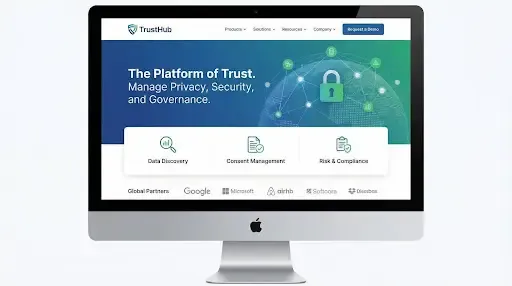
Category and core use case: OneTrust is an enterprise privacy, risk, and compliance platform. In practice, it is most compelling when privacy operations are as important as audit readiness, for example consent management, data mapping, and third-party risk at scale.
Company snapshot and platform DNA
OneTrust was founded in 2016 and is headquartered in Atlanta with a major presence in London. The company has around 3,500 employees, has raised $1.13B, and built much of its breadth through 11 acquisitions. It reports more than 14,000 customers, including 75 percent of the Fortune 100, although expert notes flag that roughly half of those customers use only the cookie consent product.
Its compliance automation capabilities came largely through the Tugboat Logic acquisition in 2021, which is a helpful context when you evaluate how deep the automation goes.
Framework coverage, strong on privacy and regulatory sprawl
OneTrust supports 50+ frameworks across privacy, security, and risk domains. It is particularly strong on privacy frameworks like GDPR, CCPA, and LGPD, and it also covers newer regulations such as DORA and the EU AI Act.
Automation depth and continuous monitoring, where buyers should be precise
OneTrust can streamline compliance work through workflows, portals, and structured evidence collection, but expert analysis highlights a key limitation for security compliance teams.
- Compliance automation is workflow-driven, with users attaching evidence through processes, rather than
- continuous monitoring of internal controls.
- Evidence gathering via integrations is described as weekly or lower frequency, not near-real-time control testing.
- Pre-built automated testing is more limited than purpose-built compliance automation tools, with fewer deep checks across cloud services.
If your top priority is continuous technical evidence collection, you should validate this area in a proof of concept, not a slide deck.
Integrations and ecosystem fit
OneTrust’s total integration count is cited at about 100, with roughly 22 focused on tech risk and compliance. Expert notes also call out gaps that can matter in real deployments, including limited out-of-the-box coverage for version control systems, fewer bi-directional ticketing options, no MDM integrations, and limited policy sync with common document repositories. Custom integrations are possible, but often require coding.
AI capabilities and reporting
OneTrust has meaningful AI investment in areas like data discovery and responsible AI governance, and it supports Power BI-backed reporting for custom dashboards. The AI story is stronger on privacy and governance use cases than on automated remediation for technical controls.
Enterprise readiness, third-party risk, and vendor sprawl
Where OneTrust consistently earns its keep is enterprise workflow depth. It supports multi-entity programs, org-chart-aligned workflows, APIs, and vendor management at scale. VendorPedia provides an exchange with 6,000+ pre-populated vendor profiles, which can speed up third-party risk efforts for large healthcare ecosystems with long vendor lists.
Note that OneTrust’s product portfolio has shifted, and expert notes indicate it has sold off ethics and ESG divisions to private equity firms.
Implementation and pricing expectations
OneTrust is not “turn it on this weekend” software. Expert notes cite implementation services ranging from $5,000 for a self-starter kit up to $100,000+, and multi-module deployments commonly take months.
Pricing is also enterprise-scale and module-dependent:
- Tech Risk & Compliance: $50K to $300K
- Third-party risk (TPRM): $40K to $500K Implementation is typically additional.
Best fit for: large healthcare organizations that need privacy operations, third-party risk, and compliance workflows connected in one place, and that are willing to invest in implementation.
Limitations to plan for: If your program success is defined by continuous technical control monitoring and deep out-of-the-box integrations for automated evidence, OneTrust can require more manual work and more engineering effort than specialized compliance automation platforms.
Bottom line: OneTrust is the “wide-angle lens” choice. It shines when privacy governance and vendor risk are first-class problems. For always-on technical control validation, buyers should go in with clear eyes about the monitoring and automation model.
AuditBoard: Best fit for large hospital audit and compliance teams
AuditBoard is built for organizations where “compliance” really means audit operations. If you plan audits, test controls, track findings, manage remediation, and brief leadership, AuditBoard gives you a single workspace to run that entire lifecycle instead of stitching it together in spreadsheets and point tools.
Category and core use case: an audit and risk management platform with deep workflow for internal audit and IT risk. In healthcare, it is a strong match for large hospital audit and compliance teams that need structure, traceability, and board-ready reporting. Teams looking to hire AI healthcare engineers to support their compliance infrastructure will find AuditBoard a natural complement to an AI-augmented audit team.
How it supports HIPAA-driven programs
AuditBoard’s value is less about a fast HIPAA checklist and more about making HIPAA reviews run like disciplined audit programs. Using CrossComply, its IT-risk module, internal auditors can scope a HIPAA review, test controls, log exceptions, and assign remediation work without exporting data to another system.
Workflow depth and enterprise oversight
Where AuditBoard stands out is governance. The platform connects frontline evidence and control testing to a centralized risk register. When a control fails, the issue can roll up into enterprise risk reporting so executives see the exposure in context, not as an isolated task.
Teams also get structured workflows that hold up in complex environments:
- assign control owners
- require evidence sign-off
- route issues through configurable approval chains
- track remediation tasks end to end
For multi-department compliance programs, that structure is often the difference between “we think it’s handled” and “we can prove it’s handled.”
Implementation reality and trade-offs
AuditBoard is not a lightweight, plug-and-play compliance tool. It requires planning, configuration, and committed champions across audit and IT to get the workflows right. That upfront investment pays off when the platform becomes your system of record for audit, risk, and remediation, but it is not a weekend deployment.
Best fit for: large provider groups and health systems with dedicated internal audit functions, multiple departments involved in control ownership, and leadership expectations for real-time risk visibility.
Bottom line: AuditBoard is a strong choice when you need enterprise-grade audit execution and risk reporting, not just a place to upload evidence. If your compliance program already operates at the scale of a small city, AuditBoard is designed to be city hall.
LogicGate Risk Cloud: best when you need custom GRC workflows
LogicGate Risk Cloud is a good fit when your biggest problem is not understanding the rules, it is getting the work to move through your organization consistently. In healthcare, that often means routing the right tasks to the right owners across privacy, security, audit, clinical operations, and vendor management, then proving who approved what and when.
Category and core use case: a low-code GRC platform built for flexible, configurable workflows. The value is process design and orchestration more than out-of-the-box compliance automation. Healthcare leaders exploring future LLM use cases in clinical settings will find that a flexible workflow engine like LogicGate can adapt quickly to new AI-driven processes as they emerge.
Company snapshot
LogicGate was founded in 2015, is headquartered in Chicago, and has about 300 employees. It has raised $156M including a Series 5A in September 2024, and it reports “hundreds” of customers.
Frameworks and control mapping
Risk Cloud supports 30+ frameworks, with cross-mapping to connect requirements across standards. Expert notes also flag that it lacks out-of-the-box support for several regional and international frameworks (examples cited include Cyber Essentials, Essential Eight, TISAX, CJIS, AWS FTR, and Microsoft SSPA). If you have specialized requirements, plan to configure or extend content.
Automation and monitoring, what it does and does not do
LogicGate can automate parts of evidence collection through integrations and its Jobs engine, for example scheduled data pulls. What it does not appear to offer, based on the expert notes, is deep automated infrastructure testing like purpose-built compliance automation platforms. Monitoring is described as scheduled (quarterly or similar), not hourly or real time.
That difference matters. If your goal is continuous technical control validation across cloud and identity systems, you will want to validate whether LogicGate’s model meets that bar, or whether it shifts more of the burden to workflow design and manual evidence collection.
Integrations and ecosystem fit
LogicGate has 40+ pre-built integrations, which is materially smaller than the ecosystems offered by automation-first platforms. Custom integrations are possible via API and configuration, but that usually increases setup effort and ongoing maintenance.
AI capabilities
AI is not a primary, documented differentiator in the provided expert intelligence. There is no noted AI agent, AI policy builder, AI chatbot, or AI questionnaire automation in the template data.
Enterprise readiness and adjacent modules
Risk Cloud’s enterprise story is flexibility. It also offers modules that many compliance automation tools do not, including ESG management, internal audit management, data privacy management, and operational resilience. Another practical note from the expert data is that non-admin users are included at no extra cost, which can matter in large, distributed programs where many people need to complete attestations or approvals.
Implementation timeline and pricing
Because the platform is designed for customization, implementation typically requires design work up front. It is generally faster than legacy GRC suites, but slower than plug-and-play compliance automation, since you are building workflows rather than simply turning on pre-built tests.
Pricing is quote-based, and the expert notes cite online pricing data ranging from $11,000 to $126,000 per year, with a median around $52,000, plus likely additional implementation costs.
Best fit for: enterprise healthcare organizations that already understand what they need to do, but struggle to operationalize it across teams, entities, and approval chains. If your workflows are unique, Risk Cloud’s builder can be a strong advantage.
Limitations to plan for: fewer pre-built integrations and a lack of documented automated infrastructure testing can translate into more configuration, more maintenance, and less continuous monitoring than automation-first platforms. Expert notes also cite customer feedback about slower innovation, with some capabilities staying on the roadmap for years.
Bottom line: LogicGate Risk Cloud is a workflow engine for GRC. If you need a system that molds how your organization actually runs, it is worth shortlisting. If you need always-on technical evidence collection with minimal setup, you may want a more automation-native platform.
MetricStream: best for enterprise-scale, AI-powered compliance
MetricStream is built for organizations where risk data is everywhere and leadership expects one version of the truth. If your health system spans multiple hospitals, lines of business, and oversight committees, MetricStream’s core promise is consolidation; it centralizes compliance, enterprise risk, audit, and third-party oversight on a single platform designed for large programs.
Category and core use case: a traditional, full-suite enterprise GRC platform. The strongest use case is running a comprehensive risk operating model, not simply accelerating one audit.
Platform approach to regulations and frameworks
MetricStream does not lead with “turnkey frameworks” in the same way modern compliance automation tools do. Instead, it uses a Unified Control Framework approach that maps 9,300+ IT control statements to 1,200+ regulations. For large organizations with overlapping obligations and many internal control owners, that cross-mapping can be powerful, but it also means more upfront design and configuration.
Automation depth and continuous monitoring reality
MetricStream’s automation strength is more workflow and program management than infrastructure-connected testing. Evidence collection is described in the expert notes as primarily driven by questionnaires, surveys, and self-assessments, rather than a large library of automated technical tests.
That distinction matters for healthcare buyers. If your definition of "continuous compliance" is hourly validation of cloud and identity controls, you should expect more manual evidence operations here than with automation-first platforms. Organizations building or deploying an AI virtual assistant for healthcare will want to pair MetricStream with more granular, real-time monitoring tools to cover technical control gaps.
AI capabilities, where it helps most
MetricStream positions itself as “AI-First,” with capabilities including AI-powered policy search/chat, cyber risk quantification, asset management features that detect vulnerability patterns, and threat landscape monitoring. In other words, the AI story is strongest in risk analytics and prioritization, not in hands-off control testing.
Enterprise readiness, where it stands out
MetricStream’s depth is difficult for lightweight tools to match. The expert notes highlight modules for:
- Enterprise risk management (ERM)
- Internal audit management
- Regulatory change management, including monitoring 750+ legislative and regulatory authorities
- Operational resilience
- ESG management
- Cases and incident management
- A centralized asset inventory with risk ratings
It also supports both cloud and on-prem deployments, which can matter in complex environments.
Implementation timeline and cost expectations
MetricStream implementations are closer to ERP projects than SaaS onboarding. Expect months of configuration, process mapping, and training. The expert notes also include customer feedback that implementation can take too long and that support coverage is not always available outside standard hours.
Pricing is highly customized. The expert notes cite typical ranges of:
- $75K to $150K per year for smaller enterprise deployments
- $250K to $500K per year for mid-sized deployments
- $750K to $1M per year for large enterprises
Support and maintenance are additional and can vary by service level.
Best fit for: large health systems that need an enterprise GRC backbone across ERM, audit, regulatory change, and resilience, and that have dedicated teams to run and administer the platform.
Limitations to plan for: if your primary pain is manual evidence collection for technical controls, MetricStream’s questionnaire-driven model can feel heavy. The platform’s power comes with complexity, a longer implementation runway, and higher total cost of ownership.
Bottom line: MetricStream is the “big system” option. When you need enterprise-wide risk governance across many domains, it delivers depth. When you need plug-and-play, automated compliance testing, it is often more platform than you need.
Emerging trends in healthcare compliance automation
Healthcare compliance automation is shifting from “collect evidence for the audit” to “prove control health every day.” The platforms that win in 2026 are the ones that reduce manual evidence work, surface drift quickly, and connect technical signals to privacy and governance outcomes.
AI-powered, always-on monitoring
Compliance is moving from periodic checklists to always-on posture tracking, and AI is accelerating the shift.
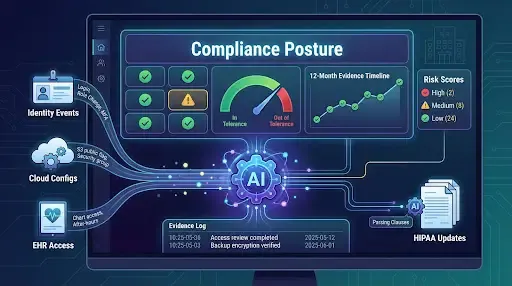
Deep learning in healthcare is one of the key drivers behind this shift, enabling platforms to detect anomalies in clinical and administrative data far faster than traditional rule-based systems.Modern platforms ingest streams of log data such as identity events, cloud configuration changes, and EHR access patterns, then use models to flag anomalies faster than a manual review cycle. When permissions drift away from least privilege or an S3 bucket flips public, the system can flag the change, assign a risk score, and in some tools, trigger a fix before protected health information (PHI) is exposed.
That continuous loop changes audit prep. Instead of scrambling for screenshots before an annual assessment, you operate from a live dashboard where controls are either in tolerance or out of tolerance right now. Auditors can review a full year of timestamped evidence already collected by the system, which reduces fieldwork and lowers the cost of getting through an audit window.
AI is also starting to compress regulatory change work. Algorithms can parse proposed HIPAA clauses, map them to existing control libraries, and suggest policy updates so compliance managers can review and publish changes faster than a manual gap analysis cycle.
Zero Trust and deeper identity integrations
Zero Trust is becoming a practical compliance expectation, not a concept deck. Ninety-six percent of healthcare organizations now plan or run Zero Trust programs, and identity controls are increasingly treated as baseline safeguards.
That shift pushes compliance tooling closer to the identity layer. Instead of relying on quarterly access dumps, modern platforms sync with identity providers such as Okta, Azure AD, or Imprivata frequently, verifying that users still need the access they have. When a physician leaves, revocation can show up in your compliance system immediately, shrinking the audit gap that used to linger for days.
Some tools go further by mapping user privileges to specific HIPAA safeguards. If an account gains a risky role outside minimum-necessary scope, the platform can flag the change as both a security risk and a potential compliance issue, and in advanced setups, open a ticket to remove the access.
Cloud-native, API-first architectures
Healthcare workloads live across cloud, data centers, and endpoints, and compliance platforms are following the same pattern with SaaS-first, API-driven designs.
API hooks let platforms pull configuration data straight from Kubernetes manifests, Terraform plans, or CI/CD pipelines. The moment a developer merges code that opens an unsecured port, the compliance engine can flag the build, stop the pipeline, and record the event for auditors. Compliance becomes a guardrail inside delivery workflows, not a retroactive review after deployment.
Cloud-native delivery also means faster updates. New HIPAA mappings, new cloud policies, or a connector for a newly adopted system can ship continuously, without weekend maintenance windows or version-upgrade projects.
Privacy and security finally converge
Privacy and security can no longer operate as parallel programs. Patients demand transparency, regulators add new disclosure requirements, and vendor ecosystems keep expanding. Compliance platforms are responding by connecting privacy governance and security controls in the same workflows.
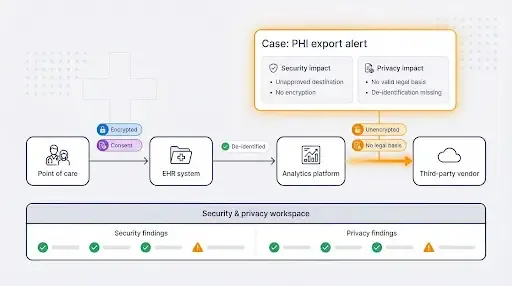
Tools increasingly let you trace where PHI moves from point of care to analytics, tagging each step with both security controls and the legal basis for processing. If data is exported without the proper de-identification flag, the platform can raise both a breach risk and a privacy-law violation in the same alert.
The operational payoff is alignment. When privacy impact assessments sit beside vulnerability findings and access reviews, teams spend less time debating ownership and more time closing gaps, which reduces incident escalations and speeds up approvals for data initiatives without sacrificing patient rights.
Conclusion: Turning software into sustained compliance
Buying a platform is the easy part. The hard part is getting consistent execution across clinics, departments, and vendors, then keeping it consistent after the rollout team moves on. These practices help you turn a tool into a program.
- Secure executive and clinical sponsorship early. Position the rollout as a patient-safety and operational resilience upgrade, not an IT project. When clinical leadership backs the change, control ownership stops feeling optional.
- Run a quick, honest gap analysis. Document where evidence lives today, what breaks during audits, and where you are paying penalties in time or risk. A clean baseline makes it easier to prove ROI later.
- Pilot narrowly, then expand. Start with one framework (often HIPAA Security) and one business unit. Fix integration and workflow friction while the blast radius is small, then scale the model.
- Connect the integrations that remove the most manual work. Prioritize identity, cloud, and ticketing first. Automated data flows are where the real time savings show up, and manual uploads tend to stay manual.
- Train by role, not by feature. Control owners need a simple way to upload or attest evidence. Executives need a one-page view. Auditors need read-only access. If everyone gets the same training, adoption drifts.
- Operate in 30-day improvement cycles. Use dashboards to find controls that fail repeatedly and teams that lag, then fix the root cause quickly. Fast iteration keeps the platform from becoming shelfware.
- Use your vendor’s community to move faster. Peers have already built connectors, templates, and reporting packs. Borrow what works instead of rebuilding from scratch.
- Keep compliance visible all year. Embed posture metrics into leadership reviews and regular operating rhythms. When red flags show up in real time, you reduce firefights and build continuous readiness.
Don’t Have Time To Read Now? Download It For Later.
Table of Contents
- How we compared the platforms
- Vanta: Best overall compliance automation for healthcare
- OneTrust: best for merging privacy and security in one pane
- AuditBoard: Best fit for large hospital audit and compliance teams
- LogicGate Risk Cloud: best when you need custom GRC workflows
- MetricStream: best for enterprise-scale, AI-powered compliance
- Emerging trends in healthcare compliance automation
- Conclusion: Turning software into sustained compliance
Breaches keep getting pricier. In 2024, attackers exposed 133 million patient records and drove the average cost of a healthcare breach to $11 million. Now the White House is reviewing the first major update to the HIPAA Security Rule in a decade, one that would bake continuous cyber safeguards into daily care.Understanding the role of AI in healthcare compliance has never been more critical for protecting patient data at scale.
If you’re responsible for protecting patient data and satisfying auditors, spreadsheets no longer cut it. This guide compares leading enterprise compliance automation platforms built for healthcare so you can stay secure, stay audit-ready, and keep pace with every new rule.
How we compared the platforms
Most compliance platforms look great in a demo. The difference shows up when an auditor asks for evidence, a new clinic comes online, or a new privacy rule drops mid-quarter. To keep this comparison grounded, we scored every vendor against the same six criteria.
- Regulatory reach: HIPAA is the baseline. We scored higher when platforms also support HITRUST, GDPR, and emerging state privacy requirements without awkward add-ons.
- Automation depth: We looked for systems that collect and validate evidence continuously, not tools that turn your team into professional screenshot-takers.
- Integrations: Healthcare environments are a patchwork of EHRs, cloud services, and identity systems. We favored platforms with ready-made connectors over solutions that depend on custom scripts.
- Scalability: A single clinic and a 30-facility health system have very different rollout needs. We prioritized tools that can support multi-entity deployments without creating disconnected workspaces.
- User experience and support: Adoption matters. Clear dashboards and responsive support reduce stalled controls and last-minute fire drills.
- Total cost of ownership: Subscription price is only part of the math. We weighed onboarding effort and ongoing staff time saved to reflect real ROI.
The outcome is a side-by-side view designed for healthcare teams, focused on day-to-day audit readiness rather than vendor promises.
Vanta: Best overall compliance automation for healthcare
Vanta takes the top spot for healthcare teams because it turns compliance from a periodic scramble into a continuous system. If your reality is constant auditor requests, changing HIPAA expectations, and a growing cloud footprint, Vanta’s core strength is simple: it keeps evidence collection running in the background so your team can focus on fixing risk, not chasing screenshots.
What it is: Vanta is an automated GRC and trust management platform built around continuous compliance automation, audit readiness, and trust reporting.
Why healthcare teams choose it
Vanta supports 35+ out-of-the-box frameworks, including HIPAA, and it is designed to map controls across multiple standards so you can implement once and reuse evidence across overlapping requirements. That matters if you need to show HIPAA readiness while also pursuing SOC 2, ISO 27001, or other frameworks used in vendor and payer security reviews. Teams exploring AI predictive analytics use cases in healthcare will find this multi-framework approach especially useful when layering compliance on top of data-driven workflows.
On the automation side, Vanta runs 1,300+ automated tests hourly and pairs that with 400+ native integrations across cloud, identity, HR, security, and engineering systems. The practical outcome is fewer manual evidence requests and faster drift detection when configurations change.
Company snapshot and proof points
Vanta was founded in 2018 and is headquartered in San Francisco, CA, with offices in Dublin, London, New York, and Sydney. It has more than 14,000 customers in over 60 countries and was positioned as a Leader in the 2025 IDC MarketScape for worldwide GRC software. IDC’s Business Value study reported 526% three-year ROI with an approximately three-month payback.
AI and trust workflows (where it goes beyond checklists)
Vanta’s AI capabilities are embedded across common compliance bottlenecks, including:
- AI Agent designed to execute compliance tasks
- AI-powered Trust Center chatbot for real-time Q&A
- AI questionnaire automation that helps teams respond faster to security reviews
- Smart Policy Builder plus AI-assisted control mapping and evidence evaluation
- AI-assisted vendor review workflows, including document scanning
Enterprise readiness and rollout
For larger provider groups and multi-entity environments, Vanta includes enterprise controls such as custom role-based access control (RBAC), SCIM provisioning, multiple identity provider support, Workspaces, and customizable SLAs. Implementation is typically measured in weeks, not months, and the original focus remains strong: get to continuous monitoring quickly, then expand coverage.
Pricing and fit
Vanta is packaged in Core, Scale, and Enterprise tiers, with pricing based on factors like framework scope, employee count, and selected modules. Reported median contract value is around $19.5K, with larger enterprise deployments scaling based on scope.
Best fit for: mid-market and enterprise healthcare organizations that want maximum automation with minimal compliance overhead, especially teams managing multiple frameworks and needing continuous evidence for auditors and customer security reviews.
Limitations to plan for: Vanta is not a full, traditional enterprise risk management suite. If you need deep ERM portfolio heat maps or broader privacy operations like cookie consent and DSAR automation, you may pair it with a privacy-first platform or a more expansive GRC system.
Bottom line: Vanta is the strongest overall pick when “always-on evidence, fast audits, and scalable controls” is the job, not “build a custom GRC program from scratch.”
OneTrust: best for merging privacy and security in one pane
OneTrust is the broadest platform in this guide. If your compliance mandate spans security controls, privacy governance, third-party risk, and executive reporting, OneTrust is designed to pull those threads into one operating system. Organizations that have already invested in a custom healthcare app will appreciate OneTrust's ability to wrap privacy governance around digital patient touchpoints.
Category and core use case: OneTrust is an enterprise privacy, risk, and compliance platform. In practice, it is most compelling when privacy operations are as important as audit readiness, for example consent management, data mapping, and third-party risk at scale.
Company snapshot and platform DNA
OneTrust was founded in 2016 and is headquartered in Atlanta with a major presence in London. The company has around 3,500 employees, has raised $1.13B, and built much of its breadth through 11 acquisitions. It reports more than 14,000 customers, including 75 percent of the Fortune 100, although expert notes flag that roughly half of those customers use only the cookie consent product.
Its compliance automation capabilities came largely through the Tugboat Logic acquisition in 2021, which is a helpful context when you evaluate how deep the automation goes.
Framework coverage, strong on privacy and regulatory sprawl
OneTrust supports 50+ frameworks across privacy, security, and risk domains. It is particularly strong on privacy frameworks like GDPR, CCPA, and LGPD, and it also covers newer regulations such as DORA and the EU AI Act.
Automation depth and continuous monitoring, where buyers should be precise
OneTrust can streamline compliance work through workflows, portals, and structured evidence collection, but expert analysis highlights a key limitation for security compliance teams.
- Compliance automation is workflow-driven, with users attaching evidence through processes, rather than
- continuous monitoring of internal controls.
- Evidence gathering via integrations is described as weekly or lower frequency, not near-real-time control testing.
- Pre-built automated testing is more limited than purpose-built compliance automation tools, with fewer deep checks across cloud services.
If your top priority is continuous technical evidence collection, you should validate this area in a proof of concept, not a slide deck.
Integrations and ecosystem fit
OneTrust’s total integration count is cited at about 100, with roughly 22 focused on tech risk and compliance. Expert notes also call out gaps that can matter in real deployments, including limited out-of-the-box coverage for version control systems, fewer bi-directional ticketing options, no MDM integrations, and limited policy sync with common document repositories. Custom integrations are possible, but often require coding.
AI capabilities and reporting
OneTrust has meaningful AI investment in areas like data discovery and responsible AI governance, and it supports Power BI-backed reporting for custom dashboards. The AI story is stronger on privacy and governance use cases than on automated remediation for technical controls.
Enterprise readiness, third-party risk, and vendor sprawl
Where OneTrust consistently earns its keep is enterprise workflow depth. It supports multi-entity programs, org-chart-aligned workflows, APIs, and vendor management at scale. VendorPedia provides an exchange with 6,000+ pre-populated vendor profiles, which can speed up third-party risk efforts for large healthcare ecosystems with long vendor lists.
Note that OneTrust’s product portfolio has shifted, and expert notes indicate it has sold off ethics and ESG divisions to private equity firms.
Implementation and pricing expectations
OneTrust is not “turn it on this weekend” software. Expert notes cite implementation services ranging from $5,000 for a self-starter kit up to $100,000+, and multi-module deployments commonly take months.
Pricing is also enterprise-scale and module-dependent:
- Tech Risk & Compliance: $50K to $300K
- Third-party risk (TPRM): $40K to $500K Implementation is typically additional.
Best fit for: large healthcare organizations that need privacy operations, third-party risk, and compliance workflows connected in one place, and that are willing to invest in implementation.
Limitations to plan for: If your program success is defined by continuous technical control monitoring and deep out-of-the-box integrations for automated evidence, OneTrust can require more manual work and more engineering effort than specialized compliance automation platforms.
Bottom line: OneTrust is the “wide-angle lens” choice. It shines when privacy governance and vendor risk are first-class problems. For always-on technical control validation, buyers should go in with clear eyes about the monitoring and automation model.
AuditBoard: Best fit for large hospital audit and compliance teams
AuditBoard is built for organizations where “compliance” really means audit operations. If you plan audits, test controls, track findings, manage remediation, and brief leadership, AuditBoard gives you a single workspace to run that entire lifecycle instead of stitching it together in spreadsheets and point tools.
Category and core use case: an audit and risk management platform with deep workflow for internal audit and IT risk. In healthcare, it is a strong match for large hospital audit and compliance teams that need structure, traceability, and board-ready reporting. Teams looking to hire AI healthcare engineers to support their compliance infrastructure will find AuditBoard a natural complement to an AI-augmented audit team.
How it supports HIPAA-driven programs
AuditBoard’s value is less about a fast HIPAA checklist and more about making HIPAA reviews run like disciplined audit programs. Using CrossComply, its IT-risk module, internal auditors can scope a HIPAA review, test controls, log exceptions, and assign remediation work without exporting data to another system.
Workflow depth and enterprise oversight
Where AuditBoard stands out is governance. The platform connects frontline evidence and control testing to a centralized risk register. When a control fails, the issue can roll up into enterprise risk reporting so executives see the exposure in context, not as an isolated task.
Teams also get structured workflows that hold up in complex environments:
- assign control owners
- require evidence sign-off
- route issues through configurable approval chains
- track remediation tasks end to end
For multi-department compliance programs, that structure is often the difference between “we think it’s handled” and “we can prove it’s handled.”
Implementation reality and trade-offs
AuditBoard is not a lightweight, plug-and-play compliance tool. It requires planning, configuration, and committed champions across audit and IT to get the workflows right. That upfront investment pays off when the platform becomes your system of record for audit, risk, and remediation, but it is not a weekend deployment.
Best fit for: large provider groups and health systems with dedicated internal audit functions, multiple departments involved in control ownership, and leadership expectations for real-time risk visibility.
Bottom line: AuditBoard is a strong choice when you need enterprise-grade audit execution and risk reporting, not just a place to upload evidence. If your compliance program already operates at the scale of a small city, AuditBoard is designed to be city hall.
LogicGate Risk Cloud: best when you need custom GRC workflows
LogicGate Risk Cloud is a good fit when your biggest problem is not understanding the rules, it is getting the work to move through your organization consistently. In healthcare, that often means routing the right tasks to the right owners across privacy, security, audit, clinical operations, and vendor management, then proving who approved what and when.
Category and core use case: a low-code GRC platform built for flexible, configurable workflows. The value is process design and orchestration more than out-of-the-box compliance automation. Healthcare leaders exploring future LLM use cases in clinical settings will find that a flexible workflow engine like LogicGate can adapt quickly to new AI-driven processes as they emerge.
Company snapshot
LogicGate was founded in 2015, is headquartered in Chicago, and has about 300 employees. It has raised $156M including a Series 5A in September 2024, and it reports “hundreds” of customers.
Frameworks and control mapping
Risk Cloud supports 30+ frameworks, with cross-mapping to connect requirements across standards. Expert notes also flag that it lacks out-of-the-box support for several regional and international frameworks (examples cited include Cyber Essentials, Essential Eight, TISAX, CJIS, AWS FTR, and Microsoft SSPA). If you have specialized requirements, plan to configure or extend content.
Automation and monitoring, what it does and does not do
LogicGate can automate parts of evidence collection through integrations and its Jobs engine, for example scheduled data pulls. What it does not appear to offer, based on the expert notes, is deep automated infrastructure testing like purpose-built compliance automation platforms. Monitoring is described as scheduled (quarterly or similar), not hourly or real time.
That difference matters. If your goal is continuous technical control validation across cloud and identity systems, you will want to validate whether LogicGate’s model meets that bar, or whether it shifts more of the burden to workflow design and manual evidence collection.
Integrations and ecosystem fit
LogicGate has 40+ pre-built integrations, which is materially smaller than the ecosystems offered by automation-first platforms. Custom integrations are possible via API and configuration, but that usually increases setup effort and ongoing maintenance.
AI capabilities
AI is not a primary, documented differentiator in the provided expert intelligence. There is no noted AI agent, AI policy builder, AI chatbot, or AI questionnaire automation in the template data.
Enterprise readiness and adjacent modules
Risk Cloud’s enterprise story is flexibility. It also offers modules that many compliance automation tools do not, including ESG management, internal audit management, data privacy management, and operational resilience. Another practical note from the expert data is that non-admin users are included at no extra cost, which can matter in large, distributed programs where many people need to complete attestations or approvals.
Implementation timeline and pricing
Because the platform is designed for customization, implementation typically requires design work up front. It is generally faster than legacy GRC suites, but slower than plug-and-play compliance automation, since you are building workflows rather than simply turning on pre-built tests.
Pricing is quote-based, and the expert notes cite online pricing data ranging from $11,000 to $126,000 per year, with a median around $52,000, plus likely additional implementation costs.
Best fit for: enterprise healthcare organizations that already understand what they need to do, but struggle to operationalize it across teams, entities, and approval chains. If your workflows are unique, Risk Cloud’s builder can be a strong advantage.
Limitations to plan for: fewer pre-built integrations and a lack of documented automated infrastructure testing can translate into more configuration, more maintenance, and less continuous monitoring than automation-first platforms. Expert notes also cite customer feedback about slower innovation, with some capabilities staying on the roadmap for years.
Bottom line: LogicGate Risk Cloud is a workflow engine for GRC. If you need a system that molds how your organization actually runs, it is worth shortlisting. If you need always-on technical evidence collection with minimal setup, you may want a more automation-native platform.
MetricStream: best for enterprise-scale, AI-powered compliance
MetricStream is built for organizations where risk data is everywhere and leadership expects one version of the truth. If your health system spans multiple hospitals, lines of business, and oversight committees, MetricStream’s core promise is consolidation; it centralizes compliance, enterprise risk, audit, and third-party oversight on a single platform designed for large programs.
Category and core use case: a traditional, full-suite enterprise GRC platform. The strongest use case is running a comprehensive risk operating model, not simply accelerating one audit.
Platform approach to regulations and frameworks
MetricStream does not lead with “turnkey frameworks” in the same way modern compliance automation tools do. Instead, it uses a Unified Control Framework approach that maps 9,300+ IT control statements to 1,200+ regulations. For large organizations with overlapping obligations and many internal control owners, that cross-mapping can be powerful, but it also means more upfront design and configuration.
Automation depth and continuous monitoring reality
MetricStream’s automation strength is more workflow and program management than infrastructure-connected testing. Evidence collection is described in the expert notes as primarily driven by questionnaires, surveys, and self-assessments, rather than a large library of automated technical tests.
That distinction matters for healthcare buyers. If your definition of "continuous compliance" is hourly validation of cloud and identity controls, you should expect more manual evidence operations here than with automation-first platforms. Organizations building or deploying an AI virtual assistant for healthcare will want to pair MetricStream with more granular, real-time monitoring tools to cover technical control gaps.
AI capabilities, where it helps most
MetricStream positions itself as “AI-First,” with capabilities including AI-powered policy search/chat, cyber risk quantification, asset management features that detect vulnerability patterns, and threat landscape monitoring. In other words, the AI story is strongest in risk analytics and prioritization, not in hands-off control testing.
Enterprise readiness, where it stands out
MetricStream’s depth is difficult for lightweight tools to match. The expert notes highlight modules for:
- Enterprise risk management (ERM)
- Internal audit management
- Regulatory change management, including monitoring 750+ legislative and regulatory authorities
- Operational resilience
- ESG management
- Cases and incident management
- A centralized asset inventory with risk ratings
It also supports both cloud and on-prem deployments, which can matter in complex environments.
Implementation timeline and cost expectations
MetricStream implementations are closer to ERP projects than SaaS onboarding. Expect months of configuration, process mapping, and training. The expert notes also include customer feedback that implementation can take too long and that support coverage is not always available outside standard hours.
Pricing is highly customized. The expert notes cite typical ranges of:
- $75K to $150K per year for smaller enterprise deployments
- $250K to $500K per year for mid-sized deployments
- $750K to $1M per year for large enterprises
Support and maintenance are additional and can vary by service level.
Best fit for: large health systems that need an enterprise GRC backbone across ERM, audit, regulatory change, and resilience, and that have dedicated teams to run and administer the platform.
Limitations to plan for: if your primary pain is manual evidence collection for technical controls, MetricStream’s questionnaire-driven model can feel heavy. The platform’s power comes with complexity, a longer implementation runway, and higher total cost of ownership.
Bottom line: MetricStream is the “big system” option. When you need enterprise-wide risk governance across many domains, it delivers depth. When you need plug-and-play, automated compliance testing, it is often more platform than you need.
Emerging trends in healthcare compliance automation
Healthcare compliance automation is shifting from “collect evidence for the audit” to “prove control health every day.” The platforms that win in 2026 are the ones that reduce manual evidence work, surface drift quickly, and connect technical signals to privacy and governance outcomes.
AI-powered, always-on monitoring
Compliance is moving from periodic checklists to always-on posture tracking, and AI is accelerating the shift.
Deep learning in healthcare is one of the key drivers behind this shift, enabling platforms to detect anomalies in clinical and administrative data far faster than traditional rule-based systems.Modern platforms ingest streams of log data such as identity events, cloud configuration changes, and EHR access patterns, then use models to flag anomalies faster than a manual review cycle. When permissions drift away from least privilege or an S3 bucket flips public, the system can flag the change, assign a risk score, and in some tools, trigger a fix before protected health information (PHI) is exposed.
That continuous loop changes audit prep. Instead of scrambling for screenshots before an annual assessment, you operate from a live dashboard where controls are either in tolerance or out of tolerance right now. Auditors can review a full year of timestamped evidence already collected by the system, which reduces fieldwork and lowers the cost of getting through an audit window.
AI is also starting to compress regulatory change work. Algorithms can parse proposed HIPAA clauses, map them to existing control libraries, and suggest policy updates so compliance managers can review and publish changes faster than a manual gap analysis cycle.
Zero Trust and deeper identity integrations
Zero Trust is becoming a practical compliance expectation, not a concept deck. Ninety-six percent of healthcare organizations now plan or run Zero Trust programs, and identity controls are increasingly treated as baseline safeguards.
That shift pushes compliance tooling closer to the identity layer. Instead of relying on quarterly access dumps, modern platforms sync with identity providers such as Okta, Azure AD, or Imprivata frequently, verifying that users still need the access they have. When a physician leaves, revocation can show up in your compliance system immediately, shrinking the audit gap that used to linger for days.
Some tools go further by mapping user privileges to specific HIPAA safeguards. If an account gains a risky role outside minimum-necessary scope, the platform can flag the change as both a security risk and a potential compliance issue, and in advanced setups, open a ticket to remove the access.
Cloud-native, API-first architectures
Healthcare workloads live across cloud, data centers, and endpoints, and compliance platforms are following the same pattern with SaaS-first, API-driven designs.
API hooks let platforms pull configuration data straight from Kubernetes manifests, Terraform plans, or CI/CD pipelines. The moment a developer merges code that opens an unsecured port, the compliance engine can flag the build, stop the pipeline, and record the event for auditors. Compliance becomes a guardrail inside delivery workflows, not a retroactive review after deployment.
Cloud-native delivery also means faster updates. New HIPAA mappings, new cloud policies, or a connector for a newly adopted system can ship continuously, without weekend maintenance windows or version-upgrade projects.
Privacy and security finally converge
Privacy and security can no longer operate as parallel programs. Patients demand transparency, regulators add new disclosure requirements, and vendor ecosystems keep expanding. Compliance platforms are responding by connecting privacy governance and security controls in the same workflows.
Tools increasingly let you trace where PHI moves from point of care to analytics, tagging each step with both security controls and the legal basis for processing. If data is exported without the proper de-identification flag, the platform can raise both a breach risk and a privacy-law violation in the same alert.
The operational payoff is alignment. When privacy impact assessments sit beside vulnerability findings and access reviews, teams spend less time debating ownership and more time closing gaps, which reduces incident escalations and speeds up approvals for data initiatives without sacrificing patient rights.
Conclusion: Turning software into sustained compliance
Buying a platform is the easy part. The hard part is getting consistent execution across clinics, departments, and vendors, then keeping it consistent after the rollout team moves on. These practices help you turn a tool into a program.
- Secure executive and clinical sponsorship early. Position the rollout as a patient-safety and operational resilience upgrade, not an IT project. When clinical leadership backs the change, control ownership stops feeling optional.
- Run a quick, honest gap analysis. Document where evidence lives today, what breaks during audits, and where you are paying penalties in time or risk. A clean baseline makes it easier to prove ROI later.
- Pilot narrowly, then expand. Start with one framework (often HIPAA Security) and one business unit. Fix integration and workflow friction while the blast radius is small, then scale the model.
- Connect the integrations that remove the most manual work. Prioritize identity, cloud, and ticketing first. Automated data flows are where the real time savings show up, and manual uploads tend to stay manual.
- Train by role, not by feature. Control owners need a simple way to upload or attest evidence. Executives need a one-page view. Auditors need read-only access. If everyone gets the same training, adoption drifts.
- Operate in 30-day improvement cycles. Use dashboards to find controls that fail repeatedly and teams that lag, then fix the root cause quickly. Fast iteration keeps the platform from becoming shelfware.
- Use your vendor’s community to move faster. Peers have already built connectors, templates, and reporting packs. Borrow what works instead of rebuilding from scratch.
- Keep compliance visible all year. Embed posture metrics into leadership reviews and regular operating rhythms. When red flags show up in real time, you reduce firefights and build continuous readiness.
Share to:

Written By:
Harram ShahidHarram is like a walking encyclopedia who loves to write about various genres but at the t... Know more
Get Help From Experts At InvoZone In This Domain
Related Articles

